
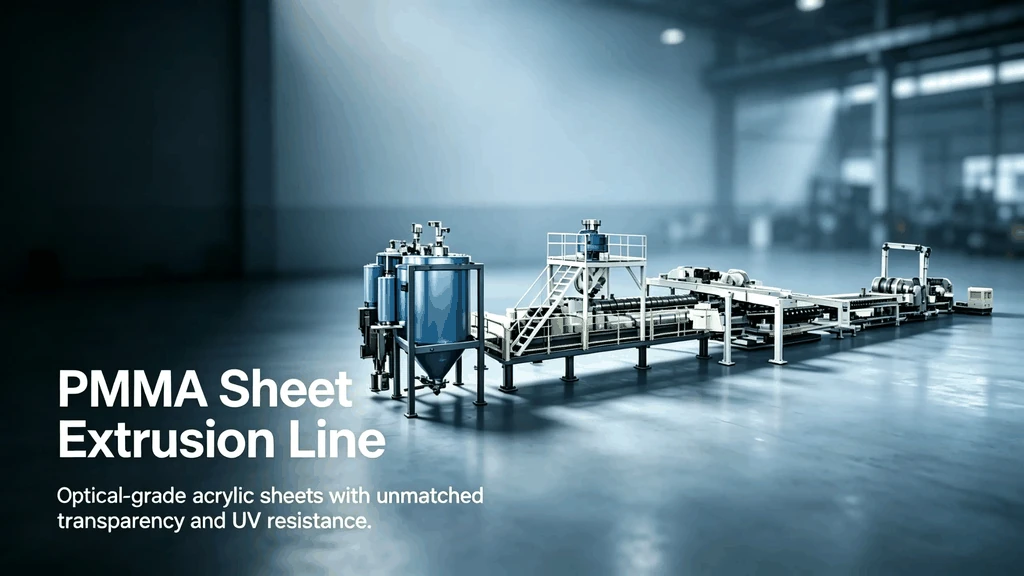

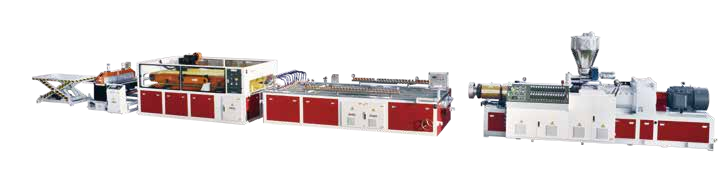
PMMA Sheet Extrusion Line

Single-screw extruder | 200–500 kg/h | 1.0–15.0 mm | 38CrMoAlA nitrided screw | Mirror-polish Ra≤0.016 μm | ±0.5°C roller control

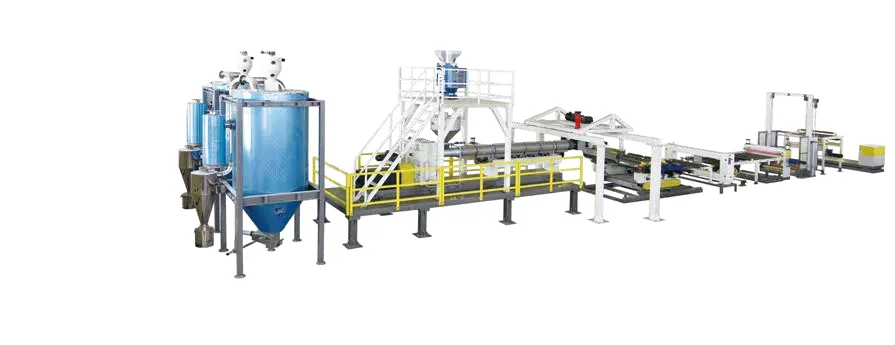
Complete production demonstration — from acrylic pellet feeding through extrusion, mirror-polish calendaring, protective film coating, and finished sheet cutting.

PMMA Sheet Extrusion Line: Related JWELL Extrusion Lines

The PMMA Sheet Extrusion Line is part of JWELL’s complete extrusion portfolio. Customers evaluating this PMMA Sheet Extrusion Line also frequently request our PC Sheet Extrusion Line | Solid Polycarbonate 1-12mm | Jwell and PVDF Plate Extrusion Line | 50-200kg/h | Jwell Machinery, which share the same proven screw, die and control platforms. For layout drawings, pricing and lead times, contact JWELL Machinery directly.

# Item Key Point
1 🌀 Optical-Grade Single-Screw Extruder 38CrMoAlA Nitrided, Large-Diameter Low-Speed Design — The Jwell PMMA/GPPS plate extrusion line is built around a precision single-screw extruder available in 120 mm
2 ⚡ Precision Three-Roll Calendar 42CrMo Rollers, HRC 58–62, Ra≤0.016 μm, ±0.5°C Control — The three-roll calendar is the primary determinant of PMMA sheet surface quality, thickness uniformity, and op
3 🎯 In-Line Protective Film Coating Unit Dual-Surface Lamination During Extrusion — PMMA acrylic sheet is valued for its pristine, glossy surface — and that surface is extraordinarily vulnerable
4 🔄 Dual Cutting System Cross Cutting + Longitudinal Cutting for Custom Sheet Dimensions — PMMA sheet is sold in finished dimensions — typically 1,220 × 2,440 mm (4 × 8 ft), 2,050 × 3,050 mm, or custom

Optical-Grade Single-Screw Extruder — 38CrMoAlA Nitrided, Large-Diameter Low-Speed Design

The Jwell PMMA/GPPS plate extrusion line is built around a precision single-screw extruder available in 120 mm and 130 mm screw diameter configurations. PMMA is a heat-sensitive material — excessive shear in the extruder causes molecular degradation visible as yellow tint, gel particles, and reduced light transmission. These defects are irreversible once formed, making screw design the single most important factor in PMMA sheet quality.

Jwell addresses this through a large-diameter, low-speed screw design philosophy. A 120–130 mm diameter screw running at reduced RPM delivers the same throughput as a smaller screw at higher speed, but with dramatically lower shear — which means lower melt temperature, less polymer degradation, and higher optical clarity in the finished sheet. This is particularly critical for PMMA: even a 5–10°C overshoot in melt temperature produces measurable yellowing.

The screw is manufactured from 38CrMoAlA nitrided steel with a nitrided layer depth of 0.5–0.7 mm, achieving surface hardness of HV≥740 on the screw and HV≥940 on the barrel. A volumetric feeder mounted on the extruder throat provides consistent material input, ensuring stable extrusion pressure and uniform sheet output.

Precision Three-Roll Calendar — 42CrMo Rollers, HRC 58–62, Ra≤0.016 μm, ±0.5°C Control

The three-roll calendar is the primary determinant of PMMA sheet surface quality, thickness uniformity, and optical clarity — and Jwell’s roller specifications reflect that importance with precision values matching premium European-built calender systems.

Key roller specifications:

| Parameter | Specification |

|———–|—————|

| Material | 42CrMo forged steel |

| Coaxiality | ≤0.005 mm |

| Surface Roughness | Ra ≤0.016 μm |

| Surface Hardness | HRC 58–62 |

| Chrome Plating | 0.08 mm |

| Temperature Deviation | ±0.5–1°C across full face width |

For PMMA sheet, the roller surface finish is the single most critical factor in determining the sheet’s surface quality. PMMA reproduces the roller surface at a microscopic level — a mirror-finish roller (Ra≤0.016 μm) produces glossy, glass-like PMMA sheet; a roller with even minor surface imperfections produces hazy, visibly flawed sheet that fails optical quality inspection. This is not a cosmetic issue — it directly determines whether the sheet can be sold into premium signage, lighting, and display applications.

The coaxiality specification of ≤0.005 mm — five microns — is critical for thickness uniformity. PMMA sheet used in light guide panel (LGP) applications must distribute LED light uniformly across the panel surface. Thickness variation across the sheet creates visible bright and dark bands in the finished LGP, a defect that is immediately obvious to end users and results in 100% rejection at the panel fabricator.

Roller temperature is controlled to ±0.5–1°C across the full face width by individual closed-loop pressurized water circuits for each roll. This precision prevents localized surface haze that occurs when any point across the roll face deviates from PMMA’s optimal polishing temperature window.

In-Line Protective Film Coating Unit — Dual-Surface Lamination During Extrusion

PMMA acrylic sheet is valued for its pristine, glossy surface — and that surface is extraordinarily vulnerable to scratching during handling, transport, fabrication, and installation. Even microscopic scratches are visible as haze on the glossy acrylic surface, and can render sheet unsellable for premium applications.

Jwell integrates a protective film coating unit directly into the extrusion line, positioned after the cooling bracket and before the haul-off unit. This unit applies a protective polyethylene film to both surfaces of the sheet while it is still in the production line — before the sheet has ever been handled by an operator or stacked in contact with another sheet. The film is applied at controlled tension to prevent wrinkling while maintaining full surface coverage from edge to edge.

The coating unit accommodates film widths matching the sheet width (up to 2,500 mm) and applies film at line speed without creating tension disturbances that would affect sheet thickness. For PMMA sheet destined for premium applications — signage faces, display panels, architectural glazing — the protective film is not an optional accessory but an essential component of the production process.

Dual Cutting System — Cross Cutting + Longitudinal Cutting for Custom Sheet Dimensions

PMMA sheet is sold in finished dimensions — typically 1,220 × 2,440 mm (4 × 8 ft), 2,050 × 3,050 mm, or custom sizes specified by the customer. Producing these finished dimensions directly on the extrusion line eliminates the labor, waste, and potential for scratching that off-line cutting introduces.

Jwell integrates two cutting systems in series on the PMMA line:

Cross Cutting Unit. Positioned after the haul-off unit, the cross cutter performs transverse cuts across the full sheet width at programmable lengths. The cut is triggered by an encoder-driven length measurement system that tracks sheet position with millimeter-level accuracy, ensuring every sheet is cut to within ±1 mm of the target dimension.

Longitudinal Cutting Unit. Positioned after the cross cutter, the longitudinal cutter performs lengthwise cuts to produce multiple narrow sheets from a single wide extruded sheet. This is particularly valuable for converters who produce sheet in standard display sizes — the 2,500 mm wide extrusion can be slit into two 1,220 mm sheets, maximizing output while producing finished dimensions ready for customer delivery.

After both cutting operations, a conveyor transports the finished cut sheets to a stacker for automatic stacking. The entire process produces finished, dimensioned, film-protected PMMA sheet — no off-line sawing, no additional handling, no opportunity for surface damage.

Technical Specifications

Extruder

Parameter Specification
Extruder Type Single-screw, large-diameter low-speed design
Screw Diameter Options 120 mm / 130 mm
Screw Material 38CrMoAlA nitrided steel
Nitrided Layer Depth 0.5–0.7 mm
Screw Surface Hardness HV ≥740
Barrel Surface Hardness HV ≥940
Feeder Type Volumetric feeder
Design Philosophy Large diameter, low speed, high plasticizing efficiency

Melt Pump & Screen Changer

Parameter Specification
Melt Pump Brand Options Jwell (self-developed) / Maag (Switzerland) / Nordson (USA)
Screen Changer Type Hydraulic, continuous operation
Screen Changer Configuration Single-column or double-column
Screen Panel Options Single-panel or double-panel, double working position
Screen Change Time <2 seconds (double-position design)

Die

Parameter Specification
Die Type Coat-hanger manifold, flexible-lip
Die Material High-quality mold steel
Flow Channel Chrome Plating 0.03–0.05 mm
Die Cavity Surface Roughness Ra 0.1 μm
Die Lip Surface Roughness Ra 0.05 μm

Roller (Three-Roll Calendar)

Parameter Specification
Configuration Three-roll vertical calendar
Roll Material 42CrMo forged steel
Coaxiality ≤0.005 mm
Surface Roughness Ra ≤0.016 μm (mirror polish)
Surface Hardness HRC 58–62
Chrome Plating 0.08 mm
Temperature Deviation ±0.5–1°C across full face width

Production Parameters

Parameter Specification
Materials PMMA (acrylic), GPPS
Output Capacity 200–500 kg/h (configuration & material dependent)
Sheet Thickness Range 1.0–15.0 mm
Sheet Width Up to 2,500 mm
Thickness Tolerance ±1.5% (with optional thickness gauge)
Light Transmission ≥92% at 3 mm thickness
Haze <1.0% at 3 mm
Gloss at 60° >130 GU
Downstream Equipment Cooling bracket + edge cutters → Coating unit → Haul-off → Cross cutting → Longitudinal cutting → Stacker
Control System Centralized electrical cabinet, PLC-controlled
Certifications CE, ISO 9001

Signage & Display Graphics

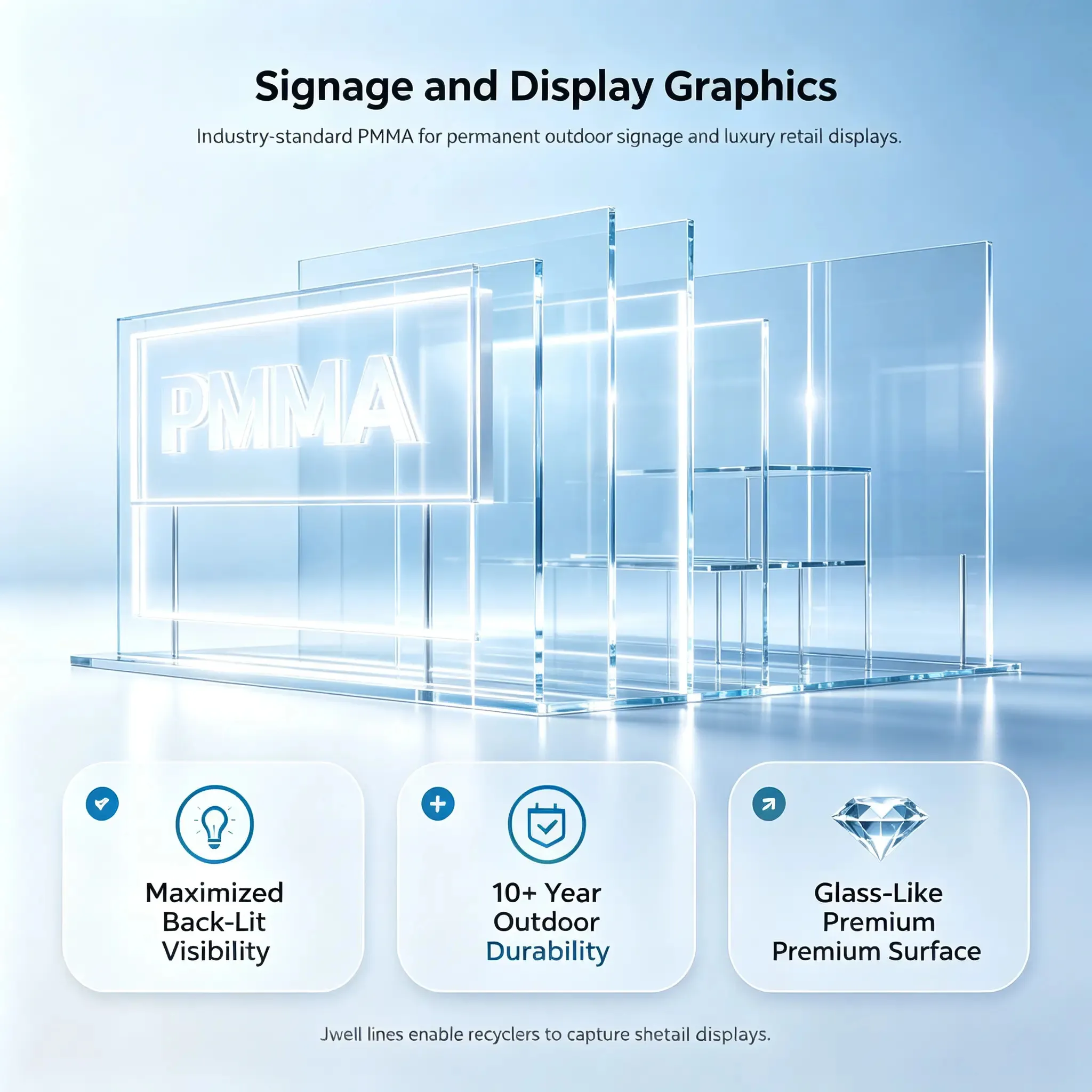
PMMA sheet at 2–5 mm thickness is the industry-standard material for illuminated signage faces, channel letter faces, point-of-purchase displays, and exhibition panels. The material’s 92%+ light transmission, ease of fabrication (cutting, routing, thermoforming), and UV resistance make it the default choice for outdoor signage that must maintain clarity and color for 5–10 years.

The Jwell PMMA line’s mirror-polish rollers (Ra≤0.016 μm) produce sheet with a glossy, glass-like surface that presents a premium appearance for luxury retail signage and corporate brand displays. The in-line protective film coating unit ensures that signage-grade PMMA sheet arrives at the fabricator scratch-free — critical for illuminated signage where even hairline scratches scatter light and create visible bright spots when the sign is backlit.

PMMA Sheet Extrusion Line

LED Lighting & Light Guide Panels

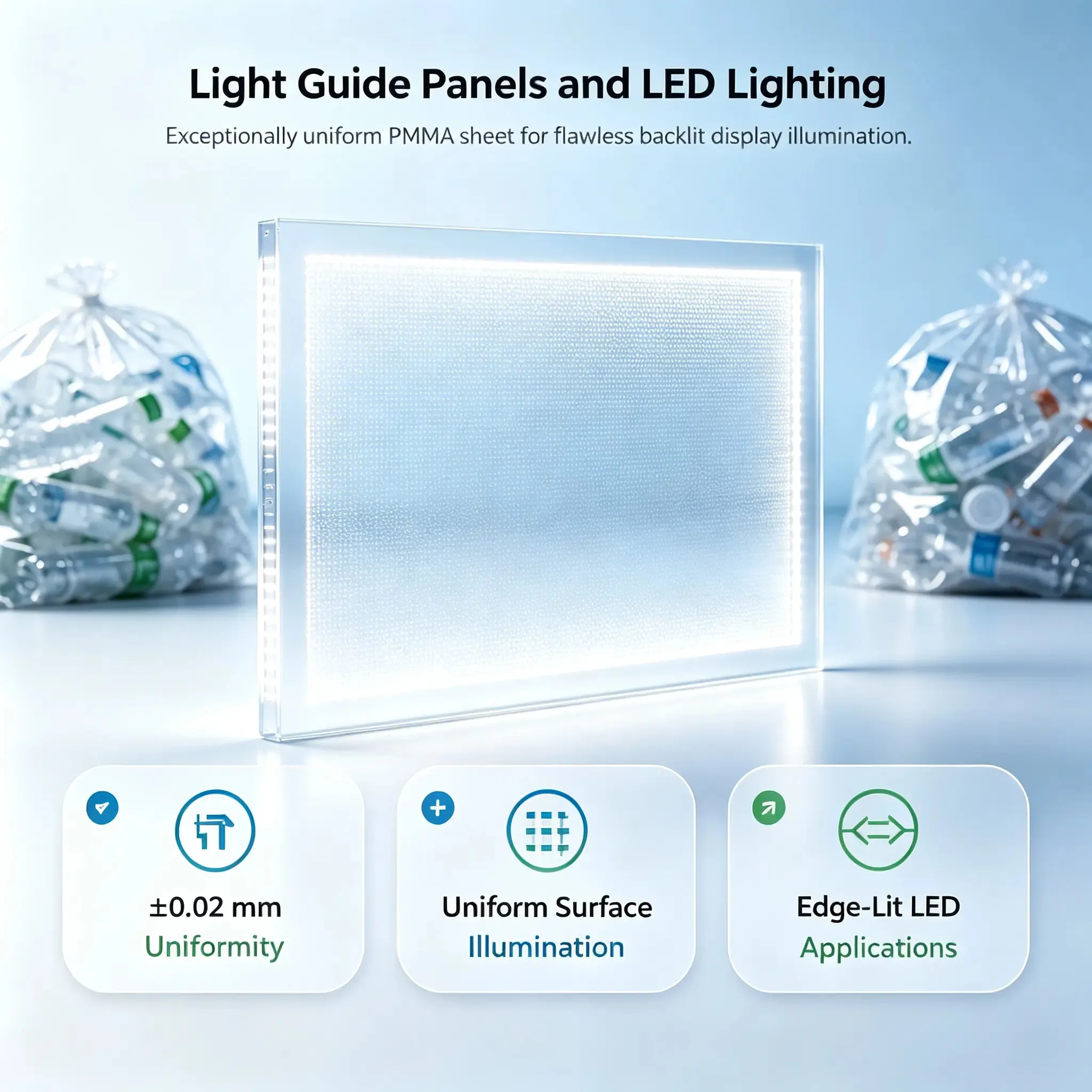
PMMA sheet at 4–8 mm thickness, laser-engraved with a dot pattern on one surface, serves as the light guide panel (LGP) in edge-lit LED signage, display backlighting, and architectural lighting panels. Light from LEDs positioned along the panel edge travels through the PMMA by total internal reflection and exits at the laser-engraved dots, creating a uniformly illuminated surface.

The Jwell line’s exceptional thickness uniformity is critical for LGP applications. Thickness variation across the panel causes visible bright and dark bands in the finished LGP — a defect that is immediately visible to end users. The ±1.5% thickness tolerance achieved with the three-roll calendar’s ≤0.005 mm coaxiality produces the thickness consistency LGP fabricators require for uniform illumination.

For architectural lighting applications — including edge-lit ceiling panels, illuminated wall panels, and decorative lighting features — the PMMA sheet’s 92%+ light transmission ensures that the maximum amount of LED light reaches the panel surface, maximizing luminous efficacy and reducing the number of LEDs required per square meter.

Frequently Asked Questions

Can the Jwell PMMA sheet extrusion line also process GPPS, and what are the differences when running both materials? -

Yes. The line is designed as a PMMA/GPPS dual-material platform. Both are amorphous polymers with similar processing temperature ranges (180–250°C), allowing the same screw, die, and roll stack configuration to process either material. The primary differences are: GPPS produces higher haze (2–3% vs <1% for PMMA) and has lower impact strength, while PMMA offers superior optical clarity (92%+ light transmission) and UV resistance. Changeover between materials requires screw cleaning and temperature profile adjustment — typically completed within one shift.

What is the thickness range and maximum sheet width of this PMMA extrusion line? +

The line produces PMMA sheet from 1.0 to 15.0 mm thickness, covering applications from thin signage sheet (1–3 mm) to thick aquarium and architectural glazing panels (12–15 mm). Maximum sheet width is 2,500 mm. The 120 mm screw is optimal for 200–350 kg/h (thin-gauge signage and lighting), while the 130 mm screw delivers 350–500 kg/h (thick-gauge architectural and sanitary ware sheet).

What optical quality can the PMMA sheet achieve, and how does it compare to cast acrylic? +

The Jwell PMMA line produces extruded acrylic sheet with 92%+ light transmission, haze below 1.0%, and a mirror-polish surface finish (Ra≤0.016 μm) from the 42CrMo calendar rollers. Extruded PMMA achieves optical quality approaching that of cast acrylic at significantly lower production cost per kilogram. The key differentiator is thickness tolerance: cast acrylic achieves ±0.5% but at 5–10× the production cost; extruded PMMA achieves ±1.5% at a cost structure suitable for volume applications from signage to architectural glazing.

What is the minimum order quantity and lead time? +

MOQ is 1 complete line. Standard lead time is 60–90 days from order confirmation for both the 120 mm and 130 mm screw configurations. Because Jwell manufactures the screw, T-die, and rollers in-house, lead times are shorter than competitors who source these components from third-party suppliers. Shipment is FOB Shanghai — a 120 mm PMMA line typically fits in 2–3 × 40′ HQ containers depending on downstream equipment configuration.

How precise is the three-roll calendar system on the PMMA line? +

The three-roll calendar uses 42CrMo forged steel rollers with the following precision specifications: coaxiality ≤0.005 mm (5 microns), surface roughness Ra ≤0.016 μm (optical mirror finish), surface hardness HRC 58–62 with 0.08 mm chrome plating, and temperature uniformity ±0.5–1°C across full face width via individual closed-loop pressurized water circuits. This precision is critical: PMMA reproduces the roller surface at a microscopic level — Ra ≤0.016 μm rollers produce glossy, glass-like PMMA sheet.

Related Sheet Extrusion Lines

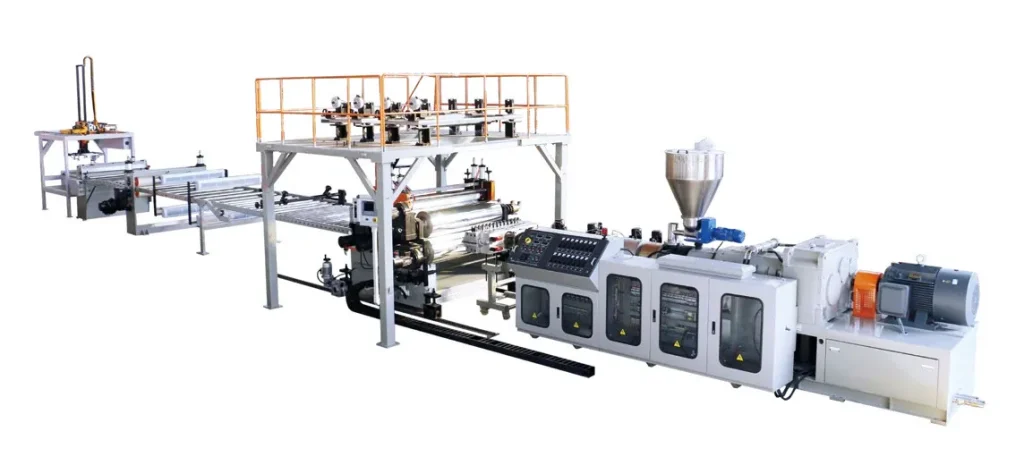
WPC Flooring Production Line

WPC Flooring Production Line

Extruder Type: Conical twin-screw, vented; Screw Material: 38CrMoAlA, nitrided, bimetallic optional; Screw Structure: Conical twin, designed for PVC + wood flour + CaCO₃ + foaming agent; L/D Ratio: Optimized for controlled foaming zone
Learn More ➔
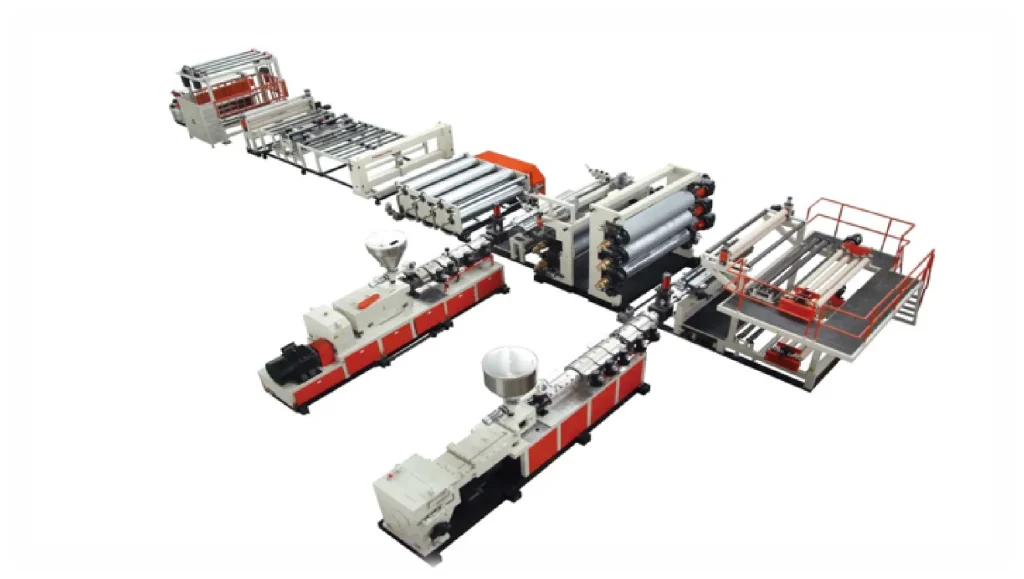
SPC Flooring Production Line

SPC Flooring Production Line

Screw Diameter: Φ 80 mm / Φ 92 mm / Φ 110 mm / Φ 180 mm; Output (24h, SPC): 6-8 T / 12-18 T / 25-32 T / 70-100 T; Line Speed at 4 mm: 0.4-0.6 m/min / 0.8-1.3 m/min / 1.8-2.4 m/min / 5-9 m/min; Screw Material: 38CrMoAlA, nitrided, bimetallic optional / ← Same / ← Same / ← Same

Learn More ➔

Why Choose Jwell for Your PET Sheet Line

🏭

Factory/Experience

Jwell has manufactured PET sheet extrusion equipment since 2005, accumulating field data from over 400 installed PET lines worldwide. Each new machine generation incorporates refinements validated across hundreds of real production environments — not just lab prototypes.

🔬

Test/Validate

Our Changzhou facility operates a full production-scale PET line for customer trials. Bring your raw materials and target specifications — we run your recipe before you commit. The line delivered to your factory is a proven configuration, eliminating startup risk.

🌍

Service/Support

Factory-trained Jwell engineers based in Brazil, Spain, Mexico, and Shanghai travel to customer sites for installation and operator training. Remote diagnostic support via WeChat/WhatsApp responds within 2 hours. Critical spares ship from Shanghai within 48 hours.

Request a Quote or Technical Consultation

Your information will never be shared with third parties.