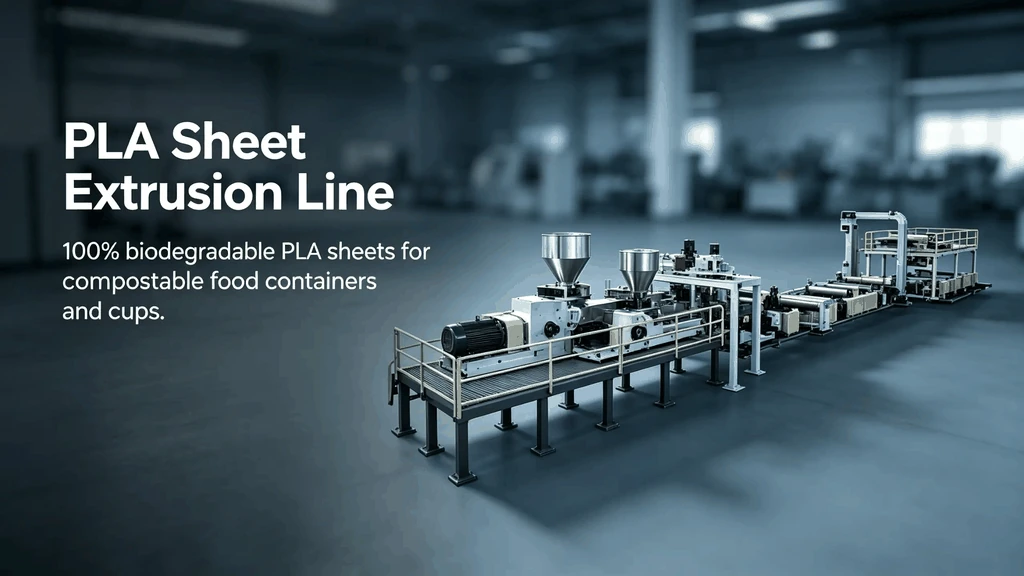
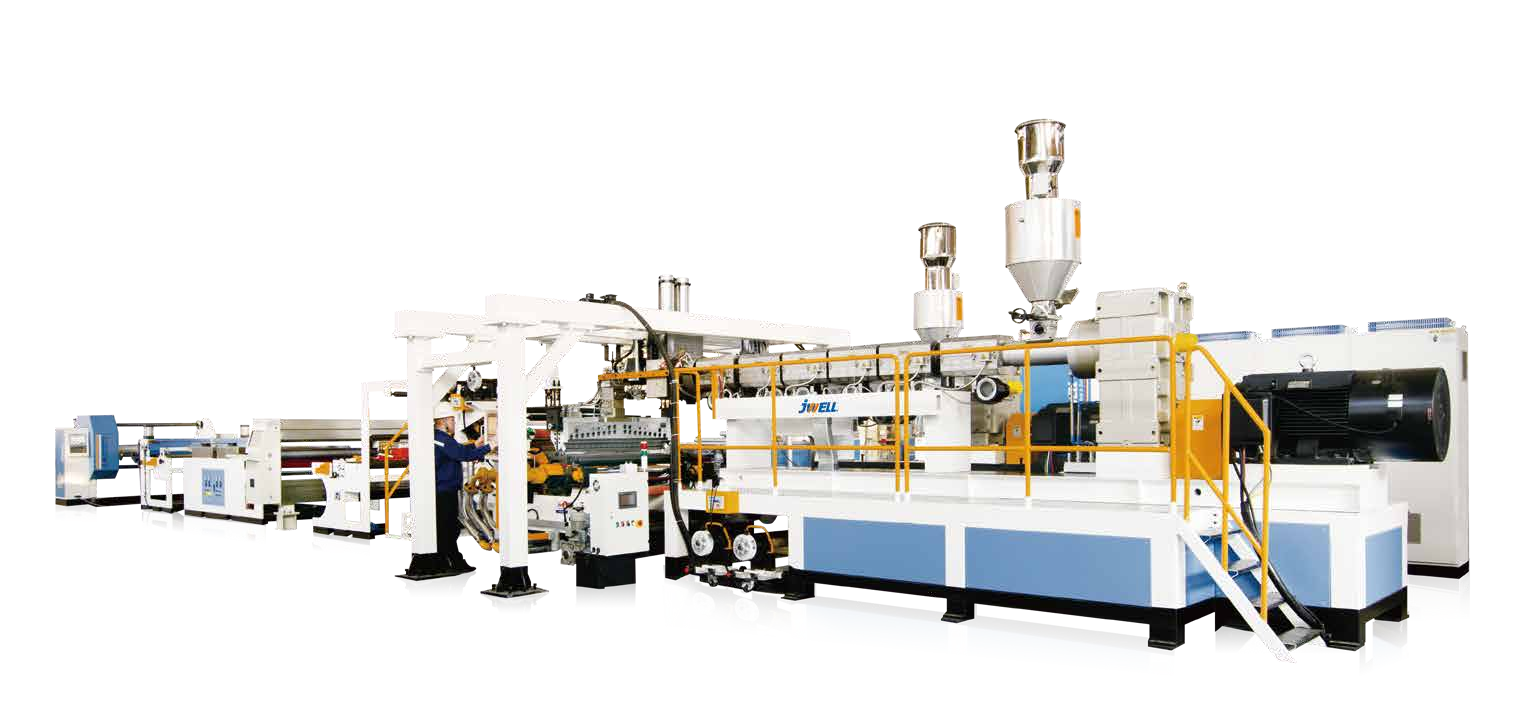
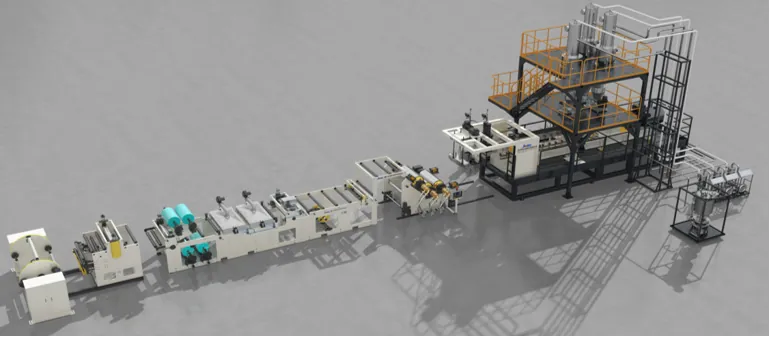
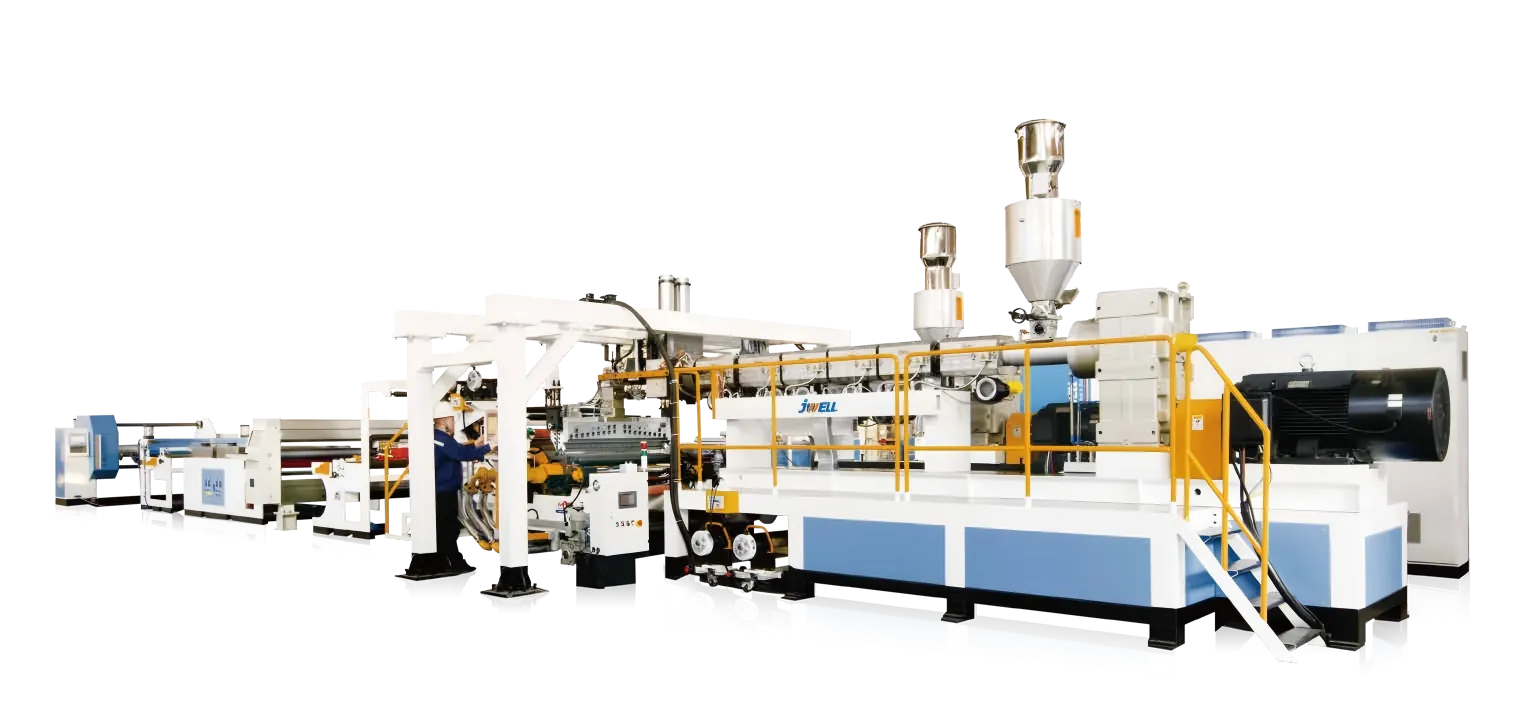
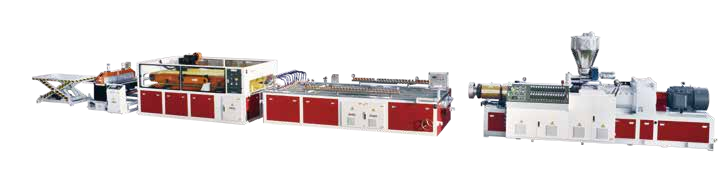
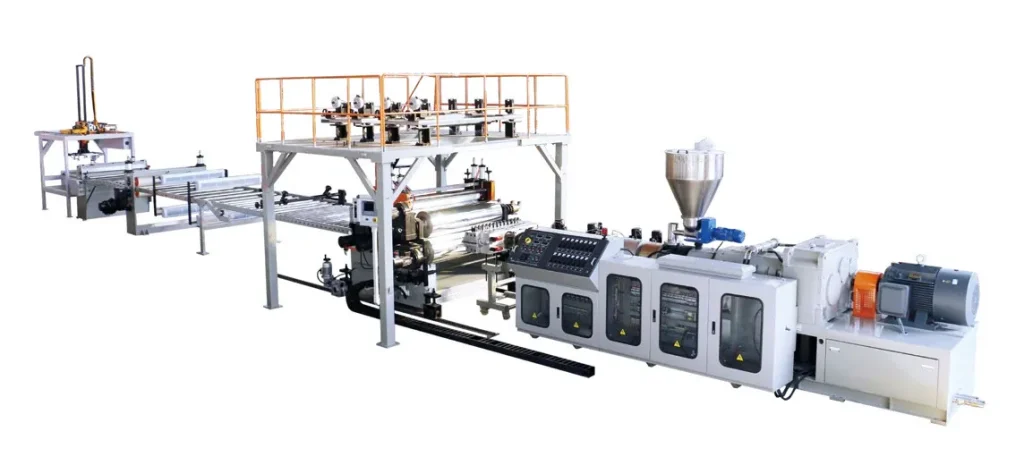
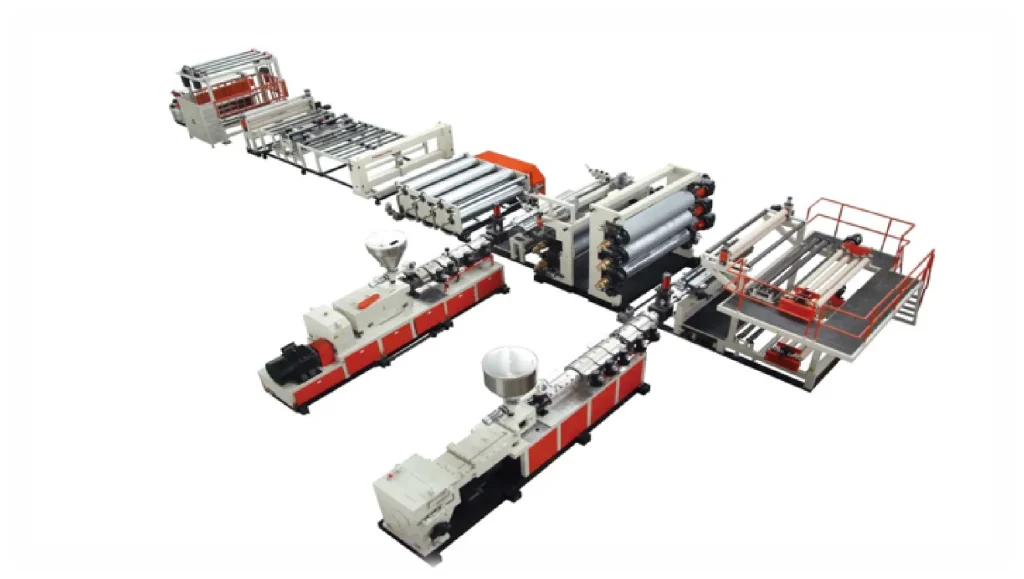
PLA Sheet Extrusion Line

The Jwell PLA sheet extrusion line is a specialized production system engineered for processing polylactic acid (PLA) — a bio-based, industrially compostable polyester derived annually renewable feedstocks (corn starch, sugarcane, cassava) — into high-clarity sheet for compostable packaging, food service ware, agricultural films, and sustainable consumer product packaging.

Operating at 200 to 500 kilograms per hour with sheet thicknesses from 0.2 to 2.0 millimeters and widths of 600 to 1,200 millimeters, the Jwell PLA line directly addresses PLA’s fundamental processing challenge: its narrow thermal processing window (170-210°C). Above 210°C, PLA undergoes rapid thermal degradation, generating lactic acid that causes bubbles, discoloration, embrittlement, and loss of compostability certification. Below 170°C, incomplete plastication produces gels and surface defects.

The line’s core process flow: Crystallization & Drying → Twin-Screw Extrusion → Melt Pump → T-Die → 3-Roller Calendering → Thickness Gauge → Winder. Each stage is engineered specifically for PLA’s unique rheology:

With single-use plastic bans enacted in over 60 countries — including the EU Single-Use Plastics Directive — converters globally are actively qualifying PLA sheet as a direct substitute for PS, PP, and PET in disposable food packaging. The Jwell PLA line is engineered to deliver the optical quality (haze 90 GU at 60°) and mechanical properties that make this material substitution commercially viable at industrial scale, while preserving the EN 13432 / ASTM D6400 compostability certification that differentiates PLA in the market.

PLA Sheet Extrusion Line: Related JWELL Extrusion Lines

The PLA Sheet Extrusion Line is part of JWELL’s complete extrusion portfolio. Customers evaluating this PLA Sheet Extrusion Line also frequently request our PP Sheet Extrusion Line | 300-800kg/h | PP/HIPS/GPPS | Jwell Machinery and %title% %sep% Jwell Machinery, which share the same proven screw, die and control platforms. For layout drawings, pricing and lead times, contact JWELL Machinery directly.

# Item Key Point
1 🌀 ±1°C Precision Temperature Control PLA degrades rapidly above 210°C and processes within a narrow 170-210°C window. Jwell’s multi-zone barrel heating/cooling with SCR power controllers maintains melt temperature within ±1°C regardless of throughput changes, preserving polymer molecular weight for sheet with high elongation at break.
2 ⚡ Twin-Screw Extruder with Low-Shear PLA Geometry Co-rotating twin-screw with modular element configuration delivers gentle plastication at shear rates below 150 s⁻¹. Barrier flight design with optimized compression ratio prevents localized hotspots that cause lactic acid generation, bubbles, and discoloration. 33:1 L/D ratio provides full residence time for temperature equilibration.
3 🎯 Integrated Crystallizer for Amorphous PLA (aPLA): 2-stage inline module IR preheating + fluidized bed — converts amorphous pellets to crystallized form in under 15 minutes at 80-110°C. Eliminates offline crystallization bottleneck. Crystallized feedstock dramatically improves sheet draw-down characteristics for thermoforming.
4 🔄 Multi-Stage Drying + Vacuum Venting for Hydrolysis Prevention Desiccant honeycomb rotor dryer achieves -50°C dew point (target: <250 ppm moisture). Vacuum-assisted vent port at 60% barrel length with liquid-ring pump at 10-15 mbar extracts residual moisture. Combined 3-stage moisture removal protects against chain scission and molecular weight loss.
5 🔧 EN 13432 / ASTM D6400 Industrial Compostability Sheet from this line meets international compostability standards when using certified PLA grades. >90% disintegration within 12 weeks at industrial composting conditions. Jwell provides processing validation documentation supporting customers’ own certification.
6 ✅ Food-Contact Approved Sheet for Sustainable Packaging Produces sheet meeting EU 10/2011 and FDA 21 CFR food-contact requirements. High clarity (haze 90 GU) matches the visual expectations of premium food brands transitioning from PS, PP, and PET.
7 ♻️ Pre-Loaded PLC Recipes for All Major PLA Grades: Siemens S7-1200 PLC with 12″ HMI arrives pre-loaded with validated recipes for NatureWorks Ingeo, TotalEnergies Corbion Luminy, and Hisun REVODE grades barrels, screws, rolls, puller, winder — so operators start production on day one, not after weeks of trial-and-error setup.

Precision Temperature Control (±1°C)

────────────────────────────────────────────── [ICON: Thermometer / Precision Control SVG] ±1°C Precision Temperature Control Preserving PLA Molecular Integrity PLA processes within a narrow 170-210°C window. Above 210°C, thermal degradation produces lactic acid causing bubbles, discoloration, embrittlement, and loss of compostability certification. Below 170°C, incomplete plastication creates gels. Jwell’s multi-zone barrel temperature system uses SCR (silicon-controlled rectifier) power controllers with PID auto-tuning for each zone independently — typically 8-12 heating/ cooling zones along the barrel. Closed-loop control maintains any setpoint within ±1°C, verified by melt thermocouple at the die entry. Result: Molecular weight retention >95% through extrusion, haze 90 GU. ──────────────────────────────────────────────

Visual: 建议配图 — temperature zone diagram showing barrel zones with color-coded setpoints

Integrated Crystallinity Management

────────────────────────────────────────────── [ICON: Crystal Structure / Molecular SVG] Integrated Crystallinity Management 2-Stage Inline Crystallizer + Quench Control PLA’s slow crystallization rate is both a challenge and an opportunity. Amorphous PLA (aPLA) offers superior thermoforming draw- down but must be crystallized before feeding the extruder to prevent screw bridging. Crystallized PLA (cPLA) feeds reliably but requires quenching after die exit to lock in clarity for transparent applications. Jwell’s integrated solution: (1) Inline Crystallizer: IR preheating + fluidized bed, 80-110°C, 80°C HDT), the line includes post-annealing capability that increases crystallinity to 35-45%. ──────────────────────────────────────────────

Visual: 建议配图 — DSC thermogram comparison showing amorphous vs crystallized PLA

Multi-Stage Drying System

────────────────────────────────────────────── [ICON: Dehumidifier / Dry Air SVG] Multi-Stage Drying System -50°C Dew Point + Vacuum Venting PLA is hygroscopic and hydrolyzes when processed above 170°C with moisture present. Even 500 ppm residual moisture causes measurable molecular weight loss through chain scission — producing lactic acid that accelerates further degradation in a self- catalyzing cycle. The Jwell PLA line deploys three sequential moisture removal stages: Stage 1 — Desiccant Dryer: Honeycomb rotor with molecular sieve desiccant achieves -50°C dew point process air. Hopper residence time 4-6 hours reduces pellet moisture from typical 0.3-0.5% to <250 ppm. Stage 2 — Feed-Throat Blanketing: Dry nitrogen purge at the feed throat prevents atmospheric moisture re-absorption between dryer hopper and extruder inlet. Stage 3 — Vacuum-Assisted Venting: Mid-barrel vent port at 60% L/D with liquid-ring vacuum pump maintaining 10-15 mbar. Continuously extracts water vapor driven from the melt during plastication. Target residual moisture at die entry: <100 ppm — verified by online moisture analyzer at die melt stream. ──────────────────────────────────────────────

Visual: 建议配图 — 3-stage moisture removal schematic (dryer → N2 blanket → vacuum vent)

Vacuum-Assisted Devolatilization

────────────────────────────────────────────── [ICON: Vacuum Pump / Vent Port SVG] Vacuum-Assisted Devolatilization Active Extraction at 10-15 mbar Unlike atmospheric venting — which relies on passive diffusion and is only effective at removing surface moisture — Jwell’s vacuum- assisted system actively extracts volatiles from the melt stream. This is critical for PLA because residual moisture, residual lactide monomer, and any volatile degradation products must be removed before they reach the die and create surface defects in the finished sheet. System components:

• Twin-vent design: Primary vent at 60%

barrel length, optional secondary vent

Technical Specifications

Core Technical Specifications

Parameter Specification / Notes
Extruder Type Twin-screw, co-rotating, modular / Intermeshing, self-wiping profile
Screw Diameter 52 mm (also: 65 mm, 75 mm) / Scaled to output requirement
L/D Ratio 33:1 / Extended for gentle, complete plastication
Screw Material Nitrided 38CrMoAlA / Bimetallic CPM-10V / Bimetallic recommended for filled compounds
Barrel Material Bimetallic lined (Xaloy or equivalent) / Corrosion-resistant for PLA’s acidic degradation products
Output Capacity 200 – 500 kg/h / Output varies by screw diameter and PLA grade
Processing Temperature 170 – 210°C / Grade-dependent; recipe-managed
Temperature Control Precision ±1°C / SCR with PID auto-tune per zone
Heating/Cooling Zones 8-12 zones (screw-diameter dependent) / Independent closed-loop per zone
Melt Pump Positive-displacement gear pump / Isolates die from extruder pulsation
Melt Pump Capacity 150 – 600 kg/h / Matched to extruder output
T-Die Type Coat-hanger manifold / Adjustable lip gap, manual or automatic
Die Width 600 – 1,400 mm / Matched to sheet width specification
Sheet Thickness 0.2 – 2.0 mm / Gauge uniformity ±3% or better
Sheet Width 600 – 1,200 mm / Trimmed width
Roll Stack 3-roll vertical, temperature-controlled / Independent chiller per roll
Roll Diameter 300 – 400 mm / Chrome-plated, mirror finish (Ra ≤0.025 µm)
Roll Temperature Range 15 – 80°C / ±1°C stability, chiller-supplied
Roll Gap Adjustment Servo-motor, 0.01 mm resolution / Recipe-controlled
Thickness Gauge Online scanning, capacitance or X-ray / ±0.5% accuracy, full-width profile
Line Speed 2 – 25 m/min / Variable frequency drive
Winder Type Torque-controlled center winder / Taper tension, 600 mm max roll OD
Max Roll Diameter (Wound) 600 mm / Optional 800 mm
Crystallizer (Optional) Inline IR + fluidized bed / 80-110°C, <15 min cycle time
Dryer Type Desiccant honeycomb rotor / -50°C dew point
Dryer Hopper Capacity 400 – 800 L / 4-6 hour residence time
Vacuum Pump Liquid-ring / 10-15 mbar absolute
Control System Siemens S7-1200 PLC / 12″ HMI touchscreen
Recipe Storage 20 recipes / Pre-loaded for major PLA grades
Total Installed Power 180 – 350 kW / Application-dependent
Line Dimensions (L×W×H) ~18 × 4 × 3.5 m / Configuration-dependent
Line Weight ~12,000 – 18,000 kg / Configuration-dependent

Optional Modules

Module Description / Recommended For
Inline Crystallizer IR + fluidized bed, <15 min, 80-110°C / Amorphous PLA (aPLA) users
Dual Vent System Second vacuum vent + independent pump / Compounds with volatile additives
Automatic Die Bolt Adjustment Closed-loop from thickness gauge feedback / High-volume production, gauge-critical applications
Embossing Roll Patterned calender roll (matte, linen, custom) / Anti-block, decorative surfaces
Post-Annealing Oven Heated roller or IR tunnel, raises crystallinity to 35-45% / Heat-resistant sheet for hot-fill applications
Corona Treater Surface activation to 42-48 mN/m / Inline printing/coating downstream
Edge Trim Recycling Granulator + refeed system / Zero-waste operations
Co-Extrusion (ABA) Secondary extruder for skin layer / Multi-layer PLA structures
Remote Access Module VPN + web-based HMI / Multi-site operations, remote troubleshooting
Anti-Static System Active ionization bar at winder / Thin sheet (<0.5 mm), dry environments

Utility Requirements

Utility Requirement
Power Supply 380V / 3-phase / 50Hz (60Hz available)
Cooling Water 4-6 m³/h at inlet ≤25°C, 3-4 bar
Compressed Air 0.6-0.8 MPa, instrument-quality (filtered, dried)
Dry Nitrogen For feed-throat blanketing (optional)
Floor Space 20 m × 6 m minimum

Compostable Food Service Ware

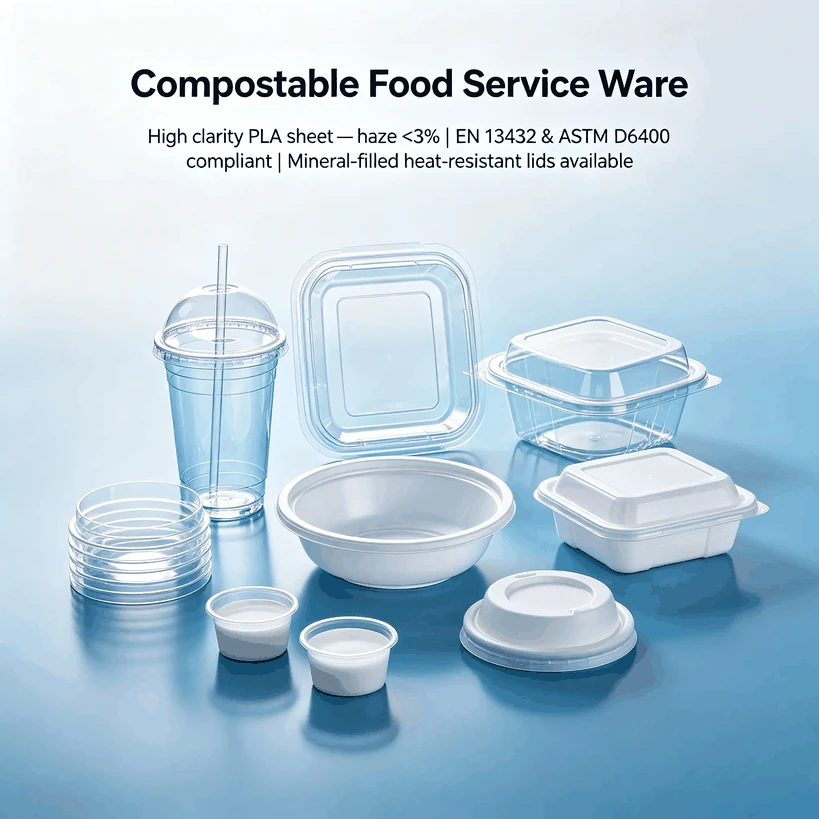
──────────────────────────────────────────────────────────────── ware.webp] Compostable Food Service Ware Clear Cups • Takeaway Lids • Salad Bowls • Deli Containers PLA sheet from the Jwell line is thermoformed into transparent food service items: clear cups for cold beverages, takeaway container lids, salad bowls, portion cups, and deli containers. The high clarity (haze <3%) matches the premium appearance that food brands demand, while industrial compostability (EN 13432) provides credible end-of-life claims that satisfy both regulators and environmentally conscious consumers. Key competitive advantages:

• Replaces PS (polystyrene) in clear cup/lid applications

• Replaces PET in cold-drink cup and fruit container markets

• Complies with EU SUPD and similar single-use plastic bans

Fresh Produce & Bakery Packaging

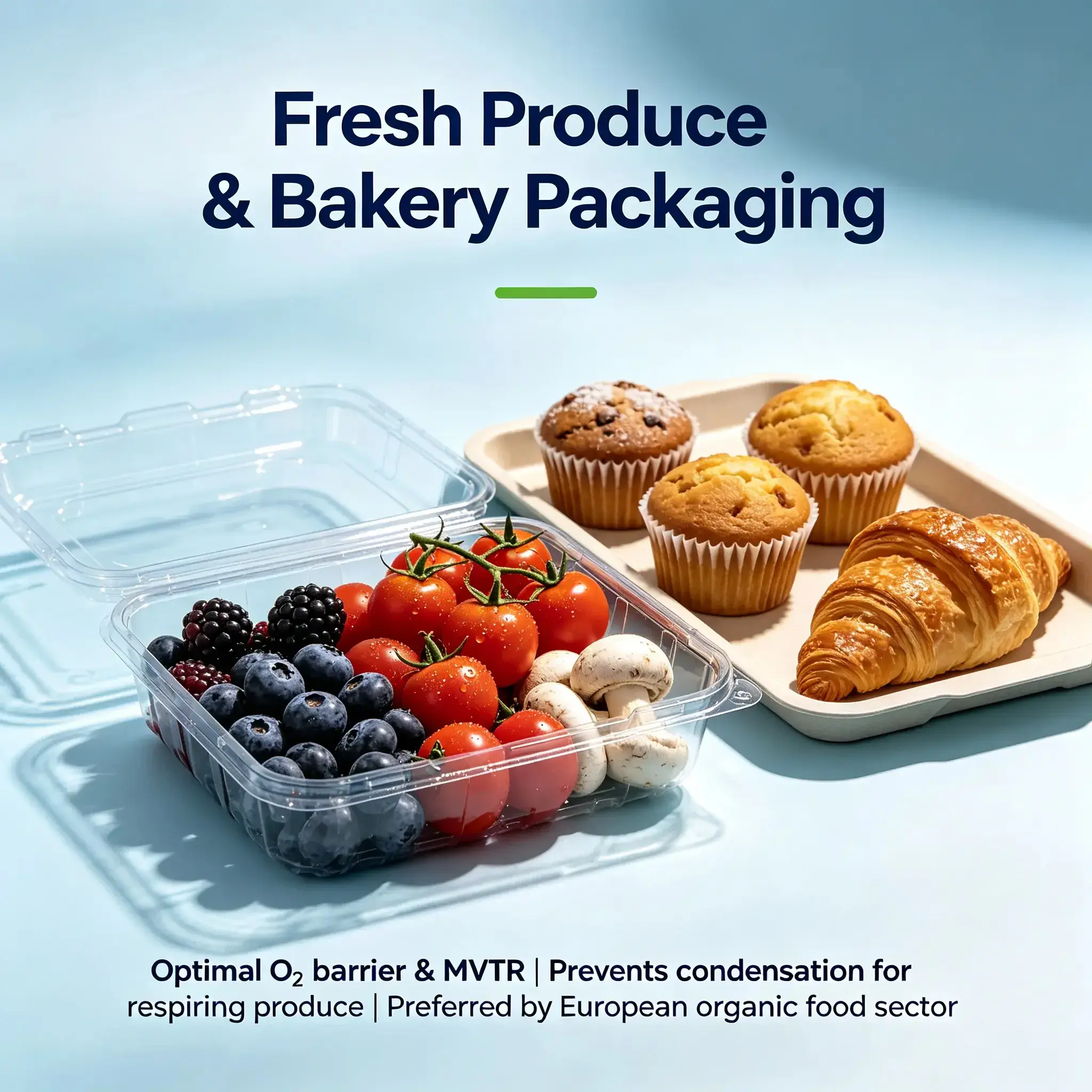
──────────────────────────────────────────────────────────────── packaging.webp] Fresh Produce & Bakery Packaging Berry Clamshells • Salad Tubs • Artisan Bakery Trays Compostable PLA packaging — clamshells, windowed boxes, pinch- grip tubs — for organic produce (berries, cherry tomatoes, mushrooms, salad greens) and artisan bakery items aligns with the sustainability positioning of premium food brands. PLA’s unique functional advantage for respiring produce: its moderate oxygen transmission rate and excellent moisture vapor transmission rate actually benefit fresh produce by preventing condensation (which causes mold and spoilage) while allowing controlled gas exchange (O₂ in, CO₂ out). This makes PLA clamshells functionally superior to PET for many produce applications — not just an environmental compromise. The Jwell line can produce sheet with anti-fog additive incorporation, ensuring visibility of the packaged product throughout the cold chain. Adjustable haze level (achieved through controlled crystallization during calendering) enables tailored product presentation from crystal-clear to translucent. Jwell customers serving the European organic food sector report that offering compostable PLA packaging (versus conventional PET) is a decisive factor in winning supermarket chain tenders for private-label organic produce. Target market: Organic produce growers/packers, supermarket private-label programs, bakery chains, meal-kit delivery services with compostable packaging commitments. ────────────────────────────────────────────────────────────────

Frequently Asked Questions

What PLA grades can the Jwell sheet extrusion line process? -

The Jwell PLA sheet extrusion line is engineered to process all major commercial PLA grades: NatureWorks Ingeo 2003D (standard extrusion), 4032D (biaxially oriented film), 4043D (higher heat resistance), and 4060D (heat-resistant); TotalEnergies Corbion Luminy LX175 (standard extrusion), L130 (higher melt strength), and L105 (higher HDT); Hisun REVODE 110 and 190 series; and custom PLA compounds with mineral fillers, impact modifiers, nucleating agents, and color masterbatches. The Siemens S7-1200 PLC stores up to 20 recipes with complete parameter sets per grade — barrel temperatures, screw RPM, roll temperatures, roll gaps, puller tension, and winder torque limits — enabling grade changeover within 2-3 hours of purging and temperature stabilization. For operations running high-heat PLA grades with elevated crystallinity for hot-beverage cup lids, Jwell recommends a separate optimized screw configuration to maintain throughput.

How does the Jwell PLA line ensure sheet quality given PLA's thermal sensitivity? +

Jwell addresses PLA’s narrow thermal processing window (170-210°C) through four integrated, sequential systems:

1. Twin-screw low-shear plastication: Co-rotating modular screws with optimized compression ratio and deep channel depths keep shear rates below 150 s⁻¹, eliminating localized hotspots that trigger lactic acid generation.

2. Desiccant honeycomb rotor drying: Achieves -50°C dew point with 4-6 hour hopper residence time, reducing pellet moisture from 0.3-0.5% to below 250 ppm — the threshold below which hydrolytic degradation is effectively suppressed.

3. Feed-throat nitrogen blanketing: Dry N₂ purge prevents atmospheric moisture re-absorption during the critical window between dryer hopper discharge and extruder inlet.

Is the PLA sheet produced on this line certified industrially compostable? +

PLA sheet produced on the Jwell line achieves industrial compostability according to EN 13432 and ASTM D6400 when using compliant PLA grades. The certification pathway is:

– The line’s role: Precise temperature control preserves PLA’s molecular weight through processing. Thermal degradation during extrusion (temperatures exceeding 210°C, or processing with moisture present) breaks polymer chains into low-molecular-weight fragments that may not achieve the 90% disintegration within 12 weeks required by EN 13432. The Jwell line’s ±1°C control, three-stage moisture removal, and low-shear screw design prevent this degradation, ensuring the sheet retains the compostability properties inherent in the virgin PLA resin.

– The converter’s/customer’s responsibility: Final product certification under EN 13432 requires testing of the finished article (thermoformed cup, tray, clamshell) by an accredited laboratory (e.g., TÜV, DIN CERTCO). Jwell provides processing validation documentation — including DSC thermograms showing preserved thermal properties and MFI data confirming no molecular weight loss — to support customers’ certification applications. This documentation demonstrates that the extrusion process has not compromised the resin’s inherent compostability.

– Real-world composting: PLA is certified for industrial composting facilities (58±2°C, high humidity, aerobic conditions), not home composting. The sheet will NOT degrade in a backyard compost pile. Jwell labels this distinction clearly to prevent customer confusion and greenwashing claims.

Do we need the crystallizer module? What does it do? +

The inline crystallizer is required when processing amorphous PLA (aPLA) grades — and recommended when running any PLA grade that has been stored in ambient conditions where it may have absorbed moisture.

What it does: Amorphous PLA pellets soften and agglomerate (stick together) at approximately 60°C — below typical dryer temperatures of 80-90°C. In a dryer hopper without pre-crystallization, aPLA pellets fuse into a solid mass that cannot feed the extruder — a problem known as “screw bridging” that stops production and requires manual hopper cleanout. The crystallizer converts aPLA to crystallized PLA (cPLA) before drying, raising the softening point above the dryer temperature.

Jwell’s 2-stage inline crystallizer:

– Stage 1 — Infrared preheating: Rapid, uniform heating to 80-90°C initiates crystallization

Can we run mineral-filled PLA compounds for heat-resistant or opaque sheet? +

Yes. The Jwell PLA line is fully configured for mineral-filled PLA compounds including talc-filled (typically 10-40% loading), calcium carbonate-filled, and proprietary mineral blend formulations.

Key considerations for filled PLA processing:

– Screw wear: Mineral fillers are abrasive. Jwell specifies bimetallic barrel liners (Xaloy 102 or equivalent) and bimetallic screw elements (CPM-10V or equivalent) for continuous filled-compound operation. Nitrided 38CrMoAlA screws are adequate for intermittent filled runs (<500 hours/year) but will show measurable wear beyond this.

– Dispersion quality: The twin-screw’s modular element design enables configuration of kneading blocks and mixing elements optimized for filler dispersion. Jwell’s application engineers specify the element configuration based on your specific compound’s filler type, loading level, and particle size distribution.

Related Sheet Extrusion Lines

WPC Flooring Production Line

WPC Flooring Production Line

Extruder Type: Conical twin-screw, vented; Screw Material: 38CrMoAlA, nitrided, bimetallic optional; Screw Structure: Conical twin, designed for PVC + wood flour + CaCO₃ + foaming agent; L/D Ratio: Optimized for controlled foaming zone

Learn More ➔
SPC Flooring Production Line

SPC Flooring Production Line

Screw Diameter: Φ 80 mm / Φ 92 mm / Φ 110 mm / Φ 180 mm; Output (24h, SPC): 6-8 T / 12-18 T / 25-32 T / 70-100 T; Line Speed at 4 mm: 0.4-0.6 m/min / 0.8-1.3 m/min / 1.8-2.4 m/min / 5-9 m/min; Screw Material: 38CrMoAlA, nitrided, bimetallic optional / ← Same / ← Same / ← Same

Learn More ➔

Why Choose Jwell for Your PET Sheet Line

🏭

Factory/Experience

Jwell has manufactured PET sheet extrusion equipment since 2005, accumulating field data from over 400 installed PET lines worldwide. Each new machine generation incorporates refinements validated across hundreds of real production environments — not just lab prototypes.

🔬

Test/Validate

Our Changzhou facility operates a full production-scale PET line for customer trials. Bring your raw materials and target specifications — we run your recipe before you commit. The line delivered to your factory is a proven configuration, eliminating startup risk.

🌍

Service/Support

Factory-trained Jwell engineers based in Brazil, Spain, Mexico, and Shanghai travel to customer sites for installation and operator training. Remote diagnostic support via WeChat/WhatsApp responds within 2 hours. Critical spares ship from Shanghai within 48 hours.

Request a Quote or Technical Consultation

Your information will never be shared with third parties.