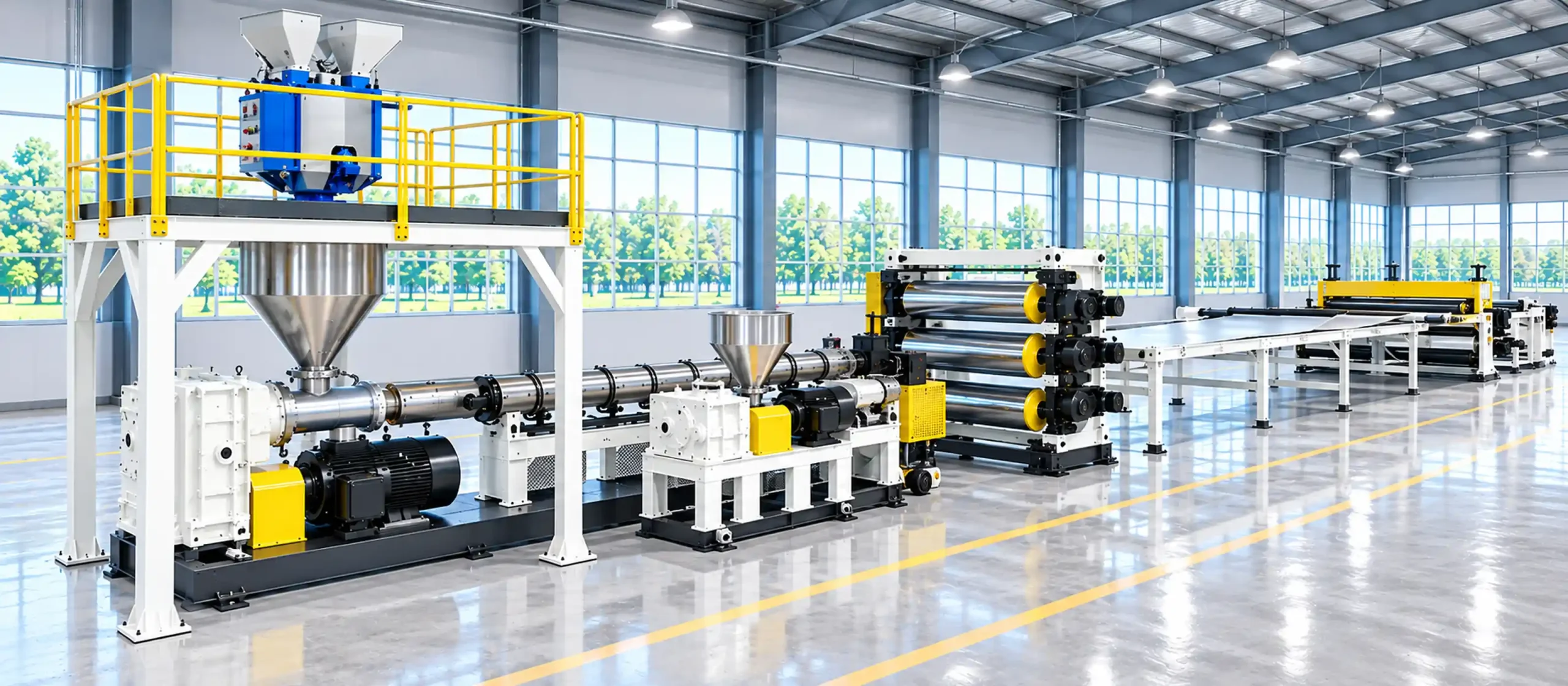
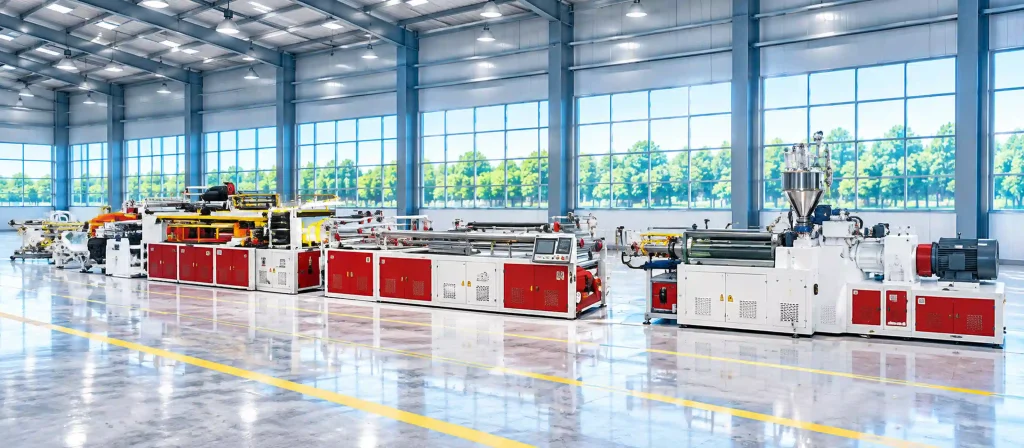
WPC Flooring Production Line
Jwell WPC Flooring Production Line produces lightweight, durable wood-plastic composite flooring with a foamed core, precision calendering, embossing, UV coating and automated profiling.
The CHDM (cyclohexane dimethanol) comonomer in PETG interrupts the polymer chain’s ability to crystallize, which has a practical consequence most extrusion engineers immediately appreciate: PETG does not require the crystallization and pre-drying steps that standard PET demands. Unlike standard PET, where residual moisture hydrolyzes the polymer at processing temperatures causing intrinsic viscosity loss and bubble formation, and where amorphous PET pellets must be crystallized before drying to prevent them from fusing together, PETG can be fed directly from sealed gaylords or silos into the extruder hopper.
This eliminates three significant operational burdens:
1. Capital Cost Elimination: A crystallizer and desiccant dryer system for a 500 kg/h PET line costs $80,000-150,000. PETG skips this investment entirely.
2. Energy Reduction: The crystallizer’s heater and dryer’s regeneration blower consume 80-120 kW of installed power. PETG production runs without this energy overhead — a 15-20% reduction in total energy consumption versus equivalent PET production.
3. Startup Speed: PET crystallizer and dryer warm-up requires 4-6 hours before every cold start. PETG cold starts reach production stability in under 1 hour. For converters running multiple short production campaigns per week, this operational flexibility directly improves machine utilization rates.
The PETG plate line shares the same basic process architecture as the PET plate line — extruder, melt pump, screen changer, T-die, three-roll calendar, cooling, haul-off, cutter — but omits the crystallization and drying front-end, simplifying the line and reducing both capital and operating costs.
配图建议: PETG 产线从料仓直接进挤出机的流程示意 vs PET 产线需结晶+干燥系统流程对比图
Jwell offers the PETG plate line in two extruder architectures, each optimized for different converter profiles:
Single-Screw Configuration: The standard configuration uses a single-screw extruder with a PETG-specific barrier flight screw geometry. This architecture is simpler, lower cost, and easier to maintain — the right choice for converters whose production is primarily or exclusively PETG. The single-screw design provides excellent melt homogenization for PETG’s amorphous structure and operates efficiently across the 250-500 kg/h output range.
Twin-Screw Configuration: For converters who need material flexibility — processing PETG, PET, and potentially other thermoplastics from the same line — the twin-screw configuration provides superior mixing, devolatilization (via vacuum venting), and material changeover capability. The co-rotating twin-screw’s self-wiping design prevents material cross-contamination during grade changes, and the vacuum venting zone removes residual volatiles that could cause bubbles in thick transparent plate.
Both architectures use Jwell-manufactured screws from 38CrMoAlA nitrided steel (single-screw) or W6Mo5Cr4V2 high-speed tool steel (twin-screw elements), with barrel hardness HV>=940. The screw design maintains controlled shear rates that preserve PETG’s impact properties while ensuring complete melting and homogeneous melt delivery to the die.
配图建议: 单螺杆 vs 双螺杆挤出机对比照片
The three-roll calendar is the primary determinant of PETG plate surface quality, thickness uniformity, and optical clarity. Each roller is manufactured from 42CrMo forged steel, providing high hardenability, excellent toughness, and dimensional stability under the thermal cycling inherent in PETG processing.
Key roller specifications:
For PETG transparent plate, the roller surface finish directly determines the plate’s surface quality. PETG’s excellent surface reproduction means any imperfection on the roll surface transfers to the plate. Jwell’s Ra≤0.016 μm mirror finish produces PETG plate with a glossy, glass-like surface suitable for POP displays, medical trays, and high-end packaging applications.
Roller temperature is controlled to ±0.5-1°C across the full face width by individual closed-loop pressurized water circuits for each roll. PETG’s glass transition temperature of approximately 81°C creates a specific roll polishing requirement: PETG must be polished on both surfaces while the melt is still above Tg, requiring roll temperatures between 70°C and 90°C. This precision eliminates the gloss variation bands that appear as visible stripes on transparent PETG plate when roll temperature is non-uniform.
配图建议: 三辊压光机近景,展示镜面辊筒表面
PETG transparent plate quality demands defect-free surfaces — gels, die lines, bubble lines, and thickness bands are all unacceptable under the controlled lighting inspection conditions used by medical and display buyers. Jwell’s systems-level approach to defect elimination includes a PID-controlled gear pump (melt pump) between the extruder and the die.
The melt pump absorbs the extruder’s natural pressure pulsations (±5-8 bar amplitude at the extruder head) and delivers melt to the die entry at pressure stabilized within ±1 bar. This pressure stability directly eliminates the die lines and thickness bands that pulsating melt pressure creates across the web width. The pump’s positive displacement also decouples extruder output from downstream pressure variations caused by filter screen changes or viscosity shifts, maintaining consistent plate quality throughout production campaigns.
Three melt pump options are available: Jwell self-manufactured (cost-optimized), Maag (Switzerland) for premium European precision, or Nordson (USA) for global serviceability. The gear pump is sized to match the line’s output range (250-500 kg/h) with minimal pressure drop.
配图建议: 熔体泵安装位置示意或近景
| Parameter | Specification |
| Extruder Type | Single-screw (standard) or Twin-screw (option) |
| Screw Diameter Options | 90 mm / 120 mm (single-screw) |
| L/D Ratio | 33:1 (single-screw) / 40:1 (twin-screw) |
| Screw Material | 38CrMoAlA nitrided steel (single) / W6Mo5Cr4V2 (twin) |
| Screw Surface Hardness | HV >=740 (single) / HV >=900 (twin) |
| Barrel Surface Hardness | HV >=940 |
| Feeder Type | Volumetric or gravimetric feeder |
| Vacuum Venting | Optional (twin-screw standard) |
| Parameter | Specification |
| Melt Pump Brand Options | Jwell (self-developed) / Maag (Switzerland) / Nordson (USA) |
| Melt Pump Pressure Stability | ±1 bar at die entry |
| Screen Changer Type | Hydraulic, continuous operation |
| Screen Changer Configuration | Single-column or double-column |
| Screen Change Time | <2 seconds (double-position design) |
| Parameter | Specification |
| Die Type | Coat-hanger manifold, flexible-lip |
| Die Material | High-quality mold steel |
| Flow Channel Chrome Plating | 0.03-0.05 mm |
| Die Cavity Surface Roughness | Ra 0.1 μm |
| Die Lip Surface Roughness | Ra 0.05 μm |
| Parameter | Specification |
| Configuration | Three-roll vertical or horizontal calendar |
| Roll Material | 42CrMo forged steel |
| Coaxiality | ≤0.005 mm |
| Surface Roughness | Ra ≤0.016 μm (mirror polish) |
| Surface Hardness | HRC 58-62 |
| Chrome Plating | 0.08 mm |
| Roll Temperature Range | 70-120°C (PETG optimal: 70-90°C) |
| Temperature Deviation | ±0.5-1°C across full face width |
| Temperature Medium | Pressurized hot water (max 120°C) |
| Parameter | Specification |
| Materials | PETG (glycol-modified PET) |
| Output Capacity | 250-500 kg/h (configuration & material dependent) |
| Plate Thickness Range | 1.0-12.0 mm |
| Plate Width | 600-1,200 mm |
| Thickness Tolerance | ±2% (with automatic die lip control) |
| Light Transmission | ≥90% at 2mm thickness |
| Haze | <2% at 2mm thickness |
| Downstream Equipment | Cooling bracket → Haul-off → Cutter → Conveyor |
| Control System | Siemens S7-1500 PLC + 15″ HMI |
| Certifications | CE, ISO 9001 |
| Parameter | Specification |
| Total Installed Power | 180-350 kW (configuration dependent) |
| Recipe Storage | Configurable slots, time-stamped parameter logging |
| Process Parameters Logged | 50+ at 10-second intervals |
| Parameter | Specification |
| Certifications | CE, ISO 9001 |
| Available as | Complete line turnkey solution |
| After-Sales | Global engineer certification system, 48-hour spare parts dispatch |
| Property | PETG / GPPS (Crystal PS) / ABS / PMMA (Acrylic) |
| Transparency | ≥90% ✅ / ≥88% ✅ / Opaque ❌ / ≥92% ✅ |
| Impact Strength (Izod, J/m) | 80-100 (no break) ✅ / 15-20 (brittle) ❌ / 20-40 / 15-20 (brittle) ❌ |
| Pre-Drying Required | No ✅ / No ✅ / Yes (3-4 hr) / No ✅ |
| Thermoforming Temp | 60-80°C ✅ / 100-130°C / 120-140°C / 140-160°C ❌ |
| Deep-Draw Capability | Excellent ✅ / Poor (cracks) ❌ / Good / Moderate (thins) |
| Chemical Resistance | Excellent ✅ / Poor (solvents) / Good / Good |
| UV Resistance | Good (with additive) / Poor (yellows) ❌ / Poor (yellows) ❌ / Excellent ✅ |
| Material Cost (relative) | 1.2-1.5× / 0.6-0.7× (lowest) / 1.0× / 1.0× |
| Service Temp (max) | 65°C / 70°C / 105°C / 80°C |
| Key Advantage | Impact + clarity + thermo + no-dry / Lowest cost + clarity / Impact + heat resistance / Highest clarity + UV |
| 维度 | PETG Plate 线定位 / 说明 |
| Impact + Clarity | Better impact than GPPS, clearer than ABS / Unique performance intersection no other material matches |
| Process Simplification | No crystallizer, no dryer, no 4-6 hr warm-up / Eliminates 3 major PET processing burdens |
| Thermoforming Premium | 60-80°C forming, excellent sag resistance / Fastest cycle times for deep-draw applications |
| Capital Advantage | $80K-150K dryer cost eliminated vs PET / Lower total investment for equivalent output |
| Application Premium | Medical + POP + deep-draw + protective / Markets where impact + clarity + formability intersect |
| Architecture Flexibility | Single-screw or twin-screw options / Material range and output optimization |
| 卡片 | 产品名称 / 链接 / 关系 |
| 1 | PETG Sheet Extrusion Line / /sheet-extrusion/petg-sheet-extrusion-line/ / 同材料薄片产线(0.2-2mm),互补厚度范围 |
| 2 | PET Sheet Extrusion Line / /sheet-extrusion/pet-sheet-extrusion-line/ / 材料同族(PETG = glycol-modified PET),多材料平台选择 |
| 3 | GPPS Plate Extrusion Line / /sheet-extrusion/gpps-plate-extrusion-line/ / 同类透明厚板,成本/耐冲替代选择 |
| # | 字段 / 类型 / 必填 / 说明 |
| 1 | Name / text / ✅ / placeholder: “Your full name” |
| 2 | Email / email / ✅ / placeholder: “your@company.com” |
| 3 | Country / select / ✅ / 200+国家 |
| 4 | Phone / tel / — / 含国际区号 |
| 5 | Company / text / — / placeholder: “Your company name” |
| 6 | Application / select / ✅ / Deep-Draw Thermoforming / POP Displays / Medical Trays / Protective Barriers / Multiple / Other |
| 7 | Extruder Architecture / select / ✅ / Single-screw / Twin-screw / Not sure / Recommend for me |
| 8 | Required Output (kg/h) / select / ✅ / <250 / 250-350 / 350-500 / >500 / Not sure |
| 9 | Plate Thickness (mm) / select / — / 1-3 / 3-6 / 6-8 / 8-12 / Not sure |
| 10 | Required Plate Width (mm) / select / — / <600 / 600-900 / 900-1200 / >1200 / Not sure |
| 11 | Medical Validation Needed / select / — / Yes (ISO 13485) / No / Not sure |
| 12 | Melt Pump Preference / select / — / Jwell / Maag (Switzerland) / Nordson (USA) / Not sure / Recommend for me |
| 13 | Message / textarea / — / placeholder: “Tell us about your production requirements, target markets, and any special material grades…” |
| — | CAPTCHA / — / ✅ / reCAPTCHA v3 |
| — | Submit / submit / — / “Request Quote & Configuration” |
| # | 检查项 / 状态 |
| 1 | 唯一 H1,含完整产品名 + 核心关键词 / ✅ |
| 2 | H2 技术关键词覆盖: PETG plate, high-impact, clear sheet, no crystallization, deep-draw thermoforming, 42CrMo roller / ✅ |
| 3 | 规格表为 HTML <table> 文本 / ✅ |
| 4 | 所有图片有描述性 alt 属性 / ✅ |
| 5 | 面包屑用 Schema BreadcrumbList / ✅ |
| 6 | FAQ 用 Schema FAQPage (6个Q&A) / ✅ |
| 7 | 产品信息用 Schema Product + 详细 Organization / ✅ |
| 8 | 视频用 Schema VideoObject + 本站托管 / ✅ |
| 9 | Material Comparison 区块覆盖 PETG/GPPS/ABS/PMMA 对比关键词 / ✅ |
| 10 | Canonical 自引用 / ✅ |
| 11 | Title tag 50-60 chars / ✅ |
| 12 | Meta description 含性能数据 + 关键词 / ✅ |
| 13 | Open Graph 完整 / ✅ |
| 信号 | 体现方式 |
| Experience | 25000+ 产线交付、29年行业经验、120+国家安装 |
| Expertise | PETG专用螺杆设计、42CrMo镜面辊筒Ra≤0.016μm全自产、单/双螺杆架构选择、1000+专利 |
| Authoritativeness | 8大生产基地、3500员工、$700M年营收、ISO/CE认证 |
| Trustworthiness | CE + ISO 9001认证、全球工程师认证体系、48小时备件发货、医疗验证文档支持 |
| 检查项 | 目标值 |
| LCP | < 2.5s |
| CLS | < 0.1 |
| INP | < 200ms |
| Mobile-friendly | ✅ |
| 图片格式 | WebP (待补充) |
| 文件夹 | 文件 / 用途 / 状态 |
| 主图/ | — / — / ❌ 空文件夹,需补充主图 |
| 详情图/ | — / — / ❌ 空文件夹,需补充应用场景图 |
| 文件 | 用途 / 状态 |
| 视频/PETG Plate Extrusion Line FAT.mp4 | [D] FAT 视频 / ✅ |
| 用途 | 建议 / 优先级 |
| Hero 主图 ×2 | PETG整线全景 + 主机特写 / 高 |
| 应用场景图 ×4 | 深拉伸热成型 / POP展示 / 医疗托盘 / 防护屏障 / 高 |
| F1 无需结晶对比图 | PETG直接进料 vs PET需结晶+干燥系统流程对比 / 高 |
| F2 螺杆架构配图 | 单螺杆 vs 双螺杆对比 / 中 |
| F3 三辊压光配图 | 压光辊近景 / 高 |
| F4 熔体泵配图 | 熔体泵安装位置 / 中 |
| F5 PETG光泽对比图 | PETG片材光泽度对比(正常 vs 温度偏差) / 中 |
| F6 冷却托架配图 | 多区温控冷却段近景 / 中 |
| F7 全球组件配图 | 电控柜 + 品牌 logo 组合 / 低 |
| FAT 视频封面图 | PETG plate FAT 视频 poster 图 / 高 |
| 相关产品卡片图 | PETG Sheet/PET Sheet/GPPS Plate 缩略图 / 中 |
| 目标页面 | 位置 / 锚文本 |
| PETG Sheet Line | [L] Related Products / “PETG Sheet Extrusion Line” |
| PET Sheet Line | [L] Related Products / “PET Sheet Extrusion Line” |
| GPPS Plate Line | [L] Related Products / “GPPS Plate Extrusion Line” |
| Sheet Extrusion Pillar Page | [A] Breadcrumb / “Sheet Extrusion” |
| 来源页面 | 链接上下文 |
| Sheet Extrusion Pillar Page | 片材挤出分类页 |
| Medical Device Packaging Guide | 医疗包装解决方案页 |
| PET vs PETG Comparison Guide | PET与PETG对比选择页 |
| Thermoforming Materials Overview | 热成型材料概览 |
| PETG Sheet Extrusion Line | 厚板/薄片产线对比 |
| 维度 | ABS 线 / PETG Plate 线 |
| Hero 卖点重点 | 市场份额 + 客户规模(90%份额 + 300线 + 海尔) / 材料差异化 + 性能优势(无需结晶 + 耐冲 + 透明 + 深拉伸) |
| 标签页数 | 5 个 (+Case Studies) / 4 个(无Case Studies) |
| 功能区块 | 8 个(冰箱高产能 + 自动化堆垛 + 共挤) / 7 个(无需结晶 + 单/双螺杆 + 高温辊 + 厚板冷却 + 熔体泵) |
| 视频数 | 2 个 (FAT + 案例) / 1 个 (FAT only) |
| 独特区块 | Case Studies [I] + Market Position (客户数据) / Material Comparison [I] (PETG vs GPPS vs ABS vs PMMA) |
| FAQ 重点 | 冰箱线产能 + ABS干燥 + 全球服务 / PETG无需结晶 + PETG vs GPPS/ABS + 深拉伸优势 + PET兼容性 |
| 表单字段 | 11 个 (Application + Timeline) / 13 个 (+Extruder Architecture + Medical Validation + Plate Width) |
| E-E-A-T 重心 | 市场地位 + 规模验证 / 材料专业性 + 性能精度 + 医疗验证支持 |
| 特色数据 | 300+冰箱线 + 90%份额 + 海尔20年 / 无需结晶 + 耐冲>GPPS + 透明>ABS + 60-80°C热成型 |
| 应用首位 | Refrigeration (冰箱板) / Deep-Draw Thermoforming (深拉伸热成型) |
| 产能定位 | 300-3000 kg/h (volume-driven) / 250-500 kg/h (performance-driven) |
| 厚度范围 | 0.5-6.0 mm / 1.0-12.0 mm (thick plate specialist) |
PETG plate at 2-6 mm thickness is the material of choice for deep-draw thermoformed products where the draw depth exceeds 3× the sheet thickness — luggage inner shells, equipment housings, automotive interior panels, and large display enclosures. PETG’s amorphous structure gives it a wide thermoforming window and excellent sag resistance — the material stretches uniformly without thinning excessively at deep-draw corners, which is the primary failure mode for GPPS (cracking) and PMMA (thinning) in deep-draw tooling.
PETG’s optimal thermoforming temperature range of 60-80°C is substantially lower than GPPS (100-130°C), ABS (120-140°C), or PMMA (140-160°C), meaning faster heating cycles, lower energy consumption, and better detail reproduction from fine mold features. The material’s impact resistance (Izod notched 80-100 J/m) ensures that deep-draw thermoformed parts maintain structural integrity through demolding, trimming, and end-use handling — a critical advantage over GPPS, whose brittleness causes cracking during demolding of deep-draw parts.
The Jwell line’s thickness tolerance of ±2% ensures uniform wall distribution in deep-draw thermoformed parts — thickness variation causes thin spots in deep-draw corners that fail under mechanical load.
Retail display manufacturers use PETG plate at 3-8 mm thickness for transparent shelves, product risers, signage panels, and display box components where the material’s combination of clarity, toughness, and ease of fabrication allows rapid assembly without the brittleness issues of GPPS or the cost of PMMA.
PETG’s impact resistance — approximately 4-5× that of GPPS at equivalent thickness — prevents display component breakage during assembly, transportation, and the inevitable handling impacts in active retail environments. Display components fabricated from GPPS crack when dropped from display height; PETG components survive the same impact without damage, reducing replacement cost and maintaining display integrity throughout the retail campaign.
The material’s solvent bonding capability (using MEK or tetrahydrofuran) enables fast, strong joint construction for display assembly without specialized welding equipment. PETG’s excellent edge polishing capability — cut edges can be polished to optical clarity using mechanical buffing or flame polishing — creates the premium “crystal edge” appearance that high-end retail displays demand.
Jwell PETG lines can produce plate in custom colors and with UV-blocking additives for window-display applications subject to direct sunlight exposure, preventing the yellowing that acrylic develops under UV exposure over time.
No. PETG’s CHDM comonomer prevents crystallization, which means PETG can be fed directly from sealed gaylords or silos into the extruder hopper without the 4-6 hour pre-drying and crystallization step required for standard PET. This eliminates the capital investment in a crystallizer and desiccant dryer system (typically $80,000-150,000 for a 500 kg/h capacity), reduces total installed power by 80-120 kW, and shortens cold-start time from 4-6 hours to under 1 hour. The PETG plate line shares the same basic process as the PET plate line but omits the crystallization and drying front-end.
PETG plate occupies a unique performance intersection between GPPS and ABS. PETG offers better impact resistance than GPPS (Izod notched 80-100 J/m vs 15-20 J/m for GPPS), meaning PETG plate does not shatter or crack when dropped. PETG offers better optical clarity than ABS (light transmission ≥90% vs opaque for ABS). PETG also offers superior thermoformability at lower temperatures (60-80°C) compared to both GPPS (100-130°C) and ABS (120-140°C), enabling faster thermoforming cycles and better detail reproduction for deep-draw applications.
The line produces PETG plate from 1.0 to 12.0 mm thickness with plate width from 600 to 1,200 mm. Output capacity ranges from 250 to 500 kg/h depending on screw configuration, material grade, plate thickness, and width. Thickness tolerance is ±2% with the optional online thickness gauge. The thickness range covers thin thermoforming sheet (1-3 mm) through thick structural plate (8-12 mm for POP displays and protective barriers).
PETG’s amorphous structure gives it a wide thermoforming window and excellent sag resistance — the material stretches uniformly without thinning excessively at deep-draw corners, which is the primary failure mode for GPPS and PMMA in deep-draw tooling. PETG’s optimal thermoforming temperature of 60-80°C is substantially lower than GPPS, ABS, or PMMA, meaning faster heating cycles, lower energy consumption, and better detail reproduction. The material’s impact resistance ensures deep-draw thermoformed parts maintain structural integrity through demolding and handling.
The line can process standard PET, but with two caveats. First, the line as configured for PETG does not include a crystallizer and desiccant dryer — these would need to be added ($80,000-150,000). Second, the screw geometry optimized for PETG’s higher melt viscosity would not achieve optimal throughput with standard PET. For converters needing maximum flexibility, Jwell recommends the PET Sheet Extrusion Line, which can process both PET and PETG through recipe changes. The PETG-dedicated plate line is the right choice when production is 70%+ PETG.
Jwell WPC Flooring Production Line produces lightweight, durable wood-plastic composite flooring with a foamed core, precision calendering, embossing, UV coating and automated profiling.
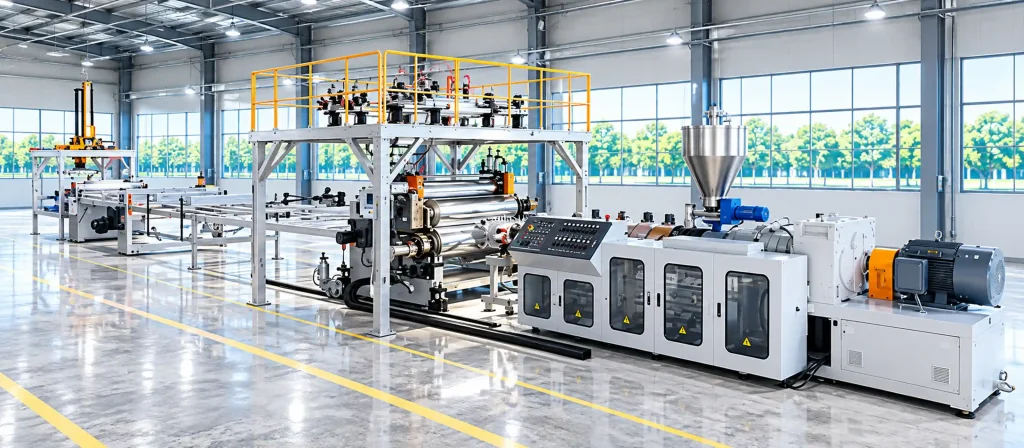
Jwell SPC Flooring Production Line delivers turnkey production from mixing and extrusion to calendering, UV coating, profiling, lamination and packaging.
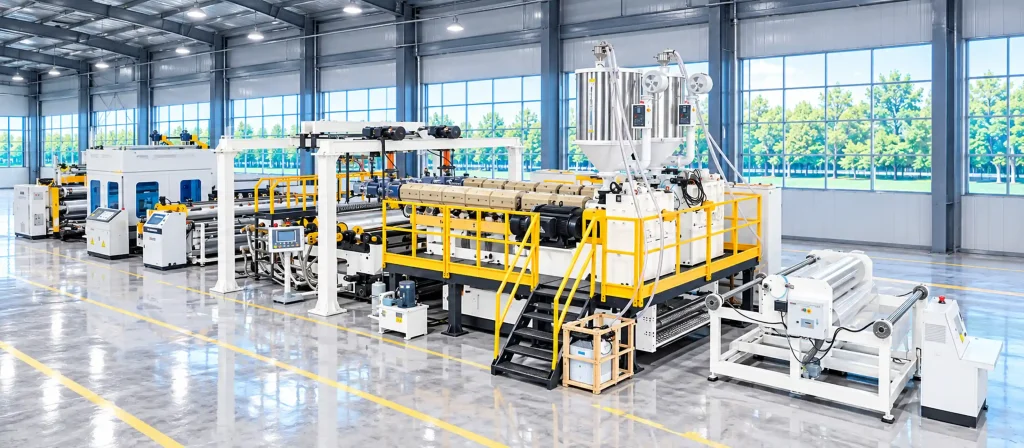
JWELL TPU Casting & Laminating Film Extrusion Line integrates precision casting, online lamination and automatic winding to produce TPU composite films and laminated fabrics for footwear, textiles and outdoor applications.

Jwell Machinery Co., Ltd sets up in 1997 , we are large manufacturer of plastic extrusion machinery in China, our headoffice was located in Shanghai.
SOLUTIONS
PRODUCTS
CONTACT
Copyright © Jwell Machinery Co., Ltd 2026. All rights reserved. Privacy Policy | Terms & Conditions | Site Map
Tell us about your specific requirements. Our team can help you identify a solution for your project.