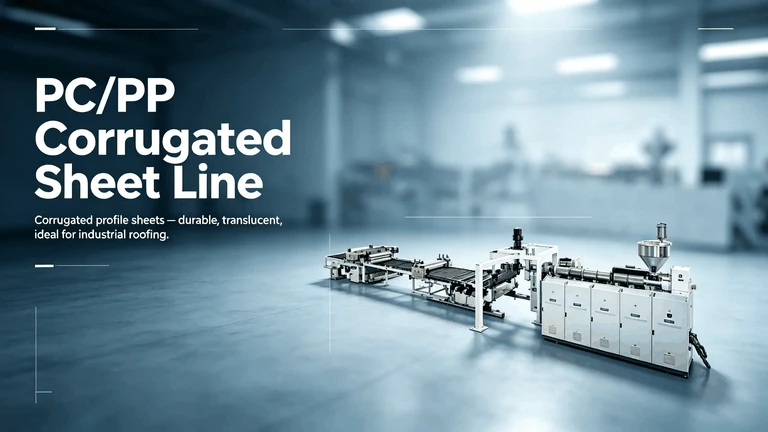
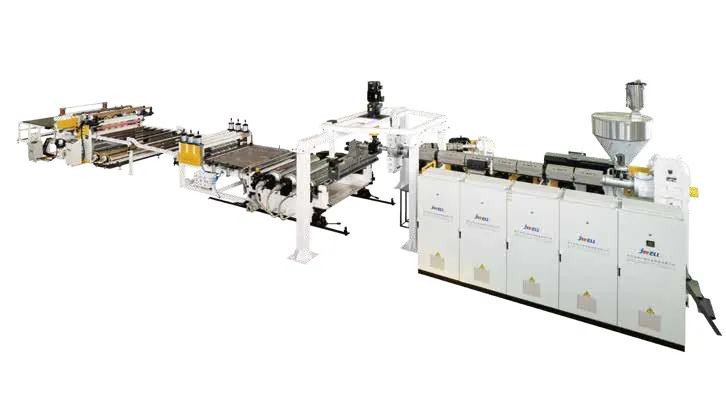
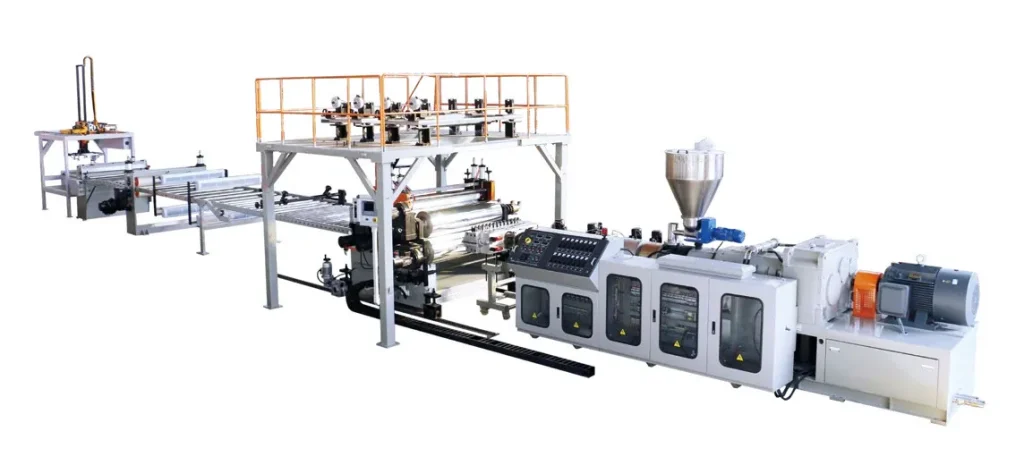
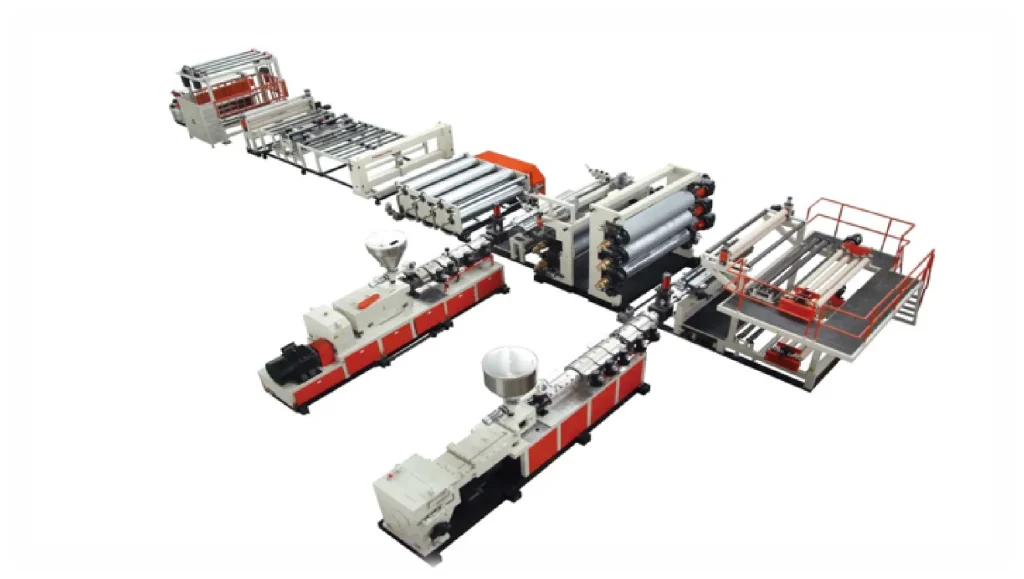
PC Corrugated Sheet Line

SEO 关键词: PC corrugated sheet extrusion production video, PC corrugated line FAT, Jwell polycarbonate corrugated roofing sheet factory acceptance test, PC wave profile sheet production machine video

The post-forming vacuum calibration station is the defining quality control element of the Jwell PC corrugated sheet line. Positioned within 200 mm of the die exit, it applies controlled vacuum and precision cooling to lock the corrugated wave geometry into the PC sheet before thermal relaxation or gravitational sag can distort the profile. This is a fundamentally different approach from conventional corrugated sheet lines where the profile is formed solely by roll-stack geometry and relies on material cooling over an extended distance to set the shape.

This profile tolerance directly determines the overlap fit accuracy when adjacent sheets are installed side by side on a roof. Inconsistent profile geometry — where wave crest height varies by even 0.5-0.8 mm between adjacent panels — causes weather-sealing gaps at panel overlaps. These gaps are the single most common source of warranty claims in corrugated roofing installations, accounting for an estimated 60-70% of post-installation water ingress complaints. Jwell’s immediate-lock calibration eliminates this quality variable at the production source.

PC Corrugated Sheet Extrusion Line: Related JWELL Extrusion Lines

The PC Corrugated Sheet Extrusion Line is part of JWELL’s complete extrusion portfolio. Customers evaluating this PC Corrugated Sheet Extrusion Line also frequently request our PC Hollow Sheet Line | Jwell Machinery and PP Hollow Grid Sheet Line | Jwell Machinery, which share the same proven screw, die and control platforms. For layout drawings, pricing and lead times, contact JWELL Machinery directly.

# Item Key Point
1 🌀 **Sinusoidal & Trapezoidal Profiles** 15+ standard geometries, custom profiles engineered to match regional building standards
2 ⚡ **Integrated UV Co-Extrusion** 30-60 micron molecularly bonded UV cap layer; 10+ year outdoor weatherability without peeling, yellowing, or chalking
3 🎯 **88-90% Visible Light Transmission** ASTM D1003 verified; 2-3 percentage points above industry average via low-shear melt processing and polished chrome rollers (Ra ≤0.08 µm)
4 🔄 **±0.3 mm Profile Height Tolerance** vacuum calibration within 200 mm of die exit locks wave geometry before thermal relaxation; eliminates overlap-fit weather-sealing gaps
5 🔧 **Recipe-Based Changeover** Siemens S7-1500 PLC stores complete parameter sets; 60-90 min profile cartridge swap, 30 min co-ex mode reconfiguration
6 ✅ **Siemens S7-1500 PLC + 16-bit Analog Input** continuous YoI monitoring via in-line spectrophotometer; SPC-ready production data logging for architectural specification compliance
7 ♻️ **CE Certified

Immediate-Lock Vacuum Calibration — ±0.3 mm Profile Tolerance Within 200 mm of Die Exit

The post-forming vacuum calibration station is the defining quality control element of the Jwell PC corrugated sheet line. Positioned within 200 mm of the die exit, it applies controlled vacuum and precision cooling to lock the corrugated wave geometry into the PC sheet before thermal relaxation or gravitational sag can distort the profile. This is a fundamentally different approach from conventional corrugated sheet lines where the profile is formed solely by roll-stack geometry and relies on material cooling over an extended distance to set the shape.

How the immediate-lock calibration works:

1. The PC melt exits the flat sheet die at 280-320°C and enters the post-forming station in a semi-molten, formable state

2. The station’s hardened chrome-plated rollers (formed to the target corrugation geometry) press the wave pattern into the sheet surface while vacuum ports between the rollers pull the sheet firmly against the forming surfaces

3. Controlled cooling water circulated through the roller cores extracts heat at a calibrated rate — rapid enough to solidify the profile geometry, gradual enough to prevent internal stress accumulation

4. The sheet exits the calibration station with the wave profile locked to ±0.3 mm height tolerance at 2.0 mm sheet thickness

5. Downstream cooling sections then complete the solidification without altering the locked-in profile dimensions

This profile tolerance directly determines the overlap fit accuracy when adjacent sheets are installed side by side on a roof. Inconsistent profile geometry — where wave crest height varies by even 0.5-0.8 mm between adjacent panels — causes weather-sealing gaps at panel overlaps. These gaps are the single most common source of warranty claims in corrugated roofing installations, accounting for an estimated 60-70% of post-installation water ingress complaints. Jwell’s immediate-lock calibration eliminates this quality variable at the production source.

配图建议: 后成型校准站特写(真空辊 + 镀铬成型辊 + 冷却水路示意)

Molecularly Bonded UV Co-Extrusion — 30-60 Micron Cap Layer for 10+ Year Outdoor Weatherability

The integrated co-extrusion system applies a concentrated UV-absorbing polycarbonate cap layer to the weather-exposed sheet surface during the extrusion process itself. This is a structurally different approach from both bulk-UV addition and post-manufacture coating — and the performance difference in outdoor roofing service is measurable in years of additional service life.

Co-Extrusion vs. Bulk-UV Addition:

– Bulk addition distributes UV absorber uniformly through the entire 0.8-3.0 mm sheet cross-section. However, UV radiation penetrates only the top 30-60 microns of the PC surface — meaning approximately 95% of the expensive UV absorber in a bulk-formulated sheet serves no protective function

– Co-extrusion concentrates the UV absorber in the 30-60 micron cap layer precisely where radiation exposure occurs, reducing additive consumption by 60-70% while providing equivalent or superior UV-blocking performance

Co-Extrusion vs. Post-Manufacture Coating:

– Spray-applied and roller-applied UV coatings are mechanically adhered films that exist as a discrete layer on the sheet surface. Under outdoor thermal cycling (daily temperature swings of 30-50°C on dark-colored roofs), differential thermal expansion between the coating and the PC substrate creates shear stress at the interface. Coating delamination — peeling, flaking, and blistering — typically begins after 3-7 years of exposure

– Co-extruded UV cap layers are molecularly integrated into the PC sheet surface during the extrusion process. There is no discrete interface to delaminate. The cap layer and the base sheet are the same polycarbonate material — the only difference is the concentration of UV absorber in the cap layer

Dual-Purpose Co-Extrusion Configuration:

The co-extruder can be used in two operating modes, switchable via Jwell’s quick-change melt pipe system in under 30 minutes:

– Top-Surface UV Protection Mode: Applies the UV cap layer to the weather-exposed (top) surface for outdoor roofing applications

– Bottom-Surface Color Layer Mode: Applies a colored PC layer to the interior-facing (bottom) surface for decorative ceiling applications where the sheet is visible from below

This dual-purpose capability expands the marketable product range from a single line investment — manufacturers can serve both the outdoor roofing market and the architectural interior cladding market without purchasing separate equipment.

Jwell-equipped manufacturers who position their product as “UV co-extruded, not coated” in their marketing materials report a measurable premium of 8-12% over coated competitors in architectural specification markets where long-term performance documentation is a purchasing requirement.

配图建议: UV共挤层截面显微照片(30-60微米帽层清晰可见)+ 共挤工位外观照片

Interchangeable Profile Cartridge System — 60-90 Minute Changeover Between 15+ Standard Geometries

The corrugation forming station accommodates interchangeable profile cartridges that define the wave shape, depth, and pitch of the finished panel. This modular tooling approach is the key to serving multiple regional markets and application segments from a single production asset.

Profile Cartridge Specifications:

Regional Profile Preferences:

– Sinusoidal profiles: Preferred in European and Middle Eastern markets for aesthetic appearance and superior water drainage in moderate-to-heavy rainfall

– Trapezoidal profiles: Standard in Southeast Asian and Latin American markets where higher structural stiffness per unit weight provides wind uplift resistance

– Custom profiles: Engineered to match existing roofing system dimensions for retrofit and replacement market opportunities — a high-margin segment where customers pay premium pricing for exact dimensional compatibility with installed roofing infrastructure

The cartridge system eliminates the compromise that single-profile lines force on manufacturers — either limiting their market to one regional aesthetic or investing in multiple dedicated production lines. With the Jwell system, a manufacturer serving the Southeast Asian market (trapezoidal standard) can add European export capability (sinusoidal) with only the cost of a profile cartridge and a one-day line reconfiguration.

配图建议: 不同波纹型材截面并排对比(正弦波 vs 梯形波 vs 定制型)+ 工具盒更换过程示意

88-90% Light Transmission Protocol — Low-Shear Processing + Optical Quality Control for Daylighting Performance

For architectural daylighting applications — stadium roofing, greenhouse covering, skylight systems — every percentage point of light transmission directly affects building performance. A 2% difference in transmission through a 5,000 m² roof area represents 100 m² of equivalent glazing area gained or lost. Jwell’s PC corrugated sheet line achieves 88-90% visible light transmission (ASTM D1003) for clear-grade panels through a multi-factor processing protocol:

1. Low-Shear Melt Processing:

The extruder screw features a barrier section with PC-optimized flight geometry that minimizes residence time at elevated temperature (280-320°C). Extended residence time is the primary cause of thermal degradation in PC — progressive molecular weight reduction that manifests as yellowing (increased yellowness index, YoI) and haze formation. Jwell’s screw design achieves complete plasticization with 15-20% shorter melt residence time compared to general-purpose PC screws.

2. Precision-Polished Chrome Roller Surfaces:

All forming rollers — in both the initial roll stack and the post-forming calibration station — are finished to Ra ≤0.08 µm surface roughness (mirror-grade chrome plating). Surface imperfections in forming rollers are mechanically replicated into the sheet surface, creating micro-scatter points that reduce transmitted light intensity. The polished chrome surface also reduces PC adhesion during forming, minimizing surface defects that would otherwise degrade optical quality.

3. In-Line Optical Quality Monitoring:

An in-line color spectrophotometer provides continuous monitoring of yellowness index (YoI) and haze. The system alerts operators to developing thermal degradation — detected as a rising YoI trend — before it produces non-conforming sheet. This closed-loop quality monitoring, combined with the Siemens S7-1500 PLC’s 16-bit analog input resolution for process variable monitoring, enables the line to hold light transmission variance to within ±1.5 percentage points across an entire production batch.

4. Rapid Startup Heating Protocol:

The barrel heating system includes ceramic band heaters with individual zone PID control that reaches stable processing temperature in under 90 minutes from cold start. The die pre-heating circuit allows concurrent heating of the die while the extruder barrel reaches temperature, reducing overall startup time by approximately 30%. This rapid startup is especially valuable in seasonal-demand markets where roofing material production peaks during dry-season construction windows and lines may be idle for weeks between production campaigns. Short startup times minimize the production of yellowed, off-spec sheet that must be scrapped during the stabilization period.

The 88-90% light transmission achievement is 2-3 percentage points above industry average for PC corrugated sheet. In the architectural specification market, where daylight modeling calculations determine compliance with building energy codes, this differential can be the deciding factor in material selection.

配图建议: 透光率测试示意(分光光度计 + ASTM D1003 测试标准图示)+ 镀铬辊表面光洁度近景

Technical Specifications

参数类别 参数 / 规格
原料 Applicable Material / Polycarbonate (PC) virgin resin; PC with UV stabilizer masterbatch
产品 Sheet Profile / Sinusoidal, trapezoidal wave; custom profiles available
产品 Sheet Width (Effective Coverage) / 900 mm, 1,050 mm, 1,260 mm
产品 Sheet Thickness / 0.8 – 3.0 mm
产品 Profile Depth / 16 mm, 18 mm, 25 mm (standard); 5–50 mm custom
产品 Corrugation Pitch / 63 mm, 76 mm, 95 mm, 130 mm
产能 Production Capacity / 150 – 400 kg/h
挤出机 — 主机 Screw Diameter / Φ65 mm / Φ90 mm / Φ120 mm
挤出机 — 主机 L/D Ratio / 33:1 with barrier section optimized for PC
挤出机 — 主机 Main Motor Power / 90 – 200 kW
挤出机 — 主机 Screw Material / 38CrMoAlA nitrided steel, nitriding depth 0.5-0.7 mm, surface hardness HV≥940
挤出机 — 主机 Barrel Heating / Ceramic band heaters with individual zone PID control; 90-min cold start to stable temperature
挤出机 — 共挤 Co-extruder Diameter / Φ35 mm / Φ45 mm for UV cap layer or color bottom layer
挤出机 — 共挤 Cap Layer Thickness / 30 – 60 microns
挤出机 — 共挤 Melt Pipe Reconfiguration / Quick-change system; 30 min for UV top ↔ color bottom mode switch
模头 Die Type / Flat sheet T-die with adjustable lip gap
模头 Die Width / 1,200 mm / 1,500 mm / 1,800 mm
成型系统 Post-Forming Calibrator / Vacuum forming station with hardened chrome rollers (Ra ≤0.08 µm)
成型系统 Profile Lock Distance / Within 200 mm of die exit
成型系统 Profile Height Tolerance / ±0.3 mm at 2.0 mm sheet thickness
成型系统 Profile Cartridge Changeover / 60 – 90 minutes by 2 operators
成型系统 Standard Profile Library / 15+ geometries (sinusoidal, trapezoidal, custom)
冷却系统 Cooling Type / Multi-zone water cooling with temperature control
冷却系统 GCC Option / Chiller-boosted configuration maintaining process water at 15-20°C at 50°C ambient
牵引 Haul-Off Speed / 0.5 – 8.0 m/min
切割 Cutting System / Automatic cut-to-length saw; center winder option available
光学性能 Light Transmission / 88-90% visible light (ASTM D1003) for clear grades; ±1.5% batch variance
光学性能 Quality Monitoring / In-line color spectrophotometer for continuous yellowness index (YoI) monitoring
防火性能 Fire Rating (Standard PC) / B1 per DIN 4102 (Euroclass B-s1,d0 equivalent)
防火性能 Fire Rating (FR Grade Option) / Euroclass B-s1,d0 or ASTM E84 Class A (throughput reduced 10-15%)
抗风性能 Wind Uplift (Reference) / 2.4 kPa at 18mm/76mm sinusoidal profile, 400mm fastener centers (~220 km/h)
控制系统 PLC / Siemens S7-1500 with 16-bit analog input resolution
控制系统 HMI / 15-inch color touchscreen
控制系统 Recipe Management / Complete parameter sets stored per product configuration; one-touch recall
控制系统 Data Logging / SPC-ready trend logging for temperature, pressure, speed, YoI
驱动系统 Main Motor / WEG high-efficiency AC motor
驱动系统 Inverter / ABB VFD series
电气 Electrical Components / Schneider Electric contactors, relays, circuit breakers
材料 Water-Contact Components / Marine-grade 316L stainless steel
材料 Structural Components / Anodized aluminum and stainless steel for weather-exposed parts
电气柜 Protection Rating / IP54 standard; IP65 optional for coastal installations
电源 Power Supply / 380V / 50Hz (customizable to 440V/60Hz)
装机功率 Installed Power / 200 – 380 kW
认证 Certifications / CE, ISO 9001

[J] Why Jwell for PC Corrugated Sheet — 信任说服

# 说服点 / 数据支撑
1 29 Years Extrusion Expertise (Since 1997) / Founded May 1997. China Plastics Machinery Industry Association vice president unit. Single-screw extruder industry standard-setter. 29 years continuous manufacturing and innovation.
2 8 Production Bases, Global Manufacturing Scale / 8 manufacturing bases worldwide. 3,500 employees including 500+ engineers. Annual revenue exceeding $700M. Total manufacturing floor space capable of simultaneous assembly of 50+ extrusion lines.
3 25,000+ Machines Installed in 120+ Countries / Proven equipment reliability across diverse operating environments — from air-conditioned European factories to open-sided production halls in tropical Southeast Asia and Middle Eastern desert conditions. Reference installations available for customer visits.
4 1,000+ Patents / Proprietary Technologies
5 Vertical Integration — In-House Critical Components / Screws (38CrMoAlA + gas nitriding), barrels, T-dies, calibrator sleeves, and forming rollers manufactured in-house. Faster spare parts availability, lower lifetime maintenance cost, and direct engineering support for custom profile development. No third-party dependency for critical wear components.
6 CE + ISO 9001 Certified / Complete Documentation

[K] Related Products — 相关产品

产品 链接 / 关联说明
PC Hollow Sheet Extrusion Line /sheet-extrusion-lines/hollow-sheet/pc/ / PC中空板(多壁结构板),采光和隔热互补产品
PC Sheet Extrusion Line (Solid) /sheet-extrusion-lines/solid-sheet/pc/ / PC实心耐力板,三辊压光工艺,平板采光应用
PVC Corrugated Board Extrusion Line /sheet-extrusion-lines/corrugated/pvc/ / PVC波纹板生产线,低成本波纹板替代方案
PMMA Sheet Extrusion Line /sheet-extrusion-lines/solid-sheet/pmma/ / PMMA(亚克力)板材,高透光率平板产品

询价表单字段

# 字段 / 类型 / 必填 / 选项/说明
1 Full Name / text / ✅ /
2 Company Name / text / ✅ /
3 Work Email / email / ✅ /
4 Phone / WhatsApp / tel / ✅ /
5 Country / select / ✅ / 国家下拉列表
6 Target Profile Type / select / ✅ / Sinusoidal / Trapezoidal / Both / Not sure
7 Required Sheet Width (mm) / select / ✅ / 900 / 1050 / 1260 / Other / Not sure
8 Required Output (kg/h) / select / ✅ / 150-250 / 250-350 / 350-400 / >400 / Not sure
9 Target Application / select / ✅ / Stadium Roofing / Carport & Canopy / Greenhouse / Architectural Facade / Multiple / Other
10 Factory Ambient Conditions / select / / Standard (≤35°C) / High Temperature (35-50°C, GCC/tropical) / Not sure
11 Additional Requirements / textarea / / 自由文本(特殊型材要求、车间布局、原材料供应商、认证需求等)

3.1 Core Web Vitals 目标

指标 移动端 / 桌面端 / 目标
LCP < 2.5s / < 1.5s / Hero 图片需压缩至 WebP < 80KB
INP < 200ms / < 100ms / 表单交互即时响应
CLS < 0.1 / < 0.05 / 固定图片/视频容器尺寸

3.2 图片优化清单

图片 当前格式 / 建议格式 / 目标大小 / 说明
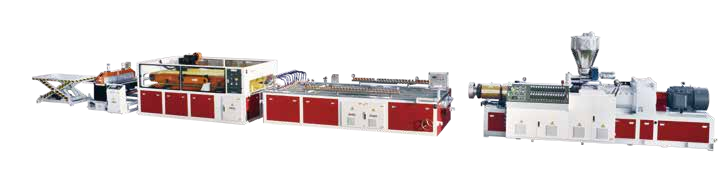
pp-pc-corrugated-sheet-extrusion-line-hero.webp WebP / WebP + AVIF fallback / < 80KB / Hero 主图,需响应式多尺寸 (800/1200/1920px)
PC_PP Corrugated Sheet Line.webp WebP / WebP + AVIF fallback / < 80KB / Hero 画廊第2张
PC Corrugated Plate Extrusion Line.webp WebP / WebP + AVIF fallback / < 80KB / 备用主图
4 张详情图 WebP / WebP + AVIF fallback / < 50KB/张 / 应用场景配图,已存在,需优化尺寸
视频 poster 图 (🆕) — / WebP / < 30KB / FAT 视频封面,首帧截图 + 品牌水印
功能特性配图 ×5 (🆕) — / WebP / < 40KB/张 / F1-F5 技术区块配图

4.1 已有图片资源

文件夹 文件 / 用途 / 状态
主图/ pp-pc-corrugated-sheet-extrusion-line-hero.webp / [C] Hero 画廊 — 主图 1 (整线全景) / ✅
主图/ PC_PP Corrugated Sheet Line.webp / [C] Hero 画廊 — 主图 2 (替代角度) / ✅
主图_merged21/ PC Corrugated Plate Extrusion Line.webp / [C] Hero 画廊 — 备用主图 / ✅
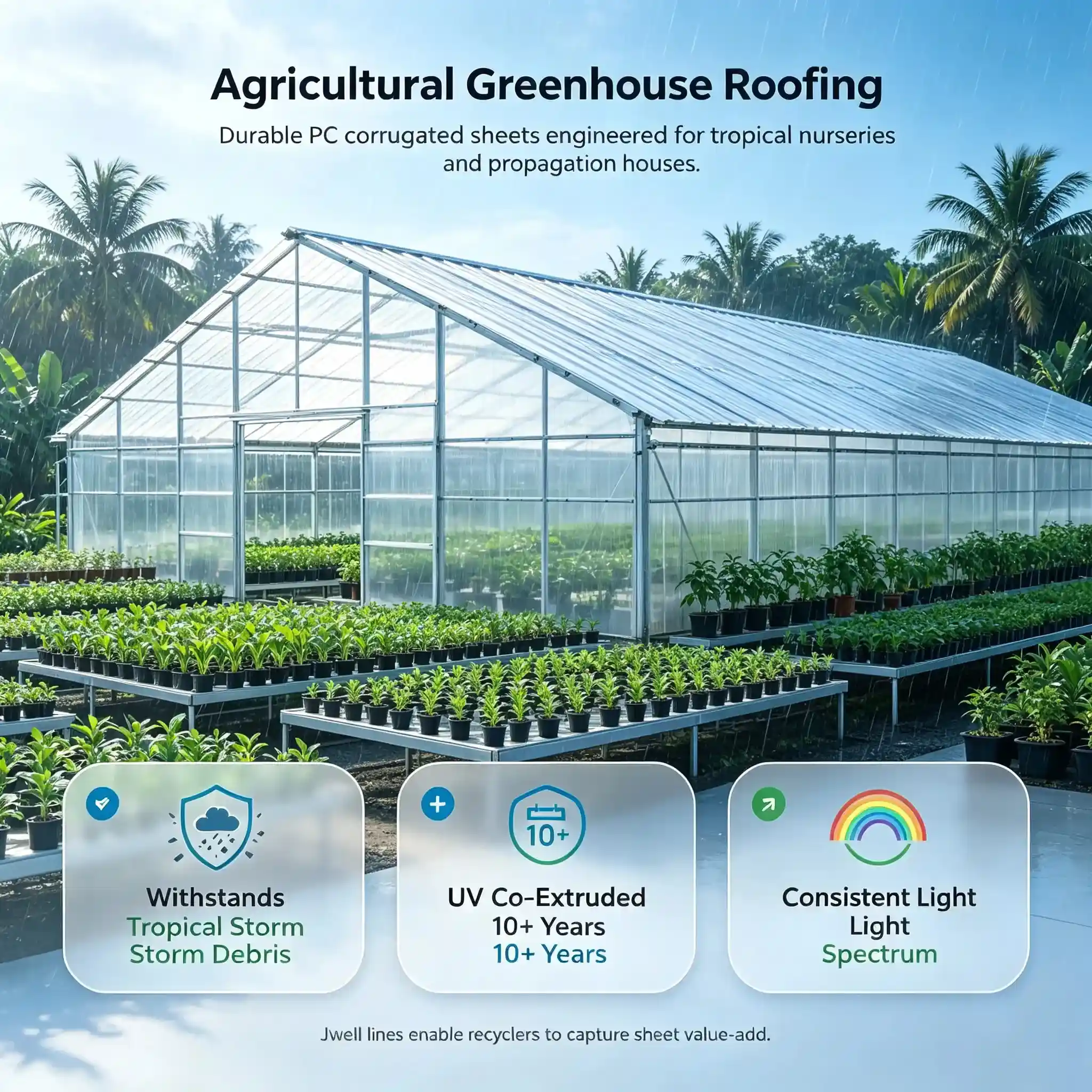
详情图/ agricultural-greenhouse-roofing.webp / [H3] 温室应用场景 / ✅
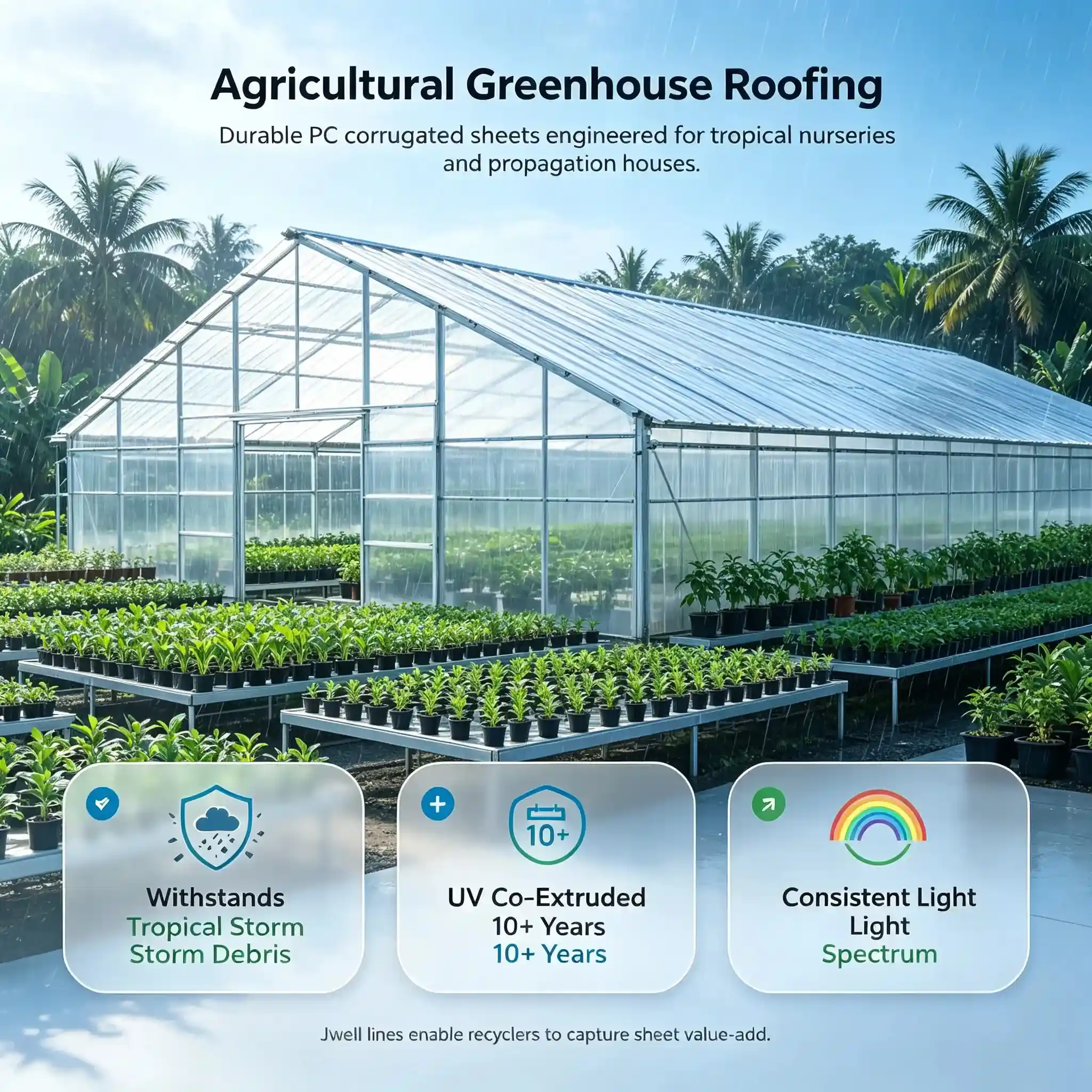
详情图/ agricultural-greenhouse-roofing-1.webp / [H3] 温室应用场景 (备用) / ✅
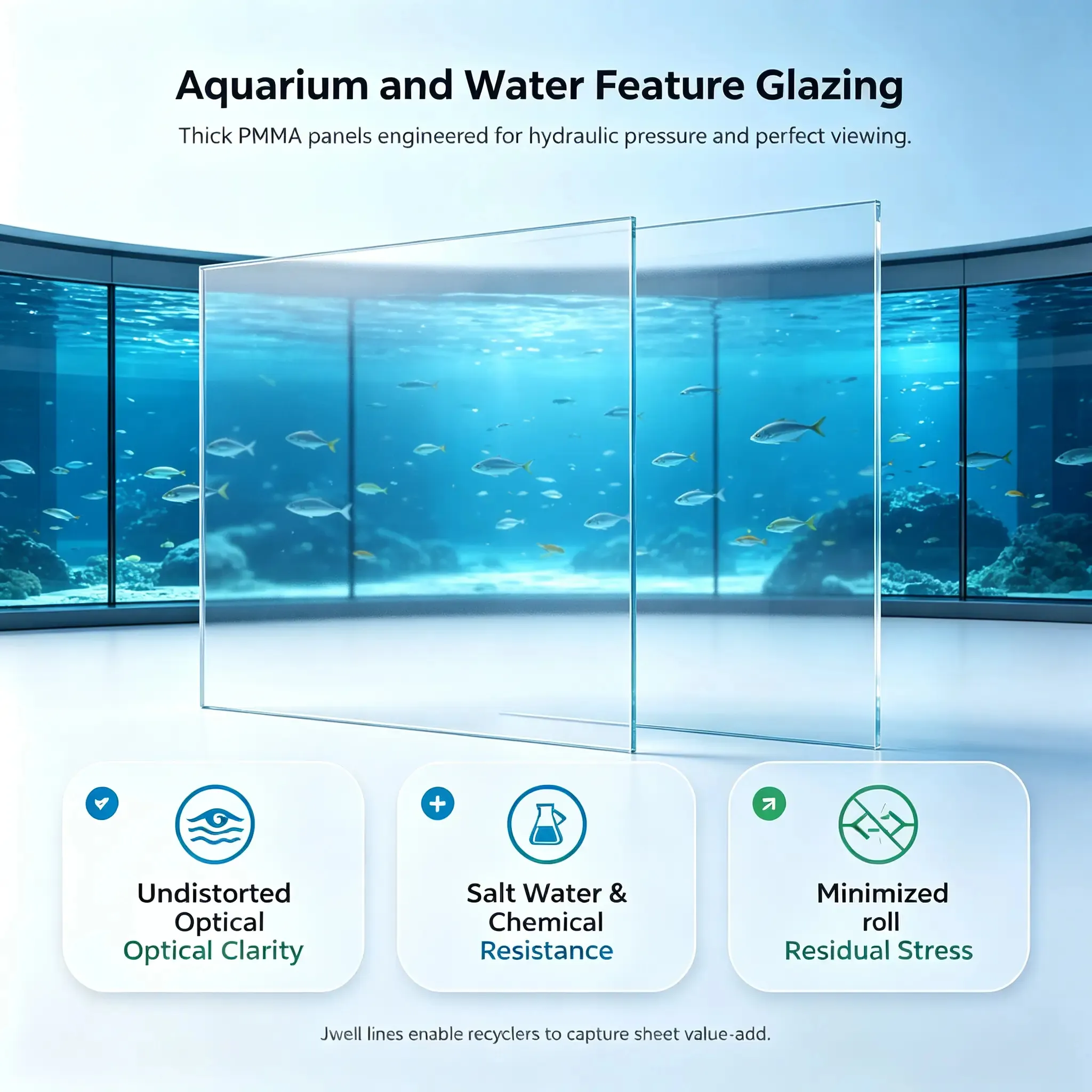
详情图/ aquarium-and-water-feature-glazing.webp / 水族馆/水景应用(暂未使用) / ⚠️
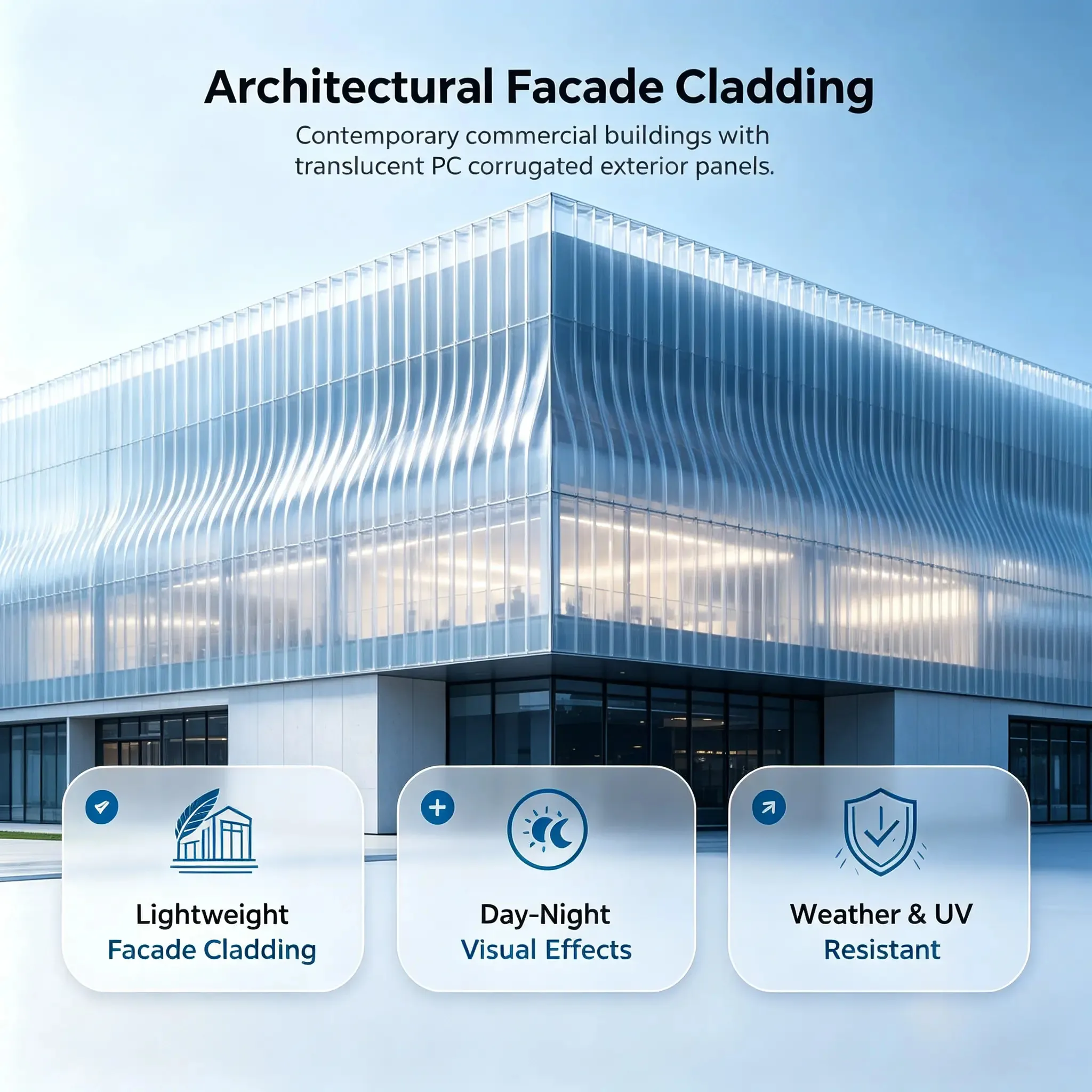
详情图/ architectural-facade-cladding.webp / [H4] 建筑幕墙应用 / ✅
详情图/ airport-canopy-construction.webp / [H1] 机场/体育场馆应用 / ✅

4.2 已有视频资源

文件 用途 / 状态
视频/PC Corrugated sheet line FAT.mp4 [D] Video 1 — FAT 工厂验收视频 / ✅ 需压缩

4.3 详情图资源

文件夹 状态 / 说明
详情图/ ⚠️ 部分充足 / 5 张图,覆盖温室、建筑幕墙、雨棚/体育场馆。缺少车棚/遮阳棚专用场景图

4.4 尚需补充的资源

用途 建议 / 优先级
Hero 画廊图 #3 — 后成型校准站特写 真空校准站近景,展示镀铬成型辊和真空分区 / 🔴 高
Hero 画廊图 #4 — 成品波纹板截面 PC 波纹板横截面特写,展示正弦波和梯形波型 / 🔴 高
[H2] 车棚/遮阳棚专用场景配图 商业停车场或住宅车棚 PC 波纹板安装效果 / 🔴 高
视频 poster 图 FAT 视频封面缩略图,首帧截图 + Jwell 品牌水印 / 🔴 高
FAT 视频压缩版 原视频 → 720p H.264 < 15 MB WebM + MP4 / 🔴 高
F1 后成型校准站配图 真空辊 + 镀铬成型辊 + 冷却水路示意或实拍 / 🟡 中
F2 UV共挤工位配图 共挤模头 + 帽层截面显微照片 (30-60μm) / 🟡 中
F3 波纹工具盒配图 不同型材截面并排对比 + 工具盒更换过程 / 🟡 中
F4 透光率测试配图 分光光度计/ASTM D1003 标准示意 + 镀铬辊光洁度 / 🟡 中
F5 环境工程配图 电控柜品牌组件 + 不锈钢管路 + 冷却系统 / 🟡 中
电控柜内部品牌 logo 条 Siemens/WEG/ABB/Schneider 组合展示 / 🟢 低
相关产品卡片图 ×4 PC Hollow/PC Solid/PVC Corrugated/PMMA 缩略图 / 🟢 低

本页链接到 (Outbound)

目标页面 位置 / 锚文本
PC Hollow Sheet Extrusion Line [K] Related Products / “PC Hollow Sheet Extrusion Line”
PC Sheet Extrusion Line (Solid) [K] Related Products / “PC Sheet Extrusion Line”
PVC Corrugated Board Extrusion Line [K] Related Products / “PVC Corrugated Board Extrusion Line”
PMMA Sheet Extrusion Line [K] Related Products / “PMMA Sheet Extrusion Line”

从其他页面链接到本页 (Inbound)

来源页面 推荐锚文本
Sheet Extrusion Lines 汇总页 “PC Corrugated Sheet Extrusion Line”
Architectural Roofing Solutions 行业页 “PC Corrugated Sheet Production Equipment for Daylighting Roofing”
Greenhouse Solutions 行业页 “PC Corrugated Sheet Line for Agricultural Greenhouse Covering”
Polycarbonate Processing 技术页 “PC Corrugated Profile Manufacturing Equipment”

六、技术数据速查表

数据 用途
Vacuum calibration within 200mm of die exit, ±0.3mm tolerance [F1] Key Feature + FAQ Q6
30-60 micron molecularly bonded UV cap layer [F2] Key Feature + FAQ Q4
88-90% light transmission (ASTM D1003), Ra ≤0.08 µm chrome rollers [F4] Key Feature + [B] Hero
B1 fire rating (DIN 4102), B-s1,d0; Class A option 10-15% throughput reduction FAQ Q3 + [G] Specs
Wind uplift 2.4 kPa / ~220 km/h (18mm/76mm sinusoidal, 400mm centers) FAQ Q2 + [G] Specs
15+ standard profile geometries, 60-90 min cartridge changeover [F3] Key Feature + FAQ Q7
30 min quick-change melt pipe (UV top ↔ color bottom) [F2] Key Feature + [F3] Key Feature
GCC chiller-boosted cooling, 15-20°C process water at 50°C ambient [F5] Key Feature + FAQ Q2
90-min cold start to stable temperature (concurrent barrel + die heating) [F4] Key Feature + FAQ Q7
Marine-grade 316L stainless steel, anodized aluminum construction [F5] Key Feature
Siemens S7-1500 PLC, 16-bit analog, recipe-based changeover, SPC data logging [B] Hero + [J] Why Jwell
WEG motors, ABB VFD, Schneider Electric, ceramic band heaters with PID [G] Specs
38CrMoAlA nitrided screw, HV≥940, 0.5-0.7mm nitriding depth [G] Specs
200-380 kW installed power, 380V/50Hz (440V/60Hz option) [G] Specs
29 years (1997), 8 bases, 3500 emp, 500 engineers, $700M+, 25000+ machines, 1000+ patents, CE, ISO 9001 [B] Hero + [J] Why Jwell + Schema

Sports Stadium & Arena Roofing — 体育场馆采光屋顶

H3: Translucent Stadium Roofing — 500-800 Lux Natural Daylight Without Heat Gain

Alt: PC corrugated sheet panels installed on sports stadium canopy roof providing natural daylight illumination for spectator stands

Major sports facilities across Southeast Asia, the Middle East, and Southern Europe use PC corrugated sheets as translucent roofing over spectator stands, training halls, indoor sports courts, and swimming pool enclosures. The sheets provide natural daylight illumination equivalent to 500-800 lux at midday — sufficient for recreational sports and training activities without supplementary artificial lighting — while eliminating the heat gain penalty of glass glazing.

Key performance requirements met by PC corrugated sheets produced on the Jwell line:

– Impact resistance of 250x glass — eliminates catastrophic shattering risk from ball impacts (tennis, basketball, football) or storm-borne debris; a critical safety consideration for occupied public spaces

– UV-filtering properties that block harmful radiation while transmitting visible light for natural illumination

– Light weight of approximately 1.7 kg/m² at 1.5 mm thickness — reduces structural steel requirements and foundation costs compared to glass roofing

– Wind uplift resistance of 2.4 kPa — meets structural code requirements for large-span canopy structures with high wind exposure

– B1 fire rating per DIN 4102 — satisfies public assembly building fire safety regulations

配图建议: 体育场馆屋顶 PC 波纹板安装全景效果图,展示采光均匀度和跨度结构

Carport & Canopy Construction — 车棚及遮阳棚

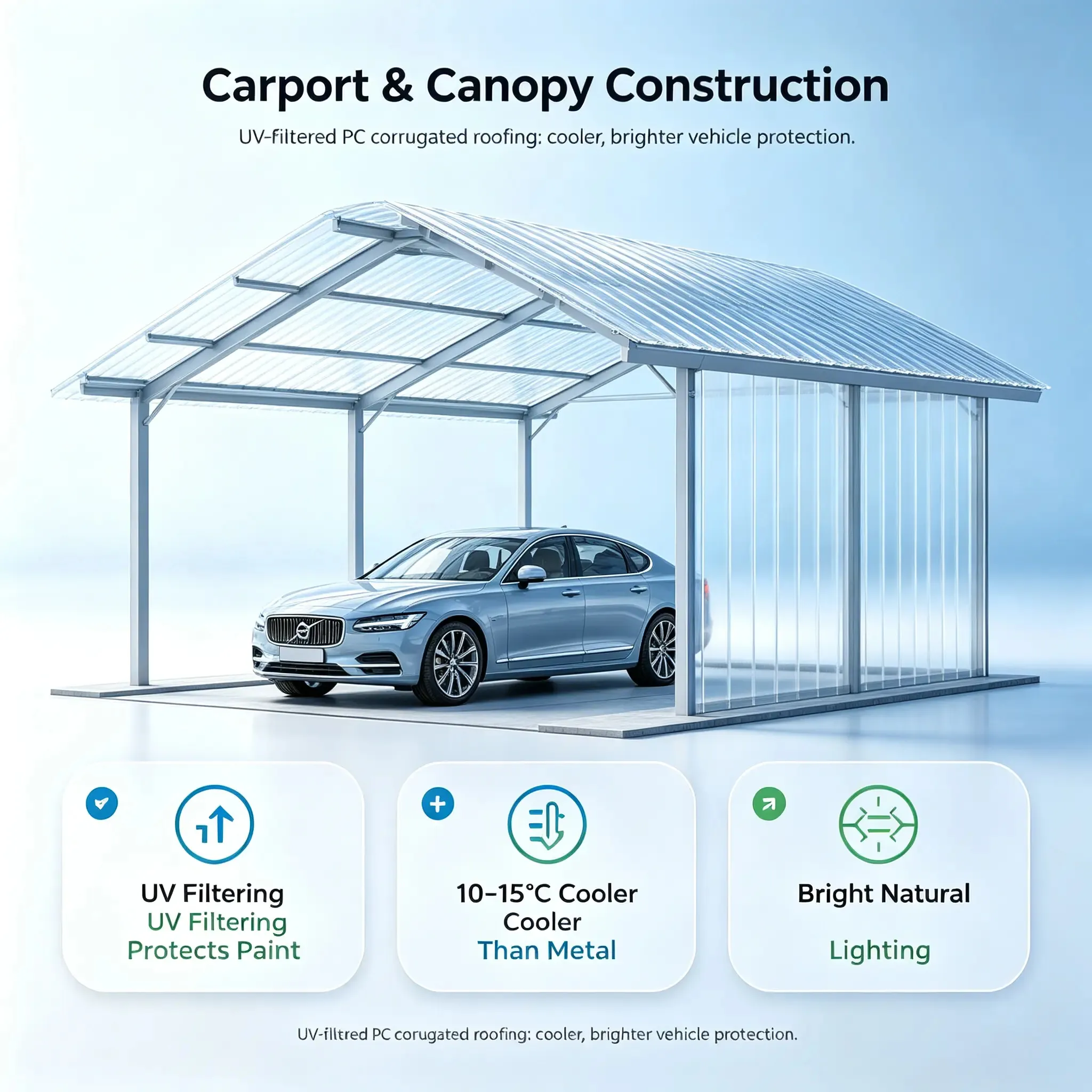
H3: UV-Protected Carport Roofing — 10-15°C Cooler Than Metal Roofing with Vehicle Paint Protection

Alt: PC corrugated sheet panels installed on carport canopy providing UV-protected shaded parking with natural light

Residential and commercial carports, hotel porte-cocheres, petrol station canopies, and outdoor commercial covered spaces increasingly specify PC corrugated sheets. The product’s UV-filtering properties protect vehicle paint from sun damage while maintaining bright, naturally lit spaces that feel open and welcoming — a qualitative advantage that drives customer preference in commercial applications.

Performance advantages specific to carport applications:

– Heat reduction: Reduces heat accumulation under the canopy by 10-15°C compared to metal roofing on sunny days — making carports comfortable for vehicle washing and maintenance activities

– Hail impact resistance: Withstands hailstones up to 25 mm diameter without cracking or perforation — a common failure mode for fiberglass and PVC alternatives

– Light transmission: Provides natural illumination without the hot-spot bright patches characteristic of clear skylight panels — diffused light creates uniform brightness across the covered area

– Color options: Tinted variants (bronze, grey, opal) provide design flexibility for architectural coordination with building aesthetics

配图建议: 商业停车场/酒店车道 PC 波纹板遮阳棚安装效果,展示光线透过效果和建筑融合度

Frequently Asked Questions

How does the profile geometry affect wind uplift resistance in roofing applications? -

Profile depth, pitch, and the radius of the wave crest all influence wind uplift performance. Deeper profiles and smaller pitch (more waves per meter of sheet width) provide higher structural stiffness, which directly improves wind uplift resistance. Jwell’s engineering team works with customers to select or design profile geometries that meet local building code requirements. As a reference, our standard 18 mm deep sinusoidal profile at 76 mm pitch, when properly fastened at 400 mm centers with Jwell-recommended fasteners (stainless steel screws with EPDM sealing washers), has been tested to withstand wind uplift pressures of 2.4 kPa, equivalent to approximately 220 km/h wind speeds. This exceeds the requirements for Category 3 cyclone regions under most national building codes. For higher wind-load regions, a 25 mm trapezoidal profile at 63 mm pitch with 300 mm fastener spacing can extend wind uplift capacity to approximately 3.5 kPa.

Can Jwell's PC corrugated sheet line handle high-temperature operating environments without compromising product quality? +

Yes. The line’s cooling system is designed with 30% excess thermal capacity beyond nominal requirements, and the electrical cabinets include active ventilation cooling with temperature-controlled exhaust fans rated for ambient temperatures up to 50°C. For customers in Gulf Cooperation Council (GCC) countries where factory ambient temperatures routinely exceed 45°C, Jwell can supply a chiller-boosted cooling configuration that maintains process water at the 15-20°C range required for proper polycarbonate solidification. The chiller circuit is independent of the standard cooling loop and sized to handle the combined heat load of PC melt cooling plus ambient heat gain at 50°C factory conditions. Motor drives (ABB VFD series) and PLC components are selected with extended temperature ratings. Marine-grade 316L stainless steel construction for all water-contact components prevents corrosion accelerated by high ambient temperatures.

What fire rating classifications can PC corrugated sheets produced on this line achieve? +

Standard polycarbonate grades processed on Jwell lines achieve a B1 fire rating per DIN 4102 (equivalent to Euroclass B-s1,d0), which is accepted for most architectural roofing applications including public assembly buildings. For projects requiring higher fire performance — such as high-rise building roofing, enclosed atria, or jurisdictions with elevated fire safety requirements — the line can process specialty flame-retardant PC compounds that achieve Euroclass B-s1,d0 or ASTM E84 Class A ratings. Note that FR-grade PC compounds typically have 15-25% higher melt viscosity than standard PC grades, which reduces throughput rates by 10-15%. The Jwell screw design’s barrier section and the melt pump’s pressure decoupling are particularly valuable when processing FR grades, as they maintain consistent melt delivery to the die despite the higher viscosity — preventing the die-head pressure fluctuations that cause incomplete rib fill or wall-thickness variation.

How does Jwell's co-extruded UV protection compare to bulk-UV addition and post-coating approaches in terms of long-term panel performance? +

These three UV protection strategies represent fundamentally different levels of durability and cost-effectiveness:

Bulk-UV Addition: UV absorber is mixed into the entire PC resin batch before extrusion. While this is the simplest approach (no additional equipment required), approximately 95% of the expensive UV absorber is distributed through the 1.5-2.0 mm sheet thickness where it provides no protective function — UV radiation penetrates only the top 30-60 microns. Additive cost is 60-70% higher than co-extrusion for equivalent UV-blocking performance. More critically, the absorbed UV energy is dissipated as heat throughout the sheet cross-section, contributing to thermal degradation of the base PC polymer.

Post-Manufacture Coating: UV-blocking lacquers are spray-applied or roller-applied to the finished sheet surface. These coatings are mechanically adhered films that exist as a discrete layer. Under outdoor thermal cycling (30-50°C daily temperature swings), the differential thermal expansion between the coating resin and the PC substrate creates cyclic shear stress at the interface. Coating delamination — peeling, flaking, blistering — typically begins after 3-7 years. Once delamination initiates at a single point, moisture penetrates the gap and accelerates propagation.

Co-Extruded UV Cap Layer (Jwell Method): The UV-absorbing layer is co-extruded onto the sheet surface during production. Because both the cap layer and the base sheet are polycarbonate, they share identical thermal expansion coefficients — eliminating the delamination mechanism. The molecular integration at the interface (PC chains from the base sheet entangle with PC chains in the cap layer during melt-phase contact) creates a bond that cannot fail mechanically. The 30-60 micron cap layer concentrates UV absorber precisely where it is needed, reducing additive cost by 60-70% compared to bulk addition. This is the only UV protection method capable of delivering 10+ year outdoor weatherability without performance degradation.

What considerations affect the choice between sinusoidal and trapezoidal profile geometries for different regional markets? +

The choice between sinusoidal and trapezoidal profiles involves a trade-off between aesthetics, water drainage, and structural stiffness:

Sinusoidal Profiles (smooth, continuous curved waves):

– Preferred in European and Middle Eastern markets

– Aesthetic preference: the flowing curves complement contemporary architectural design language

– Superior water drainage: the continuous curve channels water to the wave trough without the flow disruption at the flat-crest-to-angled-web transition of trapezoidal profiles

– Lower profile height for equivalent structural performance (shallower waves = less material per linear meter)

– Preferred for architectural applications where appearance is a primary specification criterion

Trapezoidal Profiles (flat crests connected by angled webs):

– Standard in Southeast Asian, Latin American, and Australasian markets

– Higher structural stiffness per unit weight: the angled web geometry provides approximately 20-30% greater section modulus than sinusoidal profiles of equivalent depth and pitch

– Superior wind uplift resistance for storm-prone regions

– Compatible with existing metal roofing profiles — trapezoidal PC sheets can be integrated into metal roofing installations as daylighting strips between steel panels

– Preferred for industrial and agricultural applications where structural performance is the primary criterion

The Jwell line’s interchangeable cartridge system accommodates both profile families. We recommend customers entering new export markets to invest in tooling for the locally preferred profile geometry — the market acceptance barrier for unfamiliar geometries is surprisingly high, and regions that have standardized on trapezoidal profiles for decades will not readily adopt sinusoidal alternatives regardless of technical merit.

Related Sheet Extrusion Lines

WPC Flooring Production Line

WPC Flooring Production Line

Extruder Type: Conical twin-screw, vented; Screw Material: 38CrMoAlA, nitrided, bimetallic optional; Screw Structure: Conical twin, designed for PVC + wood flour + CaCO₃ + foaming agent; L/D Ratio: Optimized for controlled foaming zone

Learn More ➔
SPC Flooring Production Line

SPC Flooring Production Line

Screw Diameter: Φ 80 mm / Φ 92 mm / Φ 110 mm / Φ 180 mm; Output (24h, SPC): 6-8 T / 12-18 T / 25-32 T / 70-100 T; Line Speed at 4 mm: 0.4-0.6 m/min / 0.8-1.3 m/min / 1.8-2.4 m/min / 5-9 m/min; Screw Material: 38CrMoAlA, nitrided, bimetallic optional / ← Same / ← Same / ← Same

Learn More ➔

Why Choose Jwell for Your PET Sheet Line

🏭

Factory/Experience

Jwell has manufactured PET sheet extrusion equipment since 2005, accumulating field data from over 400 installed PET lines worldwide. Each new machine generation incorporates refinements validated across hundreds of real production environments — not just lab prototypes.

🔬

Test/Validate

Our Changzhou facility operates a full production-scale PET line for customer trials. Bring your raw materials and target specifications — we run your recipe before you commit. The line delivered to your factory is a proven configuration, eliminating startup risk.

🌍

Service/Support

Factory-trained Jwell engineers based in Brazil, Spain, Mexico, and Shanghai travel to customer sites for installation and operator training. Remote diagnostic support via WeChat/WhatsApp responds within 2 hours. Critical spares ship from Shanghai within 48 hours.

Request a Quote or Technical Consultation

Your information will never be shared with third parties.