
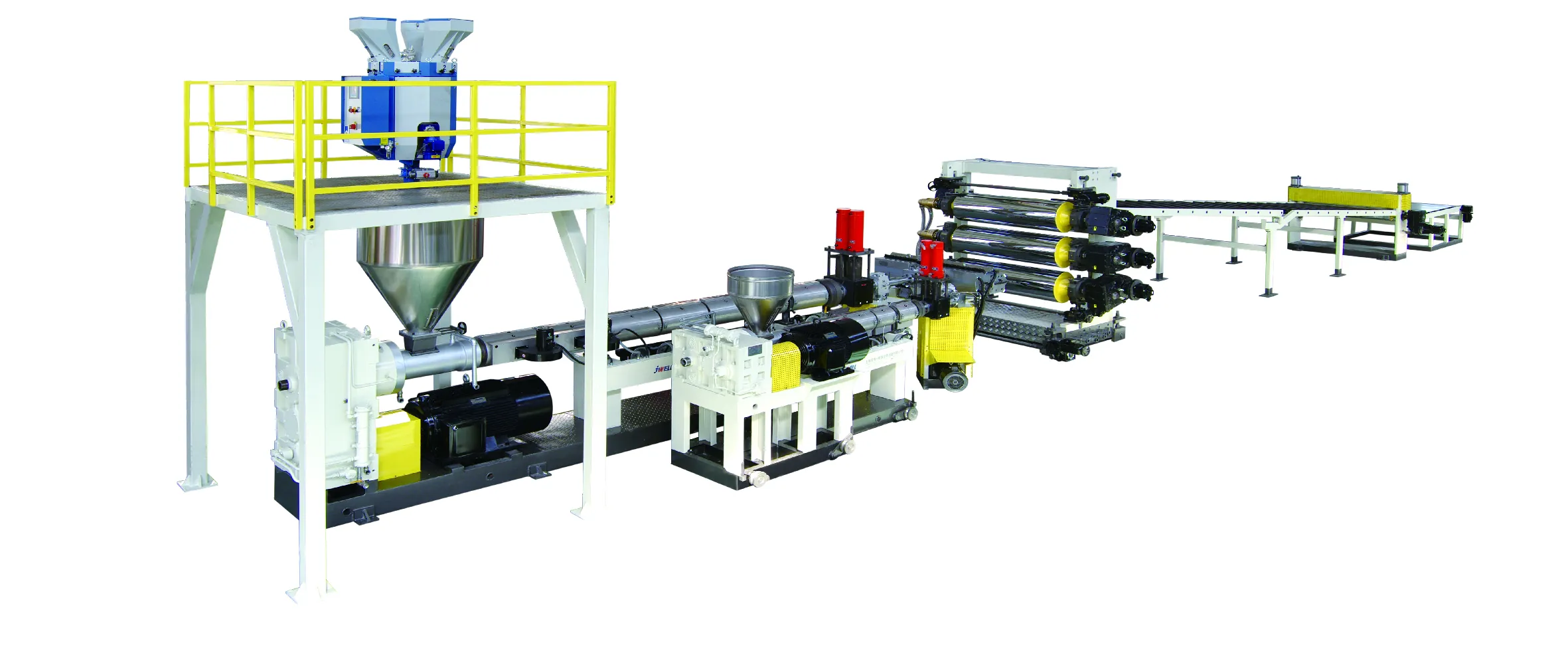
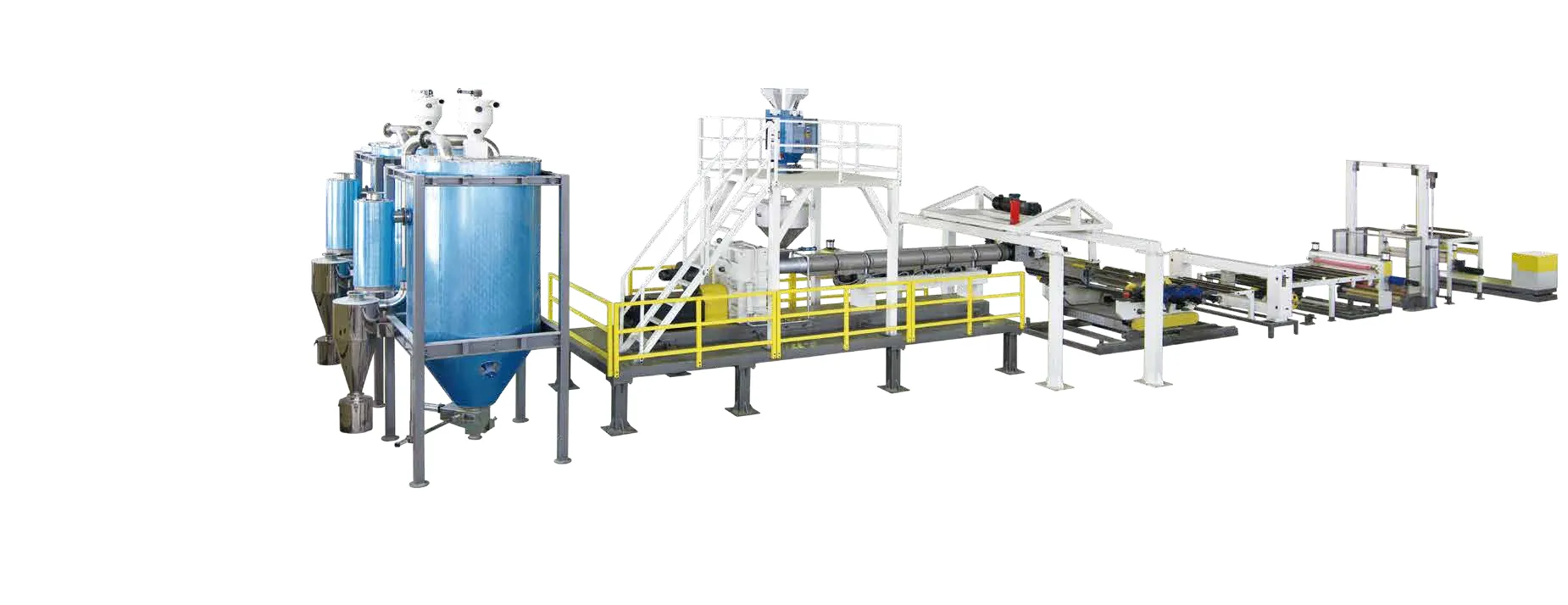
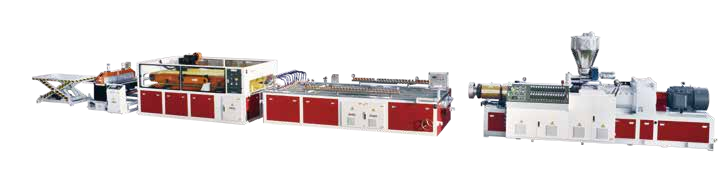
PMMA Plate Extrusion Line

Single-screw extruder | 200-500 kg/h | 2.0-15.0 mm | Width 1200-2100mm | 42CrMo mirror-polish Ra≤0.016μm | ±0.5°C roller control

See the PMMA Plate Extrusion Line in Action

Factory Acceptance Test — PMMA Plate Extrusion Line

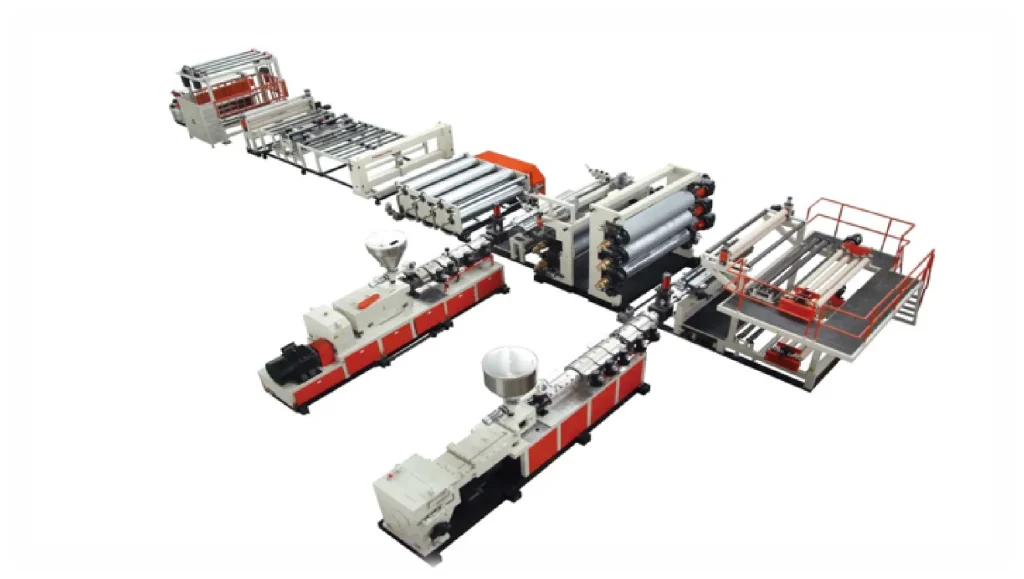
Complete production demonstration during FAT at Jwell’s manufacturing facility. Watch the full process from raw material feeding through extruder, melt pump, screen changer, T-die, three-roll calendar, cooling bracket, coating unit, haul-off, cross cutting, longitudinal cutting, and conveyor — the complete PMMA thick acrylic plate production sequence.

PMMA Plate Extrusion Line: Related JWELL Extrusion Lines

The PMMA Plate Extrusion Line is part of JWELL’s complete extrusion portfolio. Customers evaluating this PMMA Plate Extrusion Line also frequently request our PMMA Sheet Extrusion Line | Jwell Machinery and GPPS Plate Extrusion Line | Jwell Machinery, which share the same proven screw, die and control platforms. For layout drawings, pricing and lead times, contact JWELL Machinery directly.

# Item Key Point
1 🌀 **2-15mm Thick Plate Capability** thicker than PMMA sheet line (0.5-5mm), serving structural & glazing applications
2 ⚡ **42CrMo Mirror-Polish Rollers** Ra≤0.016μm, HRC58-62, chrome 0.08mm, coaxiality ≤0.005mm
3 🎯 **±0.5°C Roller Temperature Accuracy** individual closed-loop temp control across full face width
4 🔄 **Dual Cutting System** cross cutting + longitudinal cutting for finished plate dimensions inline
5 🔧 **In-Line Protective Film Coating** integrated coating unit applies protective film to both surfaces during extrusion
6 ✅ **PMMA/GPPS Dual-Material Platform** processes both amorphous polymers with PLC recipe change
7 ♻️ **Premium Melt Pump Options** Jwell self-developed / Maag Switzerland / Nordson USA
8 🌍 **29 Years, 25000+ Machines** Jwell’s extrusion expertise since 1997, CE & ISO-9001 certified

Optical-Grade Single-Screw Extruder — 38CrMoAlA Nitrided, Large-Diameter Low-Speed Design for Thick Plate

The Jwell PMMA/GPPS plate extrusion line is built around a precision single-screw extruder available in 120 mm and 130 mm screw diameter configurations, each engineered specifically for the thermal and rheological demands of thick PMMA plate processing. PMMA is an amorphous polymer with a narrow processing window — melt temperatures must be held within 220-250°C to achieve the flow characteristics needed for optical-quality plate without degrading the polymer chain. Excessive shear heat from high-speed screw operation can push melt temperature above 260°C, causing silver streaks, bubbles, and yellowing in finished plate that destroy the optical clarity which is PMMA’s primary value proposition.

For thick plate production (2-15 mm), the extruder operates at significantly lower screw speeds (15-30 rpm) than thin sheet lines (60-80 rpm) to match the reduced line speed. This lower screw speed requires careful attention to melt temperature — reduced shear heating means barrel heater output must compensate — but it also reduces thermal degradation risk, which is critical for thick sections where any melt inhomogeneity becomes visible through the plate thickness.

The screw is manufactured from 38CrMoAlA nitrided steel with a nitrided layer depth of 0.5-0.7 mm, achieving surface hardness of HV>=740 on the screw flights and HV>=940 on the barrel interior. This nitriding treatment diffuses nitrogen into the steel surface, creating a hard, wear-resistant layer that does not chip or flake like chrome plating — a critical durability advantage for continuous PMMA production where any surface degradation on the screw creates melt stagnation zones that produce discolored streaks in the plate. Under standard PMMA processing conditions, the screw and barrel provide 5-7 years of service life.

配图建议: 单螺杆挤出机主机近景,标注螺杆直径和喂料系统

Precision Three-Roll Calendar — 42CrMo Rollers, HRC58-62, Ra≤0.016μm, ±0.5°C Control

The three-roll calendar is the primary determinant of PMMA plate surface quality, thickness uniformity, and optical clarity — and Jwell’s roller specifications place it in the top tier of global acrylic plate extrusion line manufacturers. Each roller is manufactured from 42CrMo forged steel, a chromium-molybdenum alloy steel that provides high hardenability, excellent toughness, and dimensional stability under the thermal cycling inherent in PMMA processing.

Key roller specifications:

For PMMA plate, the roller surface finish is the single most critical factor in determining the plate’s surface quality. PMMA reproduces the roller surface with near-perfect fidelity — any imperfection on the roll surface transfers directly to the plate. Jwell’s Ra≤0.016 μm mirror finish, achieved through multi-stage grinding followed by diamond-paste lapping and final optical-polish inspection under 500-lux diffused light, produces PMMA plate with a glossy, glass-like surface that requires no post-extrusion polishing for aquarium, glazing, and furniture applications.

The coaxiality specification of ≤0.005 mm — five microns — is critical for thickness uniformity in thick plate. PMMA plate used in aquarium windows and architectural glazing requires thickness variation of ±3% or less; even a 0.01 mm roll runout creates visible thickness bands in transparent acrylic plate. Jwell’s precision machining capability holds coaxiality to half the tolerance budget, providing margin for thermal expansion and bearing wear over the roller’s service life.

Roller temperature is controlled to ±0.5-1°C across the full face width by individual closed-loop pressurized water circuits for each roll. This precision eliminates the gloss variation bands that appear as visible stripes on PMMA plate when roll temperature is non-uniform — a defect that is immediately apparent under showroom lighting and causes full-plate rejection by quality-conscious customers.

配图建议: 三辊压光机近景,展示镜面辊筒表面

Multi-Zone Cooling Bracket — Controlled Solidification for 2-15mm Thick PMMA Plate

Thick PMMA plate (2-15 mm) requires a substantially longer cooling path than thin sheet (0.5-5 mm). The centerline of a 10 mm plate may remain above the glass transition temperature (Tg ≈105°C) for several minutes after the surfaces have solidified on the roll stack. If the plate cools too rapidly or non-uniformly, differential shrinkage creates internal stress that can cause warping, spontaneous cracking, or optical distortion — failure modes particularly dangerous in structural applications such as aquarium windows and architectural glazing.

Jwell’s PMMA plate line features an extended multi-zone cooling bracket after the three-roll calendar. Each zone is individually temperature-controlled, with the zone temperatures following a calculated decay curve — the first zones maintain temperature close to the roll exit temperature, and subsequent zones reduce temperature gradually. This controlled cooling rate ensures that the temperature difference between plate surface and core never exceeds the critical threshold that induces permanent stress.

The cooling bracket includes edge cutters that trim the plate edges to final width, removing the thicker edge beads that form at the die edges. For thick plate, edge trimming is particularly important because thick edge beads are difficult to cut cleanly in a secondary operation and represent material waste if not removed inline.

For the thickest plate gauges (10-15 mm), Jwell offers an extended cooling configuration with additional zones and a longer total cooling path, ensuring that the plate reaches ambient temperature without residual thermal stress before the cutting operations.

配图建议: 冷却托架近景,展示多区温控系统

In-Line Protective Film Coating Unit — Dual-Surface Lamination During Extrusion

PMMA acrylic plate is valued for its pristine, glossy surface — and that surface is extraordinarily vulnerable to scratching during handling, transportation, and fabrication. Unlike polycarbonate, which can be hard-coated post-extrusion, PMMA’s surface hardness (Rockwell M95) is inherent and cannot be enhanced. Any scratch that occurs between the extrusion line and the end customer represents a quality loss that cannot be recovered.

Jwell integrates a protective film coating unit directly into the extrusion line, positioned after the cooling bracket and before the haul-off unit. This unit applies a thin polyethylene (PE) protective film to both surfaces of the PMMA plate during production — the film is bonded to the plate surface by the residual heat from the extrusion process, requiring no adhesive that could transfer to or contaminate the acrylic surface. The film remains on the plate through all downstream cutting, stacking, packaging, and transportation operations, and is peeled off by the end customer immediately before fabrication or installation.

For PMMA plate destined for premium applications — aquarium windows, architectural glazing, furniture panels — the protective film is not an optional accessory but a production necessity. Plate that arrives at the converter with surface scratches from unprotected handling is rejected, representing a total material and processing loss. The integrated coating unit eliminates this risk by ensuring that every square meter of PMMA plate produced on the Jwell line is protected from the moment it leaves the roll stack to the moment it reaches the fabricator.

配图建议: 覆膜单元近景,展示双面保护膜贴合过程

Technical Specifications

Extruder

Parameter Specification
Extruder Type Single-screw, large-diameter low-speed design
Screw Diameter Options 120 mm / 130 mm
Screw Material 38CrMoAlA nitrided steel
Nitrided Layer Depth 0.5-0.7 mm
Screw Surface Hardness HV >=740
Barrel Surface Hardness HV >=940
Feeder Type Volumetric feeder
Design Philosophy Large diameter, low speed, high plasticizing efficiency

Melt Pump & Screen Changer

Parameter Specification
Melt Pump Brand Options Jwell (self-developed) / Maag (Switzerland) / Nordson (USA)
Screen Changer Type Hydraulic, continuous operation
Screen Changer Configuration Single-column or double-column
Screen Panel Options Single-panel or double-panel, double working position
Screen Change Time <2 seconds (double-position design)

Die

Parameter Specification
Die Type Coat-hanger manifold, flexible-lip
Die Material High-quality mold steel
Flow Channel Chrome Plating 0.03-0.05 mm
Die Cavity Surface Roughness Ra 0.1 μm
Die Lip Surface Roughness Ra 0.05 μm

Roller (Three-Roll Calendar)

Parameter Specification
Configuration Three-roll vertical calendar
Roll Material 42CrMo forged steel
Coaxiality ≤0.005 mm
Surface Roughness Ra ≤0.016 μm (mirror polish)
Surface Hardness HRC 58-62
Chrome Plating 0.08 mm
Temperature Deviation ±0.5-1°C across full face width

Production Parameters

Parameter Specification
Materials PMMA (acrylic), GPPS
Output Capacity 200-500 kg/h (configuration & material dependent)
Plate Thickness Range 2.0-15.0 mm
Plate Width 1,200-2,100 mm
Thickness Tolerance ±1.5% (with optional thickness gauge)
Light Transmission ≥92% at 3mm thickness
Haze <1.0% at 3mm
Gloss at 60° >130 GU
Downstream Equipment Cooling bracket + edge cutters → Coating unit → Haul-off → Cross cutting → Longitudinal cutting → Conveyor → Stacker
Control System Centralized electrical cabinet, PLC-controlled
Certifications CE, ISO 9001

[I] PLATE vs SHEET COMPARISON — 厚板与薄片产线对比

Property PMMA Plate Line (This Page) / PMMA Sheet Line
Thickness Range 2.0-15.0 mm / 0.5-5.0 mm
Max Width 2,100 mm / 2,500 mm
Output Capacity 200-500 kg/h / 200-500 kg/h
Screw Speed 15-30 rpm (low speed for thick plate) / 60-80 rpm
Roller Diameter 500-600 mm (larger for thick plate contact arc) / 300-400 mm
Cooling Section Extended multi-zone, controlled decay curve / Standard length
Downstream Cross cut + longitudinal cut → conveyor → stacker / Typically winder or cut-to-length
Primary Applications Aquarium windows, glazing, sanitary ware, furniture / Signage, LED lighting, display, light guide panels
Material Format Flat cut sheets (finished dimensions) / Rolls or cut sheets
Optical Quality ≥92% transmission, haze <1.0%, Ra≤0.016μm / ≥92% transmission, haze <1.0%, Ra≤0.016μm
Roller Precision 42CrMo, ≤0.005mm coaxiality, ±0.5°C / 42CrMo, ≤0.005mm coaxiality, ±0.5°C

[J] MARKET POSITION — PMMA厚板市场定位

维度 PMMA Plate 线定位 / 说明
Thickness Differentiation 2-15mm thick plate vs 0.5-5mm sheet / Serves structural & glazing markets inaccessible to sheet lines
Material Versatility PMMA + GPPS dual-material / Both amorphous polymers, same extruder with recipe change
Application Premium Aquarium + architecture + sanitary + furniture / Markets where optical quality and structural integrity intersect
Optical Quality ≥92% transmission, haze <1.0%, Ra≤0.016μm / Mirror-polish roller quality matching cast acrylic at lower cost
Fabrication Advantage Cut, polished, solvent-bonded, thermoformed / Thermoplastic processing flexibility vs glass
Weight Advantage ~50% lighter than equivalent glass / Easier installation, reduced structural load

[L] RELATED PRODUCTS 相关产品

卡片 产品名称 / 链接 / 关系
1 PMMA Sheet Extrusion Line / /sheet-extrusion/pmma-acrylic-sheet-extrusion-line/ / 同材料薄片产线(0.5-5mm),互补厚度范围
2 GPPS Plate Extrusion Line / /sheet-extrusion/gpps-plate-extrusion-line/ / 同线可加工GPPS材料,厚板应用互补
3 PC Sheet Extrusion Line / /sheet-extrusion/pc-sheet-extrusion-line/ / 同类透明板材,建筑glazing应用互补

[N] INQUIRY FORM 询价表单

# 字段 / 类型 / 必填 / 说明
1 Name / text / ✅ / placeholder: “Your full name”
2 Email / email / ✅ / placeholder: “your@company.com”
3 Country / select / ✅ / 200+国家
4 Phone / tel / — / 含国际区号
5 Company / text / — / placeholder: “Your company name”
6 Target Material / select / ✅ / PMMA / GPPS / Both / Not sure
7 Application / select / ✅ / Aquarium Windows / Protective Barriers / Architectural Glazing / Sanitary Ware / Furniture / Multiple / Other
8 Required Output (kg/h) / select / ✅ / <200 / 200-350 / 350-500 / >500 / Not sure
9 Plate Thickness (mm) / select / — / 2-5 / 5-8 / 8-12 / 12-15 / Not sure
10 Required Plate Width (mm) / select / — / <1200 / 1200-1600 / 1600-2100 / >2100 / Not sure
11 Screw Diameter Preference / select / — / 120mm / 130mm / Not sure / Recommend for me
12 Melt Pump Preference / select / — / Jwell / Maag (Switzerland) / Nordson (USA) / Not sure / Recommend for me
13 Message / textarea / — / placeholder: “Tell us about your production requirements, target markets, and any special material grades…”
CAPTCHA / — / ✅ / reCAPTCHA v3
Submit / submit / — / “Request Quote & Configuration”

4.1 On-Page 元素

# 检查项 / 状态
1 唯一 H1,含完整产品名 + 核心关键词 / ✅
2 H2 技术关键词覆盖: PMMA plate, thick acrylic, single-screw, melt pump, T-die, 42CrMo roller, mirror-polish / ✅
3 规格表为 HTML <table> 文本 / ✅
4 所有图片有描述性 alt 属性 / ✅
5 面包屑用 Schema BreadcrumbList / ✅
6 FAQ 用 Schema FAQPage (6个Q&A) / ✅
7 产品信息用 Schema Product + 详细 Organization / ✅
8 视频用 Schema VideoObject + 本站托管 / ✅
9 Plate vs Sheet Comparison 区块覆盖厚板/薄片对比关键词 / ✅
10 Canonical 自引用 / ✅
11 Title tag 50-60 chars / ✅
12 Meta description 含性能数据 + 关键词 / ✅
13 Open Graph 完整 / ✅

4.2 E-E-A-T 信号强化

信号 体现方式
Experience 25000+ 产线交付、29年行业经验、120+国家安装
Expertise 38CrMoAlA氮化螺杆自研、42CrMo镜面辊筒Ra≤0.016μm全自产、1000+专利
Authoritativeness 8大生产基地、3500员工、$700M年营收、ISO/CE认证
Trustworthiness CE + ISO 9001认证、全球工程师认证体系、48小时备件发货、FAT出厂检测

4.3 技术性能

检查项 目标值
LCP < 2.5s
CLS < 0.1
INP < 200ms
Mobile-friendly
图片格式 WebP (已满足)

5.1 已有图片资源

文件夹 文件 / 用途 / 状态
主图/ pmma-plate-extrusion-line-hero-01.webp / [C] Hero 画廊 — 主图 / ✅
主图/ pmma-plate-extrusion-line-hero-02.webp / [C] Hero 画廊 — 主机特写 / ✅
详情图/ pmma-plate-extrusion-line-architectural-glazing-structural-panels.webp / [H1] 水族馆与防护屏障应用 / ✅
详情图/ pmma-plate-extrusion-line-architectural-glazing-structural-panels-1.webp / [H2] 建筑glazing应用 / ✅
详情图/ pmma-plate-extrusion-line-swimming-pool-and-water-feature-windows.webp / [H3] 卫浴应用 / ✅
详情图/ pmma-plate-extrusion-line-swimming-pool-and-water-feature-windows-1.webp / [H4] 家具与装饰面板应用 / ✅

5.2 已有视频资源

文件 用途 / 状态
视频/PMMA Plate extrusion line FAT.mp4 [D] FAT 视频 / ✅

5.3 尚需补充的资源

用途 建议 / 优先级
F1 单螺杆主机配图 挤出机主机 + 螺杆特写,标注 38CrMoAlA 材质和氮化层 / 高
F2 三辊压光配图 压光辊近景,展示镜面表面和温度控制系统 / 高
F3 冷却托架配图 多区温控冷却段近景 / 高
F4 覆膜单元配图 覆膜单元近景,展示双面保护膜贴合过程 / 中
F5 切割系统配图 横切 + 纵切单元组合照片 / 中
F6 全球组件配图 熔体泵 + 换网器 + T-die + 电控柜组合照片 / 中
FAT 视频封面图 PMMA plate FAT 视频的 poster 图 / 高
Hero 画廊补充图 补充主机特写、压光段、电控系统等角度照片(当前仅2张主图) / 高
相关产品卡片图 PMMA Sheet/GPPS Plate/PC Sheet 缩略图 / 中

本页链接到 (Outbound)

目标页面 位置 / 锚文本
PMMA Sheet Line [L] Related Products / “PMMA Sheet Extrusion Line”
GPPS Plate Line [L] Related Products / “GPPS Plate Extrusion Line”
PC Sheet Line [L] Related Products / “PC Sheet Extrusion Line”
Sheet Extrusion Pillar Page [A] Breadcrumb / “Sheet Extrusion”

从其他页面链接到本页 (Inbound)

来源页面 链接上下文
Sheet Extrusion Pillar Page 片材挤出分类页
Aquarium & Architectural Glazing Solutions 水族馆与建筑glazing方案页
Thick Plate Processing Guide 厚板加工概览
PMMA Sheet Extrusion Line 厚板/薄片产线对比

八、与 ABS 线页面结构的关键差异

维度 ABS 线 / PMMA Plate 线
Hero 卖点重点 市场份额 + 客户规模(90%份额 + 300线 + 海尔) / 厚度差异化 + 辊筒精度(2-15mm + Ra≤0.016μm + ±0.5°C)
标签页数 5 个 (+Case Studies) / 4 个(无Case Studies)
功能区块 8 个(冰箱高产能 + 自动化堆垛 + 共挤) / 6 个(厚板冷却 + 覆膜 + 双切割 + 厚板挤出)
视频数 2 个 (FAT + 案例) / 1 个 (FAT only)
独特区块 Case Studies [I] + Market Position (客户数据) / Plate vs Sheet Comparison [I] (厚板vs薄片对比)
FAQ 重点 冰箱线产能 + ABS干燥 + 全球服务 / 厚板vs薄片差异 + GPPS兼容性 + 辊筒精度 + 板宽板厚
表单字段 11 个 (Application + Timeline) / 13 个 (+Plate Width + Screw/Melt Pump Preference)
E-E-A-T 重心 市场地位 + 规模验证 / 技术精度 + 厚板专业性
特色数据 300+冰箱线 + 90%份额 + 海尔20年 / 2-15mm厚板 + Ra≤0.016μm + ±0.5°C + 42CrMo
应用首位 Refrigeration (冰箱板) / Aquarium Windows (水族馆窗口)
产能定位 300-3000 kg/h (volume-driven) / 200-500 kg/h (precision-driven)
厚度范围 0.5-6.0 mm / 2.0-15.0 mm (thick plate specialist)

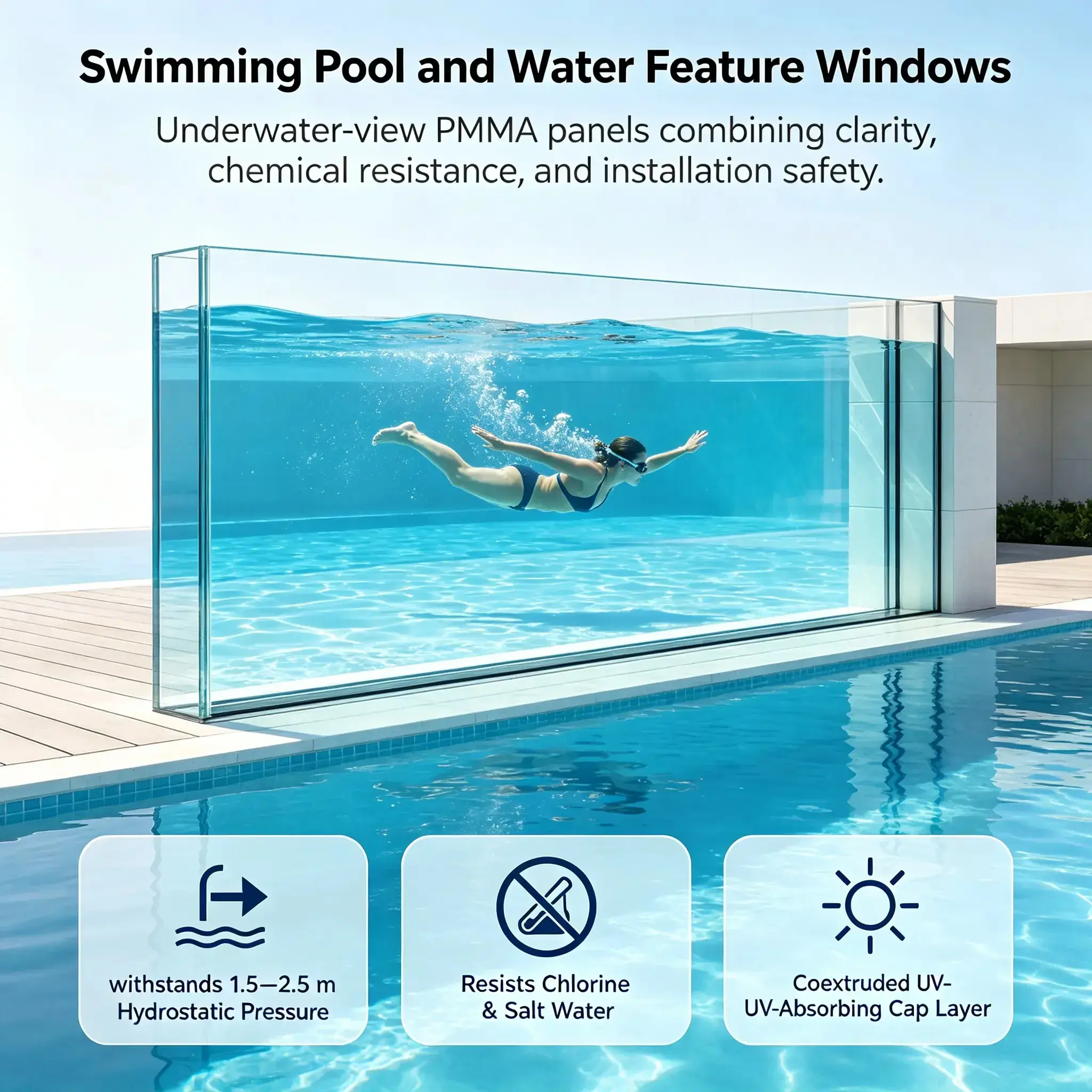
Aquarium Windows & Protective Barriers — Thick PMMA Plate for Structural Transparency

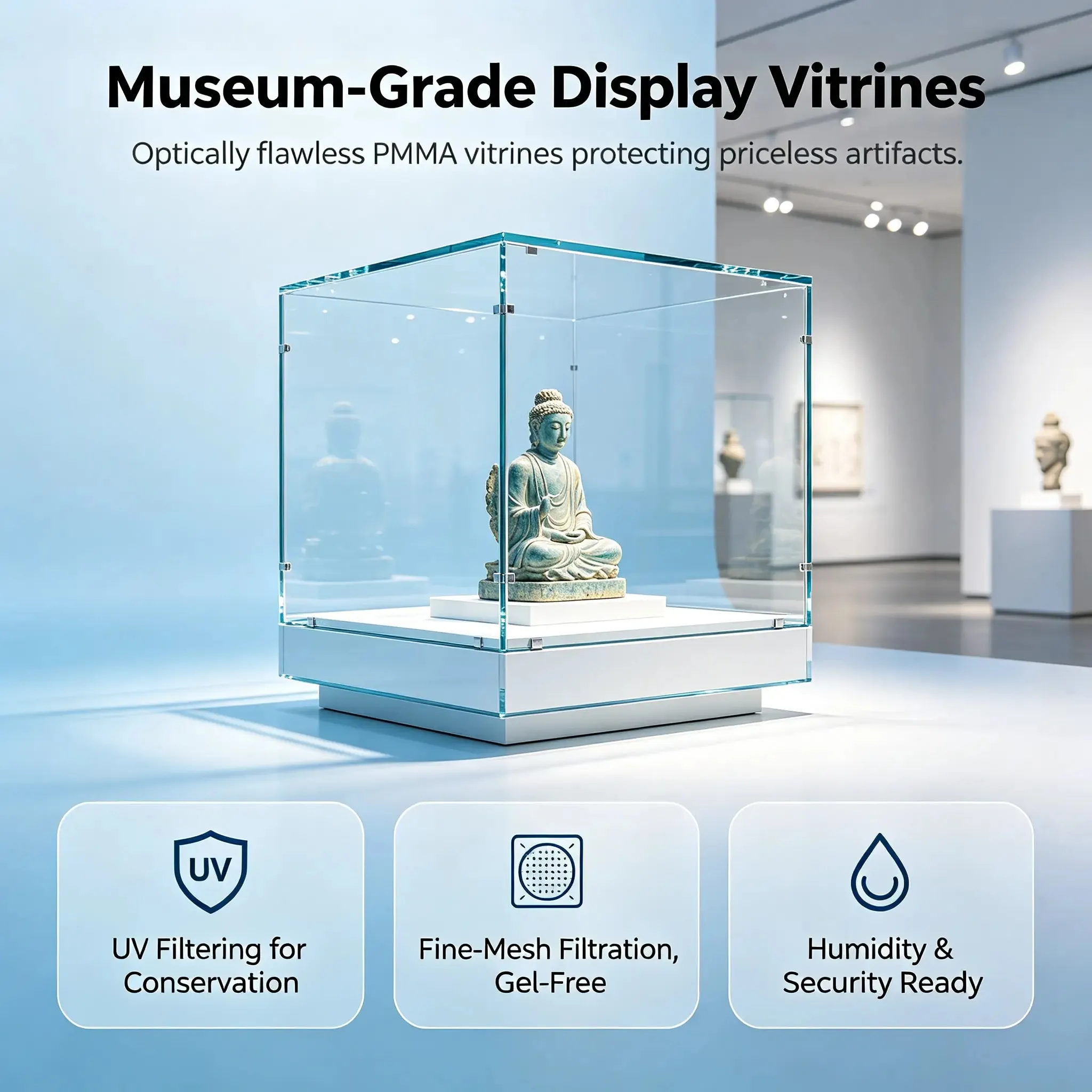
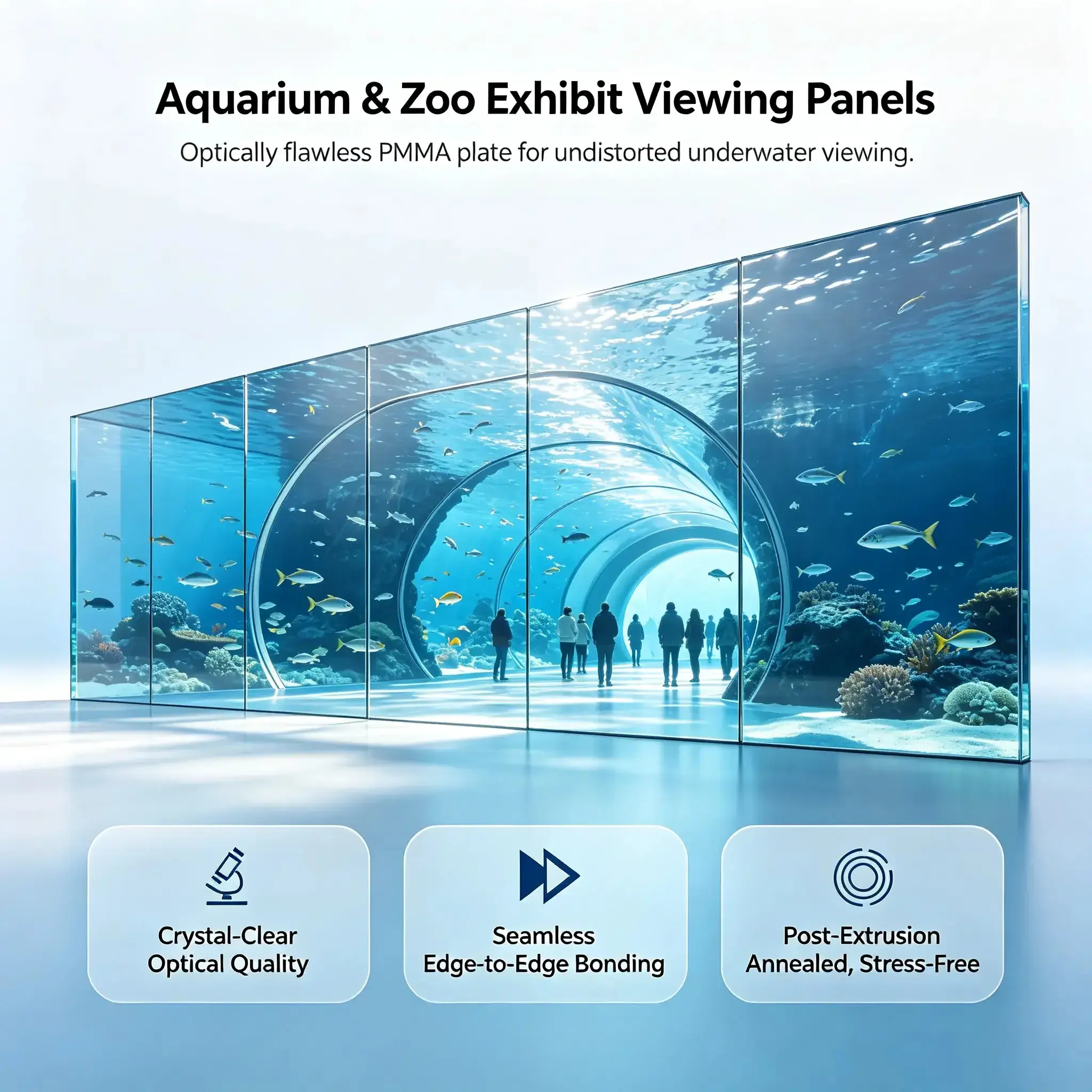
PMMA plate at 8-15 mm thickness forms the viewing windows of public aquariums, zoo marine exhibits, and underwater tunnels where visitors expect an undistorted, crystal-clear view of aquatic life. At these thicknesses, even small optical imperfections — a 0.1 mm thickness variation across a 3-meter panel, a subtle haze from incomplete monomer devolatilization, residual stress birefringence — are visible to the public and unacceptable to exhibit designers.

PMMA’s optical clarity exceeds the best low-iron glass (92% light transmission versus approximately 90% for low-iron glass), weighs approximately 50% less than equivalent-thickness glass, and offers the fabrication flexibility of a thermoplastic — edges can be polished, panels can be solvent-bonded for virtually invisible seams, and curved sections can be formed via controlled heating. These properties have made thick PMMA plate the standard material for public aquarium viewing panels.

For protective barriers — sneeze guards, machine guards, crowd control panels — PMMA plate at 3-8 mm provides impact resistance, optical clarity, and the ability to be cut and drilled with standard fabrication tools. The Jwell line’s protective film coating ensures that barrier panels arrive at installation scratch-free, and the dual cutting system produces standard barrier dimensions inline.

Architectural Glazing — PMMA Plate for Skylights, Sound Barriers & Security Glazing

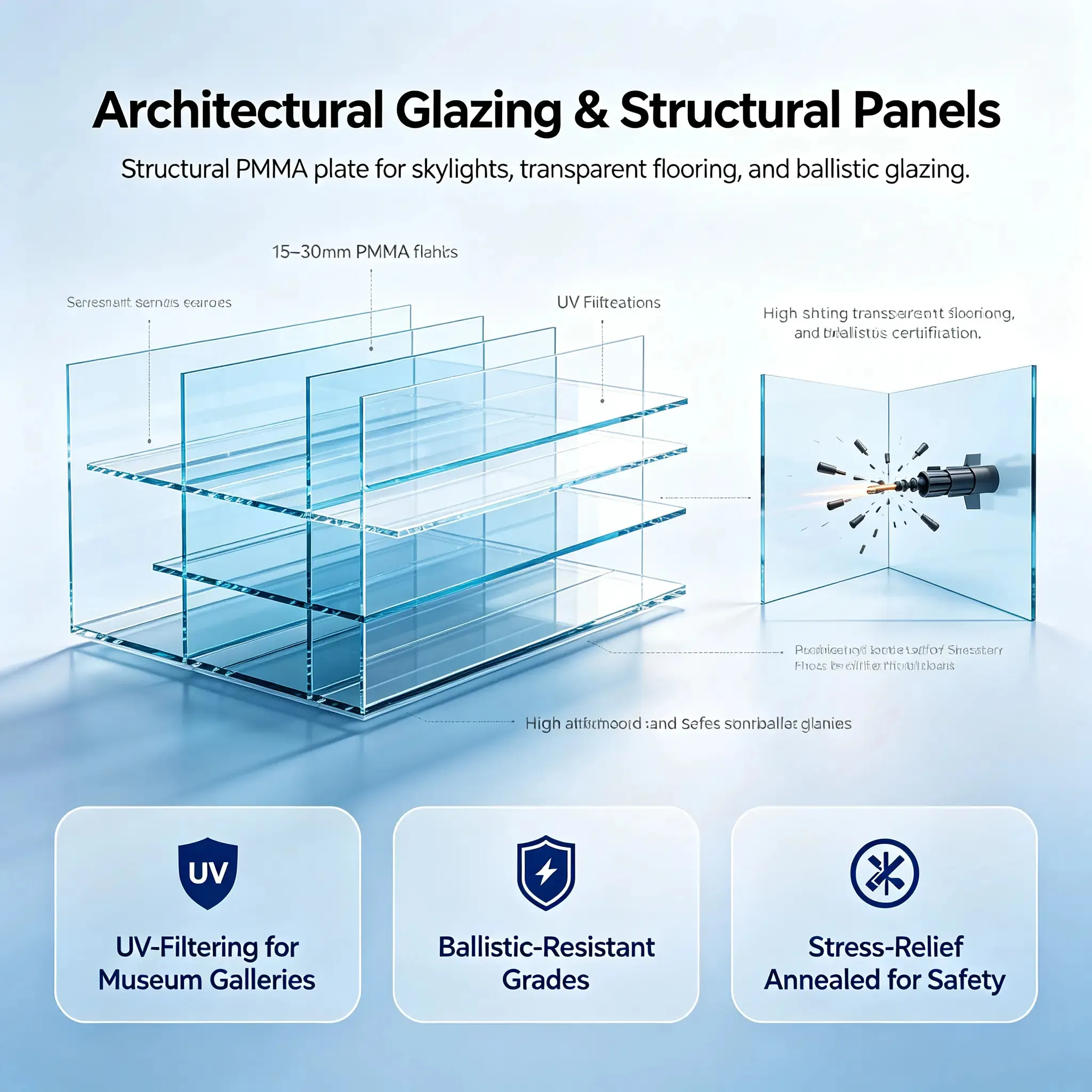
PMMA plate at 5-15 mm thickness serves architectural applications where safety, weight, and optical quality intersect: skylight panels in museums and galleries (where UV-filtering PMMA grades protect light-sensitive exhibits), transparent flooring panels in observation decks and elevated walkways, sound-barrier panels along highways and railways, and security glazing in banks and government buildings.

PMMA’s inherent UV stability provides 10+ years of outdoor exposure with minimal yellowing (ΔYI <1.0), no loss of light transmission, and no hazing — without the coextruded UV cap layer that polycarbonate requires. This optical longevity makes PMMA the material of choice for architectural applications where the glazing must maintain its appearance for decades. The material weighs approximately 50% less than equivalent-thickness glass, reducing structural load and installation complexity.

The Jwell line’s precision roller system (coaxiality ≤0.005 mm, Ra≤0.016 μm) produces the flaw-free surface quality that architectural glazing demands. The PLC data logging provides production traceability that building codes and architectural specifications require — material lot numbers, production parameters, and quality measurements for every plate produced.

Frequently Asked Questions

What is the difference between the PMMA plate extrusion line (2-15mm) and the PMMA sheet extrusion line (0.5-5mm)? -

The PMMA plate line is engineered for thicker acrylic plate from 2 to 15 mm, serving structural and glazing applications such as aquarium windows, protective barriers, and architectural panels. The PMMA sheet line covers thinner gauges (0.5-5 mm) for signage, lighting, and display. Key differences include: larger-diameter polishing rollers (500-600 mm vs 300-400 mm) for longer contact arc with thick extrudate; extended cooling section with multi-zone temperature control to manage the longer solidification cycle of thick plate; higher roll nip force for gauge control; and reduced screw speeds (15-30 rpm vs 60-80 rpm) to match lower line speeds. The plate line’s downstream includes cross cutting and longitudinal cutting for finished sheet dimensions, while the sheet line typically winds into rolls.

Can the Jwell PMMA plate extrusion line also process GPPS? +

Yes. The line is designed as a PMMA/GPPS dual-material platform. Both are amorphous polymers with similar processing temperature ranges (180-250°C), allowing them to run on the same single-screw extruder with a PLC recipe change. PMMA requires slightly higher melt temperatures (220-250°C) and benefits from vacuum venting to remove residual MMA monomer, while GPPS processes at 180-220°C with lower melt viscosity. The 38CrMoAlA nitrided screw’s large-diameter, low-speed design delivers high plasticizing efficiency for both materials. Changeover between PMMA and GPPS typically requires 45-60 minutes for temperature profile adjustment and screw speed reset.

What roller precision does the PMMA plate line achieve? +

The three-roll calendar uses 42CrMo forged steel rollers with coaxiality ≤0.005 mm (5 microns), surface roughness Ra≤0.016 μm (optical mirror finish), hardness HRC58-62, chrome plating 0.08 mm, and temperature deviation ±0.5-1°C across the full face width via individual closed-loop temperature circuits. For thick PMMA plate, roller precision is critical because the plate’s surface quality directly determines its visual appearance in applications like aquarium windows and architectural glazing. Even 0.01 mm of roll runout creates visible thickness bands in transparent acrylic plate.

What is the maximum plate width and thickness? +

The line produces PMMA plate from 2.0 to 15.0 mm thickness with maximum plate width of 2,100 mm. The 120/130 mm screw configurations support outputs of 200-500 kg/h. For applications requiring wider panels — such as large aquarium viewing walls — multiple plates can be solvent-bonded edge-to-edge using PMMA cement to create seamless panels wider than the extrusion line’s maximum width. Thickness tolerance is ±1.5% with the optional online thickness gauge.

What downstream equipment is included? +

The complete line includes: single-screw extruder (120/130) with volumetric feeder, melt pump (Jwell/Maag/Nordson options), hydraulic screen changer, T-die, three-roll calendar (42CrMo, mirror-polished), cooling bracket with edge cutters, protective film coating unit, haul-off unit, cross cutting unit, longitudinal cutting unit, and conveyor with stacker. The film lamination unit applies protective PE film to both plate surfaces during production. Cross and longitudinal cutting units produce finished plate in custom dimensions inline.

Related Sheet Extrusion Lines

WPC Flooring Production Line

WPC Flooring Production Line

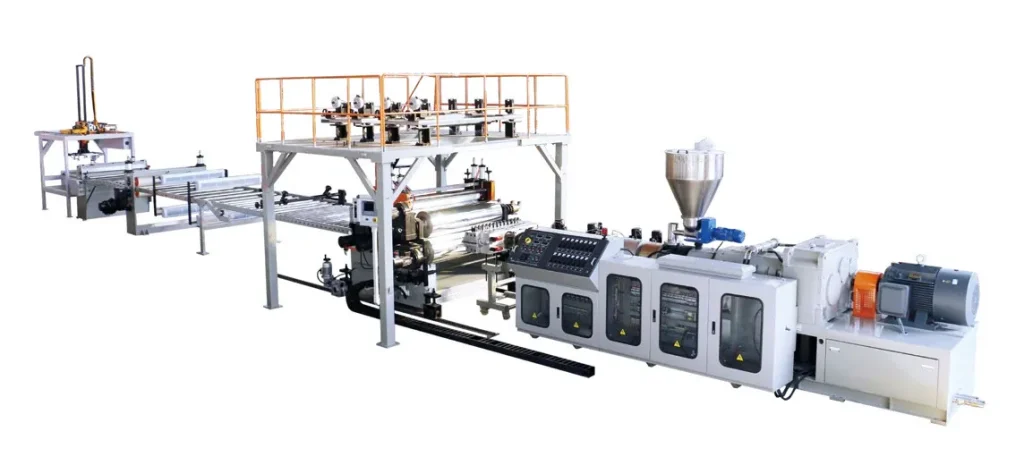
Extruder Type: Conical twin-screw, vented; Screw Material: 38CrMoAlA, nitrided, bimetallic optional; Screw Structure: Conical twin, designed for PVC + wood flour + CaCO₃ + foaming agent; L/D Ratio: Optimized for controlled foaming zone
Learn More ➔
SPC Flooring Production Line

SPC Flooring Production Line

Screw Diameter: Φ 80 mm / Φ 92 mm / Φ 110 mm / Φ 180 mm; Output (24h, SPC): 6-8 T / 12-18 T / 25-32 T / 70-100 T; Line Speed at 4 mm: 0.4-0.6 m/min / 0.8-1.3 m/min / 1.8-2.4 m/min / 5-9 m/min; Screw Material: 38CrMoAlA, nitrided, bimetallic optional / ← Same / ← Same / ← Same

Learn More ➔

Why Choose Jwell for Your PET Sheet Line

🏭

Factory/Experience

Jwell has manufactured PET sheet extrusion equipment since 2005, accumulating field data from over 400 installed PET lines worldwide. Each new machine generation incorporates refinements validated across hundreds of real production environments — not just lab prototypes.

🔬

Test/Validate

Our Changzhou facility operates a full production-scale PET line for customer trials. Bring your raw materials and target specifications — we run your recipe before you commit. The line delivered to your factory is a proven configuration, eliminating startup risk.

🌍

Service/Support

Factory-trained Jwell engineers based in Brazil, Spain, Mexico, and Shanghai travel to customer sites for installation and operator training. Remote diagnostic support via WeChat/WhatsApp responds within 2 hours. Critical spares ship from Shanghai within 48 hours.

Request a Quote or Technical Consultation

Your information will never be shared with third parties.