
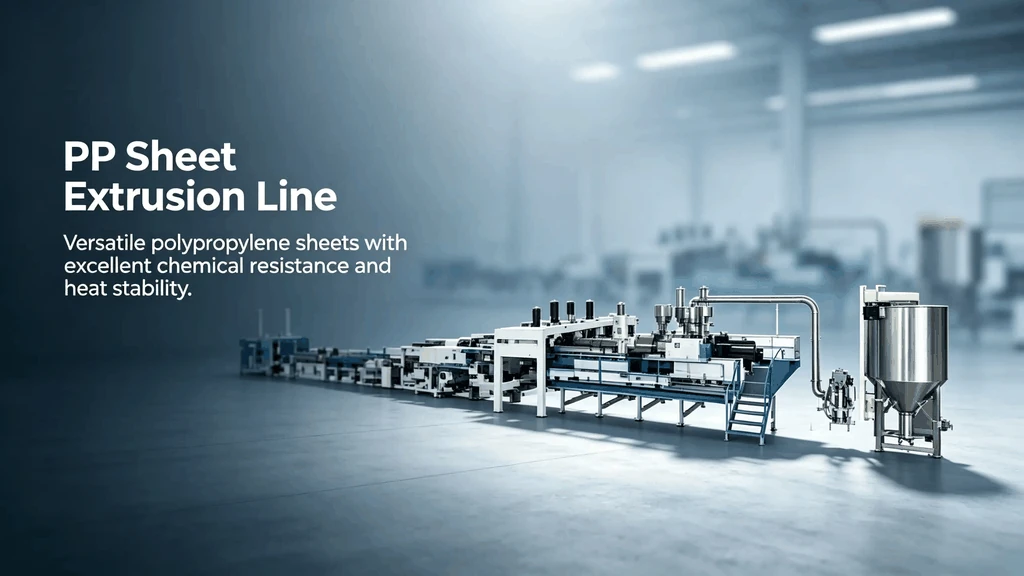
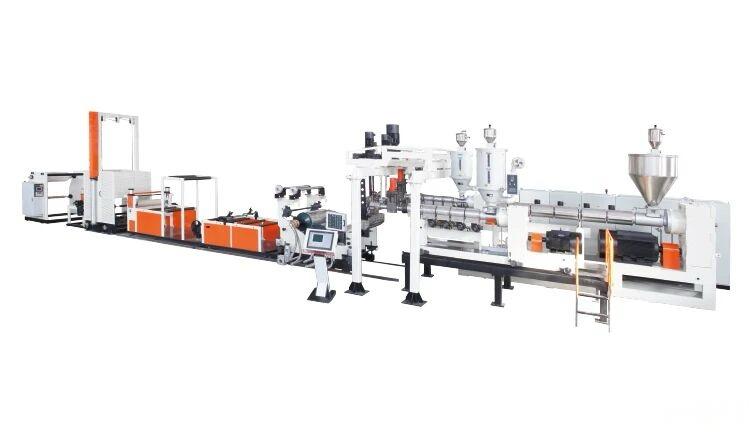
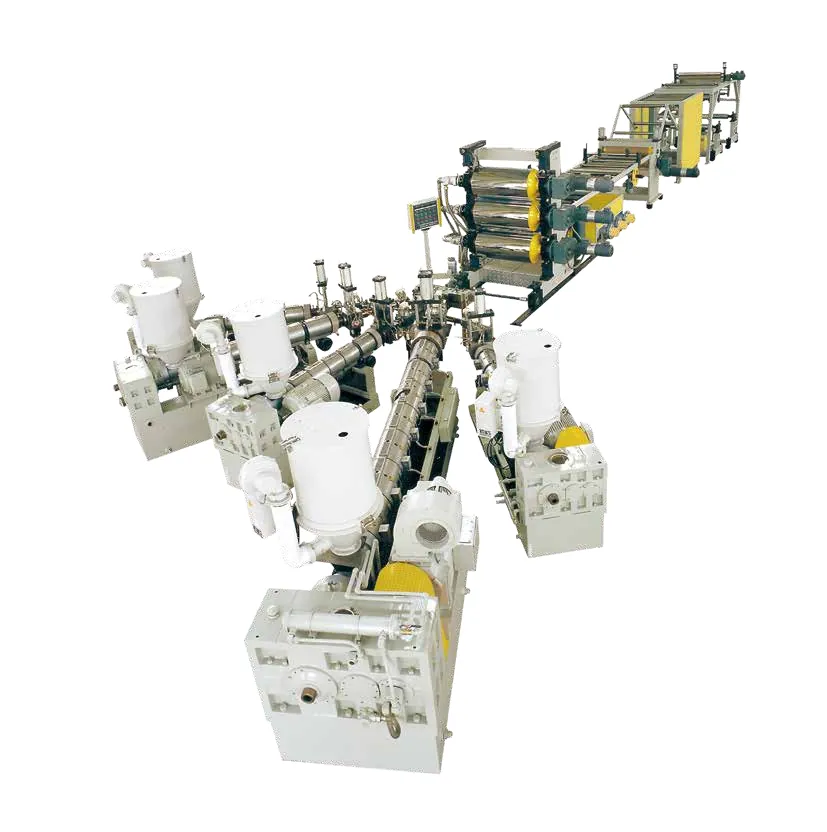
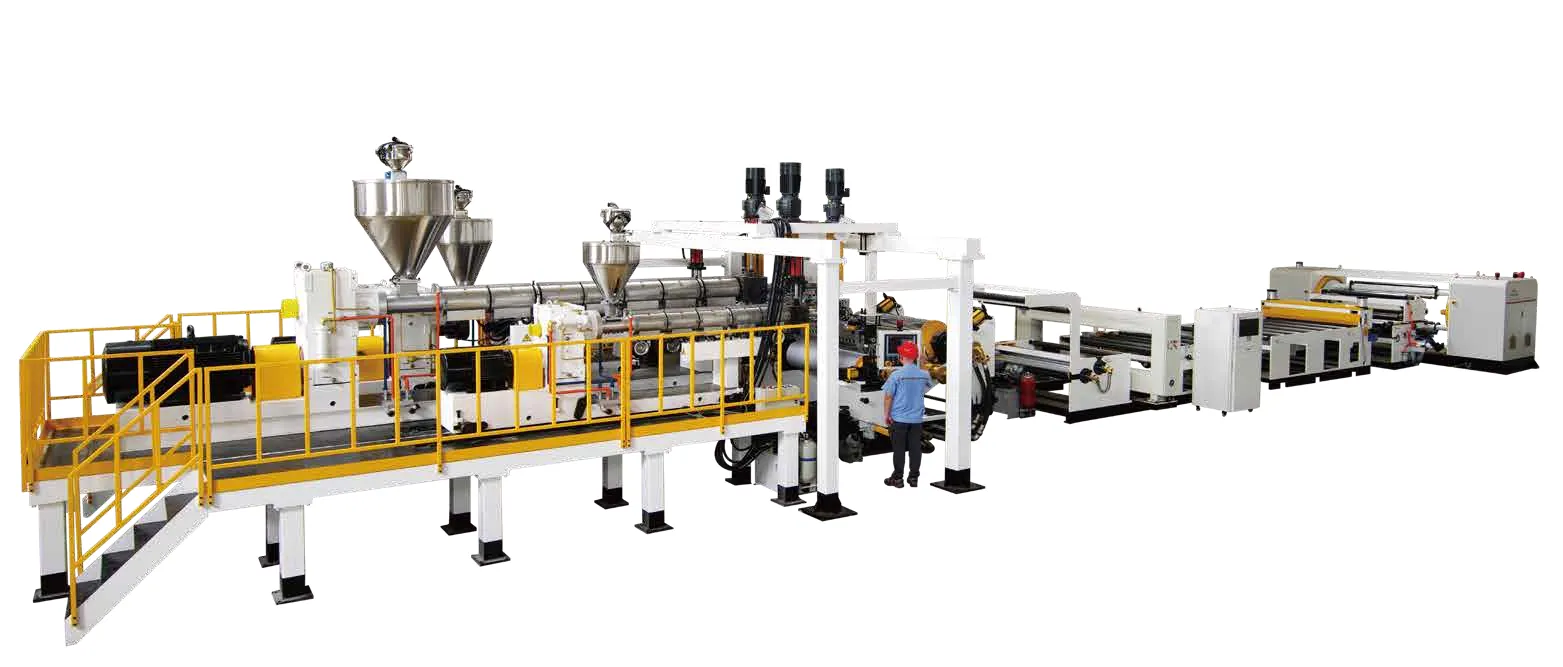
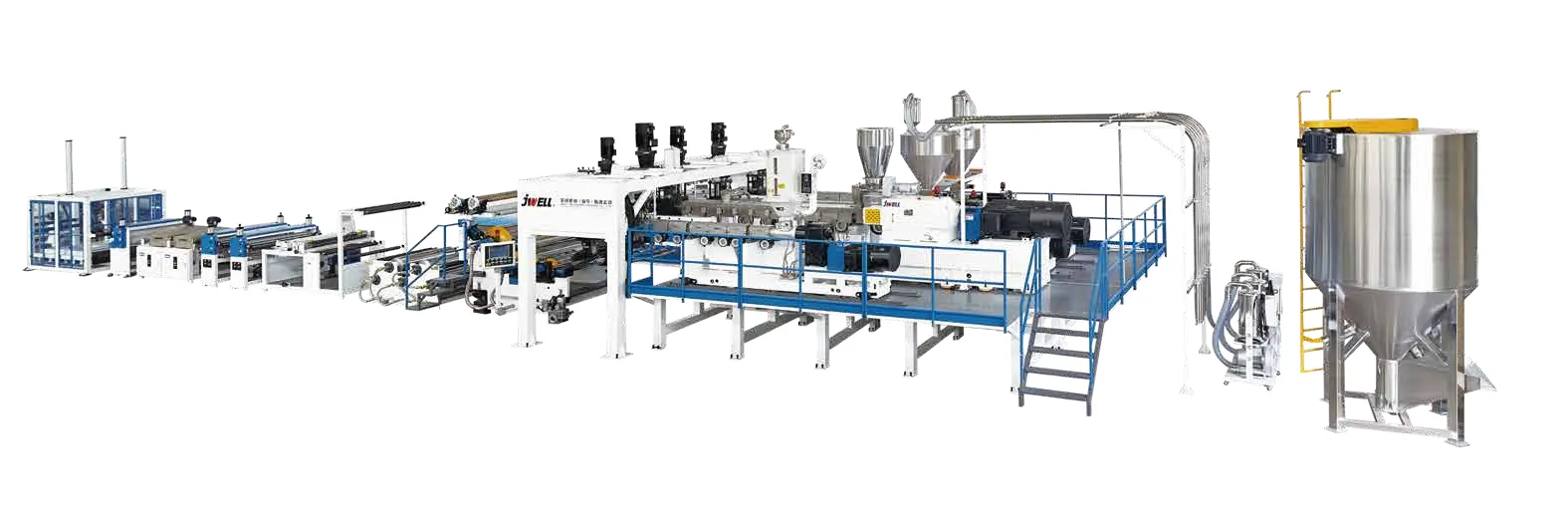
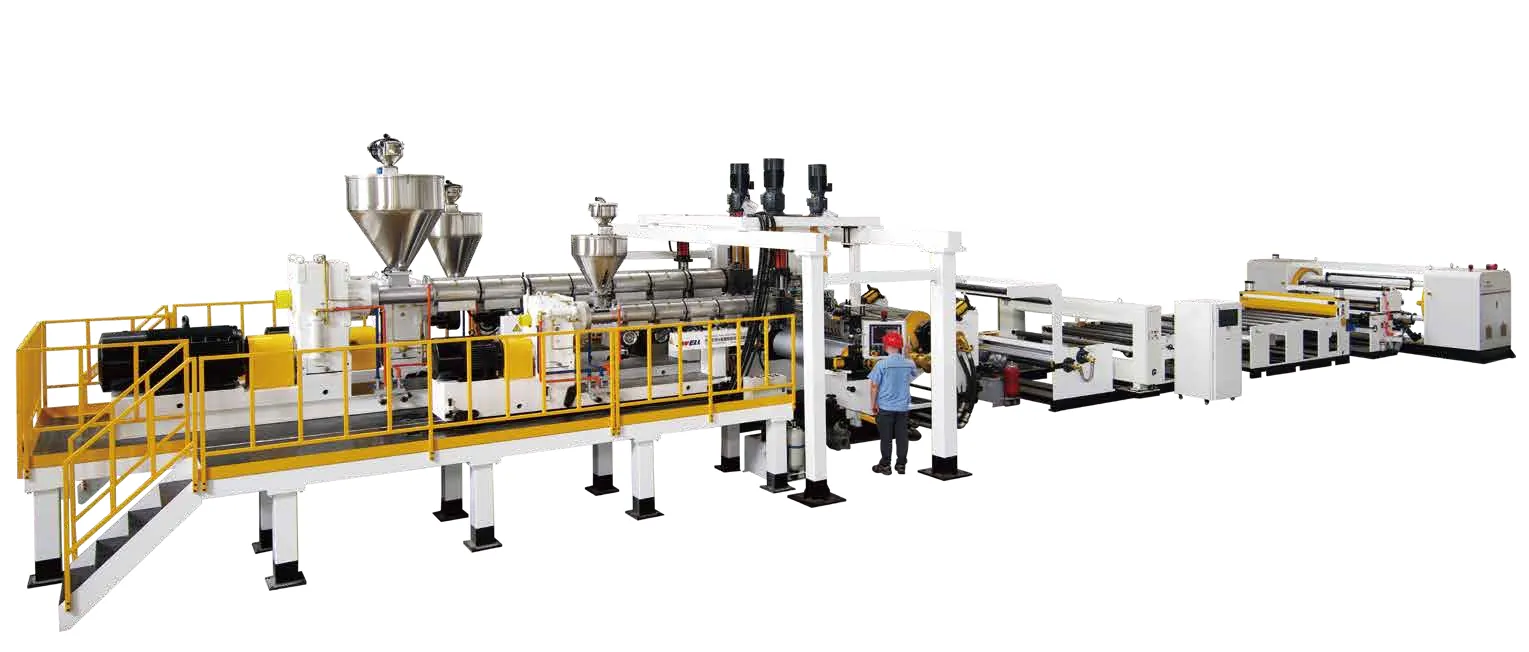
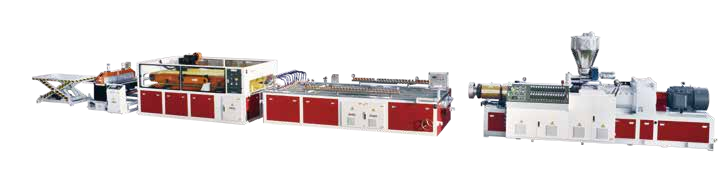
PS HIPS GPPS Sheet Extrusion Line

Single-screw extruder | 300–800 kg/h | 0.3–2.0 mm | 38CrMoAlA nitrided screw | Multi-material: PP, PS, HIPS, GPPS

Complete production demonstration — from pellet feeding through extrusion, polishing, and finished sheet winding.

allow=”accelerometer; autoplay; clipboard-write; encrypted-media; gyroscope; picture-in-picture”

PS HIPS GPPS Sheet Extrusion Line: Related JWELL Extrusion Lines

The PS HIPS GPPS Sheet Extrusion Line is part of JWELL’s complete extrusion portfolio. Customers evaluating this PS HIPS GPPS Sheet Extrusion Line also frequently request our ABS Sheet Extrusion Line | Jwell Machinery and PP Sheet Extrusion Line | 300-800kg/h | PP/HIPS/GPPS | Jwell Machinery, which share the same proven screw, die and control platforms. For layout drawings, pricing and lead times, contact JWELL Machinery directly.

# Item Key Point
1 🌀 Versatile Single-Screw Extruder PP, PS, HIPS, GPPS on One Platform — The Jwell PS/HIPS/GPPS sheet extrusion line is built around a versatile single-screw extruder available in thr
2 ⚡ Integrated Drying System Moisture Control for PS, HIPS, and PP Processing — The line’s upstream drying system serves a dual purpose depending on the material being processed.
3 🎯 Festoon Accumulator & Dual-Station Winder Zero-Stop Sheet Production — High-volume PS/HIPS sheet production for food packaging and stationery markets demands uninterrupted output —
4 🔄 AccuRoll Precision Three-Roll Calendar 42CrMo Rollers, HRC 58–62, Ra ≤0.016 μm — The three-roll calendar is the primary determinant of sheet surface quality, thickness uniformity, and optical

Versatile Single-Screw Extruder — PP, PS, HIPS, GPPS on One Platform

The Jwell PS/HIPS/GPPS sheet extrusion line is built around a versatile single-screw extruder available in three screw diameter configurations — 120 mm, 130 mm, and 150 mm — enabling converters to select the output capacity that matches their target production volume while maintaining the flexibility to process four different materials on the same platform.

The screw is manufactured from 38CrMoAlA nitrided steel with a nitrided layer depth of 0.5–0.7 mm, achieving surface hardness of HV≥740 on the screw and HV≥940 on the barrel. This combination delivers a screw service life of 3–5 years before reconditioning under normal production conditions — performance comparable to premium European single-screw designs.

The design philosophy is large-diameter, low-speed operation: a 120–150 mm diameter screw running at reduced RPM delivers the same throughput as a smaller screw at higher speed, but with lower shear heating (critical for heat-sensitive PS), more uniform melt quality, and significantly reduced mechanical wear. For converters running multi-shift operations producing thin-gauge sheet for high-volume packaging markets, this translates into longer uninterrupted production runs and lower maintenance costs per kilogram of output.

A volumetric feeder mounted on the extruder throat provides consistent material input, while the integrated drier upstream removes surface moisture from PS and HIPS pellets and pre-heats PP to reduce the thermal load on the first barrel zone.

Integrated Drying System — Moisture Control for PS, HIPS, and PP Processing

The line’s upstream drying system serves a dual purpose depending on the material being processed. For PS, HIPS, and GPPS — which are non-hygroscopic in storage but can pick up surface moisture during handling — the forced hot air drier (60–120°C, PLC-controlled) removes this surface moisture before the pellets enter the extruder, preventing surface defects like splay marks, bubbles, and silver streaks on the finished sheet.

For PP processing, the drier serves a different function: pre-heating the pellets to reduce the thermal load on the extruder’s first barrel zone, improving output consistency and reducing energy consumption in the initial melting stage. This is especially valuable when running PP at high throughput rates (500+ kg/h on the 150 mm screw configuration), where every reduction in thermal demand on the first zone translates into more stable melt temperature at the die.

The drier is positioned in the material flow path before the volumetric feeder, ensuring that all material entering the extruder has been conditioned — whether the objective is moisture removal (PS/HIPS/GPPS) or thermal pre-conditioning (PP).

The drying system is sized to match the extruder’s throughput — a 120 mm screw line producing 400–500 kg/h requires approximately 800–1,000 kg/h of drier capacity to provide adequate residence time for effective moisture removal.

Festoon Accumulator & Dual-Station Winder — Zero-Stop Sheet Production

High-volume PS/HIPS sheet production for food packaging and stationery markets demands uninterrupted output — every line stoppage for roll change produces scrap material equivalent to the entire sheet path from die to winder, and restarting introduces thickness transients that produce additional waste before process stability is re-established.

Jwell integrates a festoon-type sheet accumulator between the haul-off unit and the winder that stores 8–15 meters of sheet in a vertical configuration. During a roll change at the winder, the accumulator discharges stored sheet to the winder, allowing the extrusion line upstream to continue running at full speed without interruption. This eliminates 100% of roll-change-related stoppages and the associated scrap generation.

The winder itself is a dual-station design with automatic cut-and-transfer: when a roll reaches the preset diameter or length, the winding system automatically transfers the sheet to the empty second station without operator intervention. The cut is a clean, straight cut — no jagged edges, no sheet tears, no manual intervention required.

The cooling bracket upstream of the haul-off provides extended cooling distance with edge cutters that trim the sheet to final width, removing the thinner edge beads inherent to the extrusion process.

AccuRoll Precision Three-Roll Calendar — 42CrMo Rollers, HRC 58–62, Ra ≤0.016 μm

The three-roll calendar is the primary determinant of sheet surface quality, thickness uniformity, and optical clarity — and Jwell’s roller specifications reflect that importance with tolerance values that match or exceed premium European-built calender systems.

Key roller specifications:

| Parameter | Specification |

|———–|—————|

| Material | 42CrMo forged steel |

| Coaxiality | ≤0.005 mm |

| Surface Roughness | Ra ≤0.016 μm |

| Surface Hardness | HRC 58–62 |

| Chrome Plating | 0.08 mm |

| Temperature Deviation | ±0.5–1°C across full face width |

The coaxiality specification of ≤0.005 mm — five microns — is critical for thin-gauge sheet production. At 0.3 mm sheet thickness, a 0.01 mm roll runout produces a 3.3% thickness variation band across the sheet width. By holding coaxiality to 0.005 mm, that variation is reduced to well under 1.5%, producing sheet with the thickness uniformity required for high-speed thermoforming lines.

The surface roughness of Ra ≤0.016 μm achieves optical mirror finish, producing glossy sheet surfaces required for stationery products (document protectors, report covers) and transparent GPPS packaging (clamshell containers, blister packs). The chrome plating at 0.08 mm provides both the mirror-finish surface quality and the wear resistance for multi-year production campaigns.

Roller temperature is controlled to ±0.5–1°C across the full face width by individual closed-loop pressurized water circuits for each roll. This precision prevents the “hot spots” that create localized surface haze on PS sheet — a defect visible to the naked eye on finished stationery and packaging products.

Technical Specifications

Extruder

Parameter Specification
Extruder Type Single-screw, large-diameter low-speed design
Screw Diameter Options 120 mm / 130 mm / 150 mm
Screw Material 38CrMoAlA nitrided steel
Nitrided Layer Depth 0.5–0.7 mm
Screw Surface Hardness HV ≥740
Barrel Surface Hardness HV ≥940
Feeder Type Volumetric feeder
Drier Integrated, forced hot air, 60–120°C, PLC-controlled

Melt Pump & Screen Changer

Parameter Specification
Melt Pump Brand Options Jwell (self-developed) / Maag (Switzerland) / Nordson (USA)
Screen Changer Type Hydraulic, continuous operation
Screen Changer Configuration Single-column or double-column
Screen Panel Options Single-panel or double-panel, double working position
Screen Change Time <2 seconds (double-position design)

Die

Parameter Specification
Die Type Coat-hanger manifold, flexible-lip
Die Material High-quality mold steel
Flow Channel Chrome Plating 0.03–0.05 mm
Die Cavity Surface Roughness Ra 0.1 μm
Die Lip Surface Roughness Ra 0.05 μm
Thickness Gauge Optional, online scanning

Roller (Three-Roll Calendar)

Parameter Specification
Configuration Three-roll vertical calendar
Roll Material 42CrMo forged steel
Coaxiality ≤0.005 mm
Surface Roughness Ra ≤0.016 μm
Surface Hardness HRC 58–62
Chrome Plating 0.08 mm
Temperature Deviation ±0.5–1°C across full face width

Production

Parameter Specification
Materials PP, PS, HIPS, GPPS
Output Capacity 300–800 kg/h (configuration & material dependent)
Sheet Thickness Range 0.3–2.0 mm
Sheet Width 800–1,500 mm (standard)
Thickness Tolerance ±1.5% (with optional thickness gauge)
Max Line Speed 50 m/min (at thin gauge)
Downstream Equipment Cooling bracket with haul-off + edge cutters → Haul-off unit → Accumulator → Dual-station winder
Winder Type Dual-station, automatic cut-and-transfer
Control System Centralized electrical cabinet, PLC-controlled
Certifications CE, ISO 9001

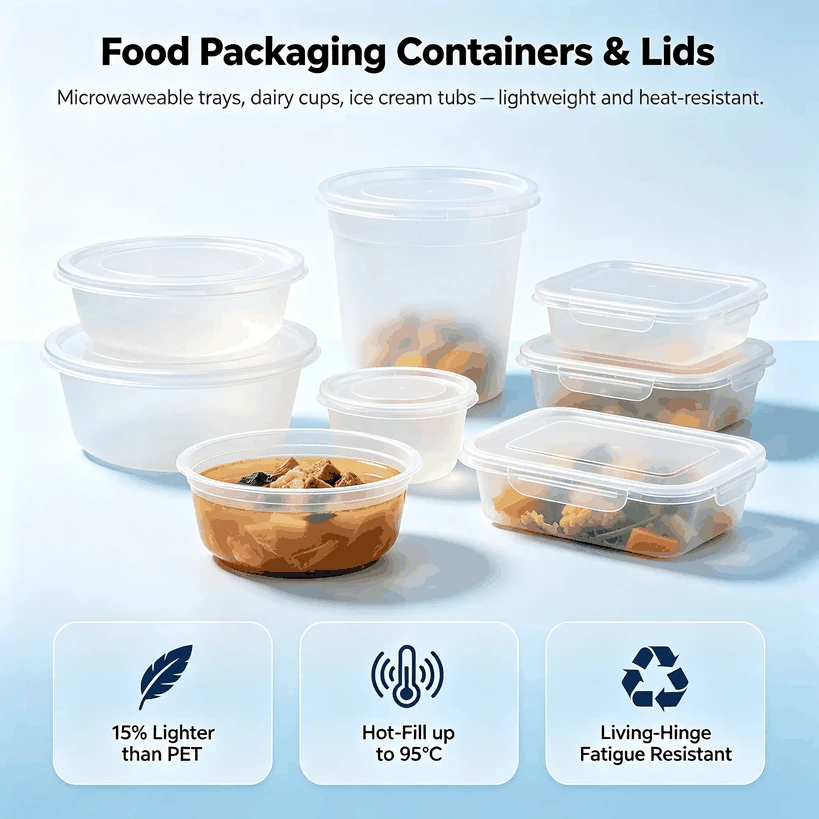
Food Packaging Containers & Lids (PP)

PP sheet from the Jwell line is thermoformed into hot-fill food containers, microwaveable meal trays, dairy product cups, ice cream tubs, and thin-gauge lids for ready-meal packaging. PP’s combination of heat resistance (microwave-safe to 120°C), low density (0.90–0.91 g/cm³ — the lightest commodity thermoplastic), and food-contact compliance makes it the dominant material for prepared food packaging globally.

For food packaging converters, the Jwell line’s multi-material capability provides a strategic advantage: the same line can produce PP sheet for hot-fill and microwave applications, HIPS sheet for thermoformed trays where impact resistance is the priority, and GPPS sheet for transparent clamshell containers for fresh produce and bakery products — all from a single capital investment.

PS HIPS GPPS Sheet Extrusion Line

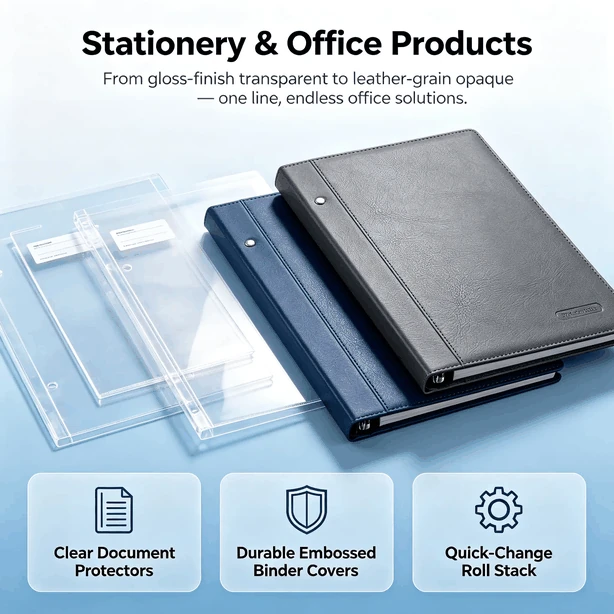
Stationery & Office Products (PS/HIPS)

The global stationery sheet market — file folders, report covers, ring binder covers, divider sheets, and document wallets — consumes significant volumes of PS and HIPS sheet. These applications demand sheet that is rigid, dimensionally stable, and available in a wide range of colors and surface finishes.

Jwell’s line produces both transparent GPPS sheet and opaque HIPS sheet on the same platform, with the three-roll calendar’s mirror-finish rollers (Ra ≤0.016 μm) delivering the glossy, defect-free surfaces that stationery brands demand for premium product presentation. The melt pump’s ±1 bar pressure stability eliminates the die lines and thickness bands that are visible on transparent document covers held up to light — a common quality rejection point in stationery sheet production.

For converters producing colored stationery sheet, the volumetric feeder accommodates color masterbatch dosing, and the PLC’s recipe storage enables reliable reproduction of specific color formulations across production batches.

Frequently Asked Questions

What materials can the Jwell PS/HIPS/GPPS sheet extrusion line process? -

The line processes four materials on a single platform: PP (polypropylene), PS (polystyrene), HIPS (high-impact polystyrene), and GPPS (general-purpose polystyrene). Material changeover is straightforward — clean the screw, adjust temperature profiles, and the line is ready for the next material within a single shift. This multi-material capability allows converters to serve diverse end markets from one capital investment.

What is the output capacity and sheet thickness range? +

The line delivers 300–800 kg/h output depending on screw diameter (120/130/150 mm), material type, and sheet thickness. Sheet thickness ranges from 0.3–2.0 mm with width options up to 1,500 mm. The 120 mm screw is optimal for 300–500 kg/h (PP thin-gauge), the 130 mm for 400–600 kg/h (HIPS/PS mid-range), and the 150 mm for 500–800 kg/h (high-volume production).

What screw and barrel materials are used, and what is the expected service life? +

The screw is manufactured from 38CrMoAlA nitrided steel with a nitrided layer depth of 0.5–0.7 mm. Screw surface hardness is HV≥740 and barrel surface hardness is HV≥940. With proper maintenance and processing of standard PP/PS/HIPS/GPPS grades, the screw service life is 3–5 years before reconditioning and 8–10 years before replacement — comparable to premium European-built single-screw extruders.

What melt pump options are available and why is a melt pump recommended? +

Three melt pump options are available: Jwell self-developed (cost-optimized), Maag (Switzerland, premium precision), or Nordson (USA, widely serviced globally). A melt pump is recommended because it absorbs the extruder’s natural pressure pulsations and delivers melt at ±1 bar stability to the die — eliminating thickness bands, surge marks, and flow-related die lines. For thin-gauge sheet below 0.5 mm, a melt pump is strongly recommended.

What is the minimum order quantity and lead time? +

MOQ is 1 complete line. Standard lead time is 60–90 days from order confirmation for the 120 mm and 130 mm screw configurations; the 150 mm configuration requires 90–120 days. Shipment is FOB Shanghai with standard container loading — a 120 mm line typically fits in 2 × 40′ HQ containers.

Related Sheet Extrusion Lines

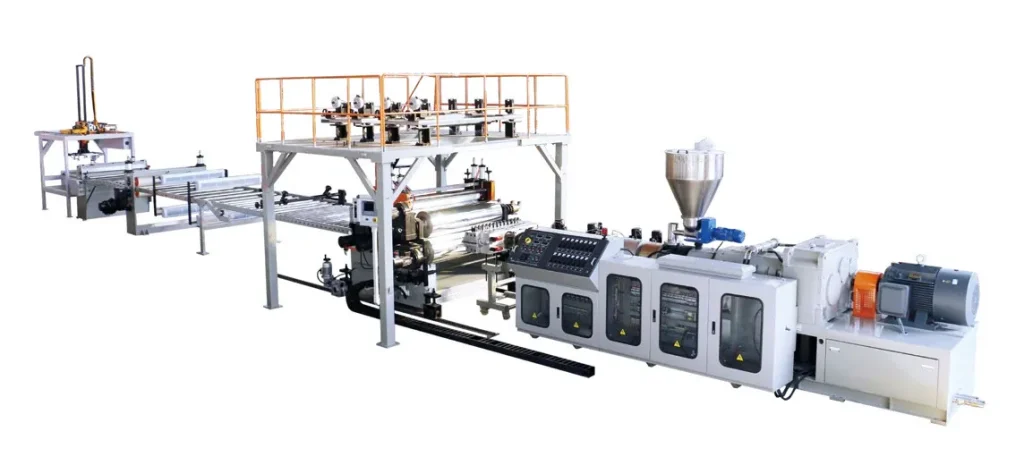
WPC Flooring Production Line

WPC Flooring Production Line

Extruder Type: Conical twin-screw, vented; Screw Material: 38CrMoAlA, nitrided, bimetallic optional; Screw Structure: Conical twin, designed for PVC + wood flour + CaCO₃ + foaming agent; L/D Ratio: Optimized for controlled foaming zone
Learn More ➔
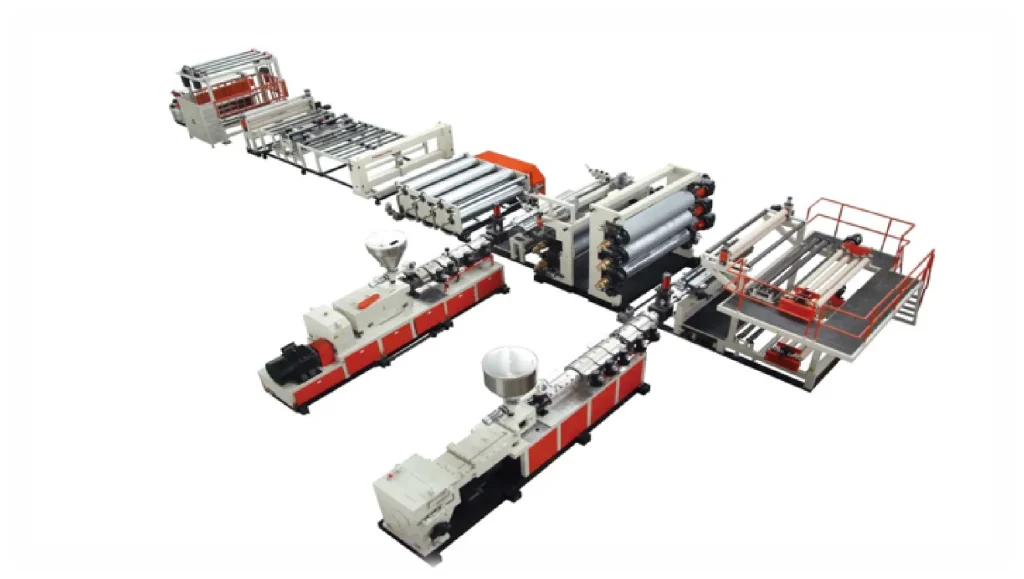
SPC Flooring Production Line

SPC Flooring Production Line

Screw Diameter: Φ 80 mm / Φ 92 mm / Φ 110 mm / Φ 180 mm; Output (24h, SPC): 6-8 T / 12-18 T / 25-32 T / 70-100 T; Line Speed at 4 mm: 0.4-0.6 m/min / 0.8-1.3 m/min / 1.8-2.4 m/min / 5-9 m/min; Screw Material: 38CrMoAlA, nitrided, bimetallic optional / ← Same / ← Same / ← Same

Learn More ➔

Why Choose Jwell for Your PET Sheet Line

🏭

Factory/Experience

Jwell has manufactured PET sheet extrusion equipment since 2005, accumulating field data from over 400 installed PET lines worldwide. Each new machine generation incorporates refinements validated across hundreds of real production environments — not just lab prototypes.

🔬

Test/Validate

Our Changzhou facility operates a full production-scale PET line for customer trials. Bring your raw materials and target specifications — we run your recipe before you commit. The line delivered to your factory is a proven configuration, eliminating startup risk.

🌍

Service/Support

Factory-trained Jwell engineers based in Brazil, Spain, Mexico, and Shanghai travel to customer sites for installation and operator training. Remote diagnostic support via WeChat/WhatsApp responds within 2 hours. Critical spares ship from Shanghai within 48 hours.

Request a Quote or Technical Consultation

Your information will never be shared with third parties.