
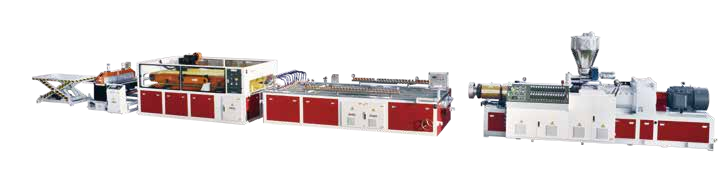
PVC Thick Plate Extrusion Line

Conical twin-screw extruder | 3-20 mm thickness | 200-500 kg/h | 900-1,560 mm width

See the PVC Thick Plate Line in Action

Factory Acceptance Test — Changzhou Facility

Complete production demonstration during FAT at Jwell’s Changzhou manufacturing facility. Watch the PVC thick plate extrusion process from dry blend feeding through finished plate stacking.

PVC Thick Plate Extrusion Line: Related JWELL Extrusion Lines

The PVC Thick Plate Extrusion Line is part of JWELL’s complete extrusion portfolio. Customers evaluating this PVC Thick Plate Extrusion Line also frequently request our PE Thick Plate Extrusion Line | Jwell Machinery and PVC Soft Rigid Sheet Extrusion Line | Jwell Machinery, which share the same proven screw, die and control platforms. For layout drawings, pricing and lead times, contact JWELL Machinery directly.

# Item Key Point
1 🌀 **Conical Twin-Screw Extruder** 80/156 and 92/188 configurations, specifically engineered for PVC thermal sensitivity
2 ⚡ **Short Residence Time** 30-50% less than parallel twin-screw, minimizes PVC thermal degradation
3 🎯 **3-20 mm Thick Rigid PVC Plates** from chemical tank liners to heavy structural panels
4 🔄 **200-500 kg/h Output** high-throughput production for industrial-scale manufacturing
5 🔧 **900-1,560 mm Width Range** covers standard and wide-format plate sizes
6 ✅ **Chrome-Plated PVC-Specific T-Die** prevents PVC degradation/buildup, mirror-polish flow channels
7 ♻️ **Complete Turnkey Line** from material feeding through finished plate stacking
8 🌍 **ISO 9001 & CE Certified** international quality and safety compliance

Why Conical Twin-Screw — PVC's Thermal Sensitivity Demands Specialized Extruder Geometry

PVC (polyvinyl chloride) is fundamentally different from polyolefins like PE and PP in one critical aspect: it is thermally sensitive. When PVC is heated above approximately 180°C or held at processing temperature for too long, the polymer chain undergoes dehydrochlorination — releasing HCl gas that is both corrosive to equipment and autocatalytic, accelerating further degradation. The result is discolored, brittle plate with visible burn marks, physical property loss, and corrosive attack on the extruder barrel and screw.

Jwell addresses this fundamental material challenge through dedicated conical twin-screw extruder geometry, available in two configurations:

Model 80/156: Screw diameters 80 mm (feed end) / 156 mm (discharge end). The converging screw geometry compresses the PVC dry blend naturally as it travels from feed zone to metering zone, without the high-shear compression that parallel screws impose. The larger-diameter feed section provides excellent intake of low-bulk-density PVC dry blend powder, while the smaller-diameter discharge section generates the melt pressure needed for die flow at lower screw RPM — and therefore lower shear heating.

Model 92/188: Screw diameters 92 mm / 188 mm. Larger capacity for higher output requirements (400-500 kg/h), with the same conical geometry advantages.

The conical design’s key advantage for PVC is residence time reduction: 30-50% shorter than a parallel twin-screw extruder of equivalent output. This directly translates to reduced thermal history exposure and lower risk of degradation. The screw is manufactured from nitrided steel with 950 HV surface hardness and corrosion-resistant treatment, while the barrel is equipped with bimetallic alloy liners specifically formulated for HCl resistance in PVC service.

The four-zone barrel temperature control (barrel zones 1-4, adapter, die) uses independent PID-controlled ceramic band heaters with closed-loop water cooling on selected zones to pull heat out when the exothermic PVC reaction raises temperature above setpoint — a cooling capability that conventional extruders without water-cooled barrels lack.

配图建议: 锥形双螺杆结构示意图 + 挤出机特写 (to be acquired)

PVC-Optimized T-Die — Chrome-Plated Flow Channels Minimize Degradation and Material Buildup

PVC melt presents unique challenges for die design that polyolefin die designs do not address. PVC melt tends to adhere to metal surfaces at processing temperature, forming a degraded layer over time that (1) narrows the flow channel, causing progressive plate thickness drift, (2) sheds degraded particles into the melt stream, creating visible black specks on the plate surface, and (3) requires increasingly frequent die cleaning — a 4-8 hour procedure on a poorly designed die.

Jwell’s PVC thick plate T-die is engineered with three PVC-specific features:

Mirror-polish chrome plating on all melt-contact surfaces. The chrome layer provides a non-stick surface that PVC melt slides over rather than adheres to, reducing material stagnation and degradation buildup. Surface roughness below Ra 0.1 μm eliminates the microscopic crevices where PVC melt accumulates and thermally degrades.

Streamlined flow channel geometry designed through computational flow simulation. The coat-hanger manifold is dimensioned to maintain uniform melt velocity from the die center to each side, with the manifold cross-section reducing progressively toward the die edges. Every transition and corner in the flow path is radiused to prevent dead zones where stagnant melt would degrade.

Flexible lip with manual or automatic adjustment. The flexible lip allows the operator to fine-tune plate thickness profile across the web width. Manual adjustment is standard; an automatic die with individual thermal bolts responding to online thickness gauge feedback is available as an upgrade for customers requiring ±1.5% thickness tolerance across the full plate width.

For PVC foam board and free-foam PVC sheet production, the T-die can be equipped with a specialized internal manifold that provides the pressure drop after the die exit required for controlled foaming.

配图建议: T-die 特写,展示铬镀层和柔性唇口 (to be acquired)

Three-Roll Vertical Calibration — Precision Temperature Control for Rigid PVC Plate Surface Quality

Rigid PVC plate surface quality — gloss, flatness, and freedom from cooling marks — is determined by the roll stack in the first 60 seconds after the melt exits the die. If the first roll is too cold, the plate surface quenches instantly, trapping flow lines from the die. If the first roll is too hot, the plate sticks and wraps. If roll temperature is non-uniform (a common problem with simple once-through cooling systems), the plate develops waviness — visible distortion bands caused by differential thermal contraction.

Jwell’s three-roll vertical calibration stack addresses all three surface quality variables through independent temperature control on each roll, maintained by a closed-loop pressurized water circuit with ±1°C uniformity across the full roll face width. The temperature range of 20-90°C covers the full PVC plate calibration window, from rapid-cool thin-gauge plate (3-6 mm) to slow-cool thick plate (12-20 mm) where excessively fast cooling would create internal stress and plate warpage.

The vertical roll orientation — melt enters from above, descends through the gap between rolls 1 and 2, wraps roll 2, then passes between rolls 2 and 3 — provides both-side contact with the calibrating roll surfaces for uniform surface finish on both faces of the plate. Roll diameter is 400 mm, sufficient to provide the contact length needed for thick plate cooling. The chrome-plated roll surfaces accept interchangeable sleeves for mirror, matte, or textured finishes.

The roll gap is servo-adjusted with 0.01 mm precision, calibrated for each plate thickness recipe stored in the PLC.

配图建议: 三辊压光堆特写 (to be acquired)

PVC Dry Blend to Finished Plate — Integrated Feeding, Extrusion, and Formulation Handling

Unlike polyolefin extrusion where the feedstock is pellets, rigid PVC thick plate production starts from PVC dry blend — a powder mixture of PVC resin, stabilizer, lubricant, impact modifier, processing aid, filler, and pigment — compounded in a high-speed hot mixer and cooled in a cold mixer. The dry blend’s low bulk density (0.45-0.60 g/cm³ versus 0.55-0.65 g/cm³ for pellets), powder flow characteristics, and thermal sensitivity create specific feeding requirements:

Volumetric or gravimetric feeding from a hopper with mechanical agitation (bridge breaker) that prevents the dry blend from arching or bridging in the hopper throat — a common issue with powder feeds. The agitator ensures consistent mass flow into the screw feed zone.

The conical twin-screw’s large-diameter feed section (80 mm or 92 mm) provides the intake volume needed for low-bulk-density powder at the target throughput. A parallel twin-screw of equivalent output would require a larger overall machine simply to accommodate powder feed volume.

Formulation flexibility: The same extruder processes standard rigid PVC (with Ca/Zn or organotin stabilizer), UV-stabilized PVC for outdoor applications, flame-retardant PVC (UL 94 V-0), and calcium-carbonate-filled PVC (up to 20 phr filler loading). The twin-screw’s distributive mixing action ensures uniform dispersion of all formulation components, preventing stabilizer-rich and stabilizer-poor zones that would cause localized degradation.

配图建议: 干混料斗和喂料系统 (to be acquired)

Technical Specifications

Model Options

Parameter Specification
Available Configurations Model 80/156 (standard) / Model 92/188 (high capacity)
Screw Configuration Conical twin-screw, counter-rotating

Extruder

Parameter Specification
Extruder Type Conical twin-screw, counter-rotating
Screw Diameter (80/156) 80 mm (feed end) / 156 mm (discharge end)
Screw Diameter (92/188) 92 mm (feed end) / 188 mm (discharge end)
L/D Ratio Application-specific (conical geometry)
Screw Material Nitrided steel, 950 HV surface hardness, corrosion-resistant treatment
Barrel Material Bimetallic alloy liner, HCl-resistant formulation
Barrel Heating Zones 4 zones + adapter + die
Heating Type Ceramic band heaters, PID control
Cooling Water-cooled barrel zones (selected) for heat extraction
Drive Motor AC motor (power model-dependent)
Inverter ABB or equivalent
Output Range 200 – 500 kg/h

Plate Specifications

Parameter Specification
Plate Thickness Range 3 – 20 mm
Plate Width Range 900 – 1,560 mm
Materials Rigid PVC (standard, UV-stabilized, flame-retardant V-0, CaCO₃-filled), PVC foam board
Feedstock PVC dry blend (powder) from hot/cold mixer system

T-Die

Parameter Specification
Die Type Coat-hanger manifold, flexible lip
Die Width Model-dependent (matched to plate width)
Flow Surface Chrome-plated, mirror polish, Ra ≤ 0.1 μm
Lip Adjustment Manual (standard) / automatic thermal bolt (optional)
Special Configuration Foam die with decompression manifold (optional)

Roll Stack

Parameter Specification
Configuration 3-roll vertical calibration
Roll Diameter 400 mm each
Roll Temperature Range 20 – 90°C
Temperature Control Independent per roll, closed-loop pressurized water
Temperature Uniformity ±1°C across roll face
Surface Finish Chrome-plated, interchangeable sleeve options
Roll Gap Adjustment Servo, 0.01 mm precision

Downstream Automation

Parameter Specification
Cutting System Transverse cutting saw, synchronized speed
Stacking Automatic counting and stacking
Plate Length 2,000 – 3,000 mm (standard), customizable

Line Performance

Parameter Specification
Line Speed (3 mm gauge) 2 – 4 m/min
Line Speed (20 mm gauge) 0.3 – 0.6 m/min
Total Installed Power 150 – 350 kW (configuration dependent)
Control System Siemens PLC + HMI touchscreen
Recipe Storage Configurable slots, temperature/roll-gap/speed recipes

Certifications & Utilities

Parameter Specification
Certifications CE, ISO 9001
Available as Complete turnkey solution
After-Sales Global engineer certification system, 48-hour spare parts dispatch

[I] CASE STUDIES 标签页 — 客户案例

文件名 Alt Text / 场景
PVC thick plate extrusion line SAT.jpg Jwell PVC thick plate extrusion line — Site Acceptance Test overview at customer facility / SAT整线
PVC thick plate extrusion line extruder.jpg PVC conical twin-screw extruder at customer facility — close-up during SAT / 挤出机特写
PVC thick plate extrusion line roller SAT.jpg Three-roll calibration stack during SAT — PVC plate surface quality verification / 三辊压光
PVC thick plate extrusion line cooling bracket SAT.jpg Cooling and handling section — downstream equipment during SAT / 冷却托架

[L] RELATED PRODUCTS 相关产品

卡片 产品名称 / 链接 / 关系
1 PVC Marble Sheet Extrusion Line / /sheet-extrusion/pvc-marble-sheet-extrusion-line/ / 相同主机平台(锥双)
2 PP Thick Plate Extrusion Line / /thick-plate-extrusion/pp-thick-plate-extrusion-line/ / 厚板同类产品
3 PE Thick Plate Extrusion Line / /thick-plate-extrusion/pe-thick-plate-extrusion-line/ / 厚板同类产品
4 PVC Soft/Rigid Sheet Extrusion Line / /sheet-extrusion/pvc-soft-rigid-sheet-extrusion-line/ / PVC 片材系列

[N] INQUIRY FORM 询价表单

# 字段 / 类型 / 必填 / 说明
1 Name / text / ✅ / placeholder: “Your full name”
2 Email / email / ✅ / placeholder: “your@company.com”
3 Country / select / ✅ / 200+国家
4 Phone / tel / — / 含国际区号
5 Company / text / — / placeholder: “Your company name”
6 Application / select / ✅ / Chemical Tanks / Construction Panels / Industrial Ducting / Laboratory Bench Tops / Multiple / Other
7 Target Plate Thickness (mm) / select / ✅ / 3-6 / 6-12 / 12-20 / Multiple ranges
8 Required Output (kg/h) / select / ✅ / <200 / 200-350 / 350-500 / >500 / Not sure
9 Extruder Configuration / select / — / 80/156 / 92/188 / Not sure
10 Project Timeline / select / — / Immediate / 1-3 months / 3-6 months / 6-12 months / Information only
11 Message / textarea / — / placeholder: “Tell us about your production requirements…”
CAPTCHA / — / ✅ / reCAPTCHA v3
Submit / submit / — / “Request Quote & Configuration”

4.1 On-Page 元素

# 检查项 / 状态
1 唯一 H1,含完整产品名 + 核心关键词 / ✅
2 H2 技术关键词覆盖: conical twin-screw, PVC thermal sensitivity, 3-20mm, chemical tanks, construction / ✅
3 规格表为 HTML <table> 文本 / ✅
4 所有图片有描述性 alt 属性 / ✅
5 面包屑用 Schema BreadcrumbList / ✅
6 FAQ 用 Schema FAQPage (5个Q&A) / ✅
7 产品信息用 Schema Product + 详细 Organization / ✅
8 视频 ×2 分别用 Schema VideoObject / ✅
9 Canonical 自引用 / ✅
10 Title tag 50-60 chars / ✅
11 Meta description 含核心规格数据 + 关键词 / ✅
12 Open Graph 完整 / ✅

4.2 E-E-A-T 信号强化

信号 体现方式
Experience 锥双挤出 PVC 厚板技术详解、干混料处理经验、SAT 案例照片
Expertise 锥形双螺杆 PVC 专用设计、镀铬 T-die 防降解、三辊温控校准、PVC 配方处理
Authoritativeness 29年经验、8大基地、3500+员工、25000+设备、1000+专利、CE+ISO 9001
Trustworthiness 全球工程师认证体系、48小时备件调度、近50%出口率、120+国家

4.3 技术性能

检查项 目标值
LCP < 2.5s
CLS < 0.1
INP < 200ms
Mobile-friendly
图片格式 WebP (建议)

5.1 已有视频资源

文件 用途 / 状态
视频/PVC thick plate extrusion line FAT.mp4 [D1] FAT 视频 / ✅ 已有
视频/PVC thick plate extrusion line SAT.mp4 备选第二案例视频 / ✅ 已有
视频/PVC imitation marble sheet extrusion line.mp4 [D2] 参考视频 / ✅ 已有

5.2 已有案例照片

文件 用途 / 状态
Case Study/PVC thick plate extrusion line SAT.jpg [I] SAT整线 / ✅ 已有
Case Study/PVC thick plate extrusion line extruder.jpg [I] 挤出机特写 / ✅ 已有
Case Study/PVC thick plate extrusion line roller SAT.jpg [I] 三辊压光 / ✅ 已有
Case Study/PVC thick plate extrusion line cooling bracket SAT.jpg [I] 冷却托架 / ✅ 已有

5.3 尚需补充的资源

用途 优先级
[C] Hero 画廊 — 产线主图 (3张)
[F1] 锥形双螺杆结构示意图 / 挤出机特写
[F2] T-die 特写(铬镀层、柔性唇口)
[F3] 三辊压光堆特写
[F4] 干混料斗和喂料系统
[F5] 不同厚度 PVC 板样品对比
[F6] 自动切割堆垛系统
[F7] 电控柜 + 品牌 logo 条
[H1] 化工储罐应用配图
[H2] 建筑板材应用配图
[H3] 工业管道应用配图
[H4] 实验台面应用配图
视频封面图 ×2 (FAT + 参考视频 poster)
相关产品卡片缩略图

本页链接到 (Outbound)

目标页面 位置 / 锚文本
PVC Marble Sheet Line [L] Related Products / “PVC Marble Sheet Extrusion Line”
PP Thick Plate Line [L] Related Products / “PP Thick Plate Extrusion Line”
PE Thick Plate Line [L] Related Products / “PE Thick Plate Extrusion Line”
PVC Soft/Rigid Sheet Line [L] Related Products / “PVC Soft/Rigid Sheet Extrusion Line”

从其他页面链接到本页 (Inbound)

来源页面 链接上下文
Thick Plate Extrusion Pillar Page 厚板挤出分类页
PVC Processing Solutions Overview PVC 加工整体方案页
Chemical Industry Equipment Solutions 化工设备方案
Construction Materials Manufacturing 建材制造方案

八、与 ABS 线页面结构的关键差异

维度 ABS 线 / PVC Thick Plate 线
挤出机类型 单螺杆 (33:1 L/D) / 锥形双螺杆 (80/156, 92/188)
核心材料挑战 ABS 橡胶相剪切敏感性 / PVC 热敏性 (HCl 释放)
Hero 卖点数 9 项 / 8 项
标签页 5 个 / 5 个
功能区块 8 个 / 7 个
视频数 2 个 (FAT + 案例) / 2 个 (FAT + 参考视频)
应用场景数 4 个 / 4 个(化工/建筑/管道/实验台)
独特区块 市场地位区 [J] (300+ 冰箱线) / 材料优势区 [J] (PVC vs 替代材料)
案例素材 6 张照片 + 视频 / 4 张 SAT 照片
E-E-A-T 重心 市场地位 + 规模验证 / 材料专业技术 + PVC 加工深度
特色数据 90% 市场份额 + 海尔20年 / 锥双优势 + PVC 热敏性解决

Chemical Storage Tanks — PVC's Superior Chemical Resistance for Acids, Alkalis, and Oxidizing Agents

Rigid PVC’s chemical resistance — excellent to most inorganic acids (sulfuric acid at concentrations up to 80%, hydrochloric acid all concentrations, nitric acid up to 50%), most alkalis (sodium hydroxide up to 50%), salt solutions, and oxidizing agents — makes PVC thick plate the standard material for chemical storage tanks, process vessels, scrubber towers, and electroplating baths in the chemical processing, metal finishing, and water treatment industries.

PVC tank fabrication uses the 6-20 mm thick plates, cut to size and hot-gas or extrusion welded at the joints to form liquid-tight vessels ranging from small day tanks (500-5,000 liters) to large storage silos (20,000-100,000 liters). The welded joint strength of properly fabricated PVC reaches 80-90% of the base material strength, and the joints share the same chemical resistance as the plate itself — unlike lined steel tanks where a liner breach exposes the steel substrate to chemical attack.

PVC plate tanks are self-supporting up to approximately 2 meters sidewall height at 6 mm thickness; taller tanks use thicker plate (12-20 mm) or external steel reinforcement. For outdoor installations, UV-stabilized PVC grades with titanium dioxide pigmentation prevent the surface chalking and embrittlement that affects unpigmented PVC under prolonged sun exposure.

Jwell line capability: The 3-20 mm thickness range directly covers the entire PVC plate spectrum used in chemical tank fabrication — from 6 mm for small vessels to 20 mm for large tank walls. Jwell PVC plate customers supplying the chemical equipment industry can produce the full thickness range for tank fabricators from a single extrusion line.

Construction Panels — Waterproof, Flame-Retardant PVC Panels for Walls, Partitions, and Cladding

Rigid PVC thick plate (3-12 mm) is fabricated into a wide range of building and construction products:

– Wall cladding and facade panels: PVC’s inherent water resistance eliminates the moisture-absorption issues of wood, gypsum, and cement-based panels. PVC cladding requires no painting, no sealing, and no periodic maintenance — a lifecycle cost advantage valued in commercial buildings, hospitals, and food processing facilities where hygiene and cleanability are regulatory requirements. UV-stabilized grades retain color and surface integrity after years of direct sun exposure.

– Partition panels and cubicle systems: PVC bathroom partitions, toilet cubicles, and changing room dividers leverage PVC’s water resistance and easy-to-clean surface. The material does not delaminate, swell, or support mold growth in the continuously humid environment that destroys wood-based and MDF partitions within 3-5 years.

– Door panels: Solid PVC plate doors for chemical plants, wastewater treatment facilities, and food processing plants where metal doors corrode and wooden doors rot. PVC doors are fabricated from 6-12 mm plate with internal reinforcing where required.

– PVC foam board: For lower-density applications (signage, exhibition displays, interior decoration), the line also produces PVC foam board using a chemical blowing agent formulation, with density adjustable from 0.4 to 0.8 g/cm³.

Fire safety: Flame-retardant PVC grades meeting UL 94 V-0 are processable on the same line with formulation adjustment. PVC is inherently self-extinguishing due to its chlorine content (approximately 57% by weight), which releases chlorine radicals that quench the combustion reaction in the gas phase. This intumescent fire behavior is a key specification advantage over polyethylene and polypropylene panels in building applications where fire codes apply.

Frequently Asked Questions

Why does Jwell use conical twin-screw extruders for PVC thick plate? -

PVC (polyvinyl chloride) is thermally sensitive — it degrades and releases corrosive HCl gas if overheated or held too long at processing temperature. Jwell’s conical twin-screw extruder (80/156 and 92/188 configurations) addresses this through its converging screw geometry, which provides natural compression without excessive shear. The residence time is 30-50% shorter than a parallel twin-screw of equivalent output, minimizing thermal history exposure. Additionally, the larger-diameter feed section handles the low bulk density of PVC dry blend powder (0.45-0.60 g/cm³) more effectively than a parallel screw intake zone. The water-cooled barrel zones extract heat from the exothermic PVC reaction, preventing temperature overshoot beyond the setpoint.

What is the difference between the 80/156 and 92/188 configurations? +

The two model designations refer to the conical twin-screw diameters:

– 80/156: 80 mm feed-end diameter / 156 mm discharge-end diameter. Standard output configuration for 200-350 kg/h production.

– 92/188: 92 mm feed-end diameter / 188 mm discharge-end diameter. Higher-capacity configuration for 350-500 kg/h production.

The larger-diameter feed section on both models provides proportional intake volume for PVC dry blend feeding. Customers select the model based on their target daily output and plate dimensions. Both models share the same conical geometry advantages for PVC processing.

What PVC plate thicknesses and applications does this line support? +

The line produces rigid PVC plates from 3 to 20 mm thickness in widths of 900-1,560 mm. The application range covers:

– 3-6 mm: Chemical tank lining, laboratory bench tops, fume hood panels

– 6-12 mm: Construction panels, wall cladding, partition panels, door panels

– 12-20 mm: Self-supporting chemical tank walls, industrial ducting panels, heavy structural plates

The line also produces PVC foam board using a chemical blowing agent formulation (density 0.4-0.8 g/cm³) and free-foam PVC sheet with appropriate die configuration.

What raw material form does the PVC thick plate line use? +

Unlike polyolefin extrusion (PE, PP) where the feedstock is pellets, rigid PVC thick plate production uses PVC dry blend — a free-flowing powder mixture of PVC resin, heat stabilizer, lubricant, impact modifier, processing aid, filler (typically calcium carbonate), and pigment. The dry blend is prepared in a separate hot/cold mixer system upstream of the extruder. The hot mixer heats the blend to 110-120°C through friction, driving the liquid stabilizer and lubricant into the PVC resin particles; the cold mixer then cools the blend to below 40°C to prevent thermal history accumulation before extrusion.

The conical twin-screw extruder’s large-diameter feed section with mechanical bridge-breaker agitation handles the low-bulk-density powder feedstock reliably.

Can this line produce PVC foam board or cellular PVC? +

Yes. With a chemical blowing agent (typically azodicarbonamide or sodium bicarbonate) incorporated in the dry blend formulation, the same conical twin-screw extruder produces PVC foam board with apparent density of 0.4-0.8 g/cm³. The T-die for foam production incorporates a decompression zone after the die exit, where the melt pressure drops and the blowing agent decomposes to form the cellular structure. The roll stack configuration is adjusted for the lower-density, thicker foam sheet. Free-foam PVC sheet (Celuka process) uses a specialized die with an internal torpedo that creates the integral skin-foam-core structure.

Related Sheet Extrusion Lines

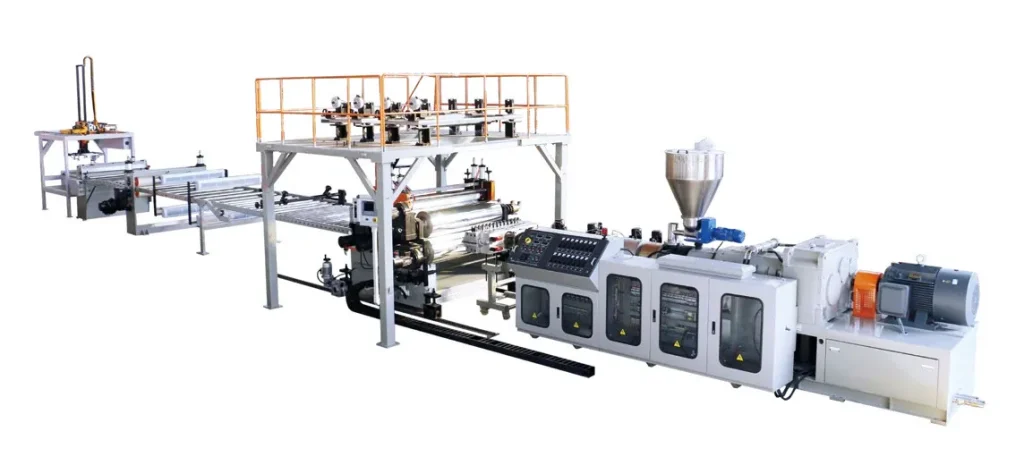
WPC Flooring Production Line

WPC Flooring Production Line

Extruder Type: Conical twin-screw, vented; Screw Material: 38CrMoAlA, nitrided, bimetallic optional; Screw Structure: Conical twin, designed for PVC + wood flour + CaCO₃ + foaming agent; L/D Ratio: Optimized for controlled foaming zone
Learn More ➔
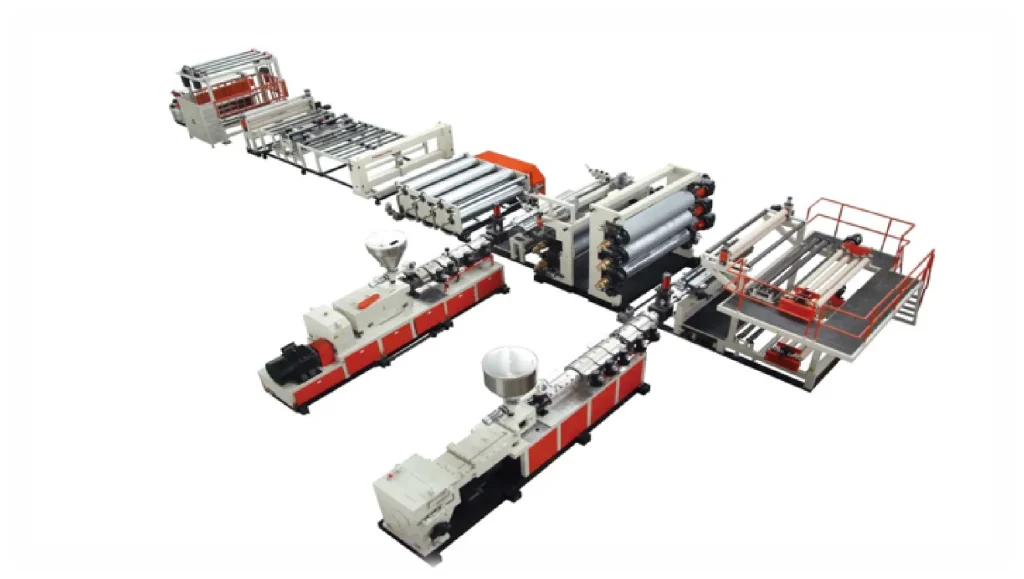
SPC Flooring Production Line

SPC Flooring Production Line

Screw Diameter: Φ 80 mm / Φ 92 mm / Φ 110 mm / Φ 180 mm; Output (24h, SPC): 6-8 T / 12-18 T / 25-32 T / 70-100 T; Line Speed at 4 mm: 0.4-0.6 m/min / 0.8-1.3 m/min / 1.8-2.4 m/min / 5-9 m/min; Screw Material: 38CrMoAlA, nitrided, bimetallic optional / ← Same / ← Same / ← Same

Learn More ➔

Why Choose Jwell for Your PET Sheet Line

🏭

Factory/Experience

Jwell has manufactured PET sheet extrusion equipment since 2005, accumulating field data from over 400 installed PET lines worldwide. Each new machine generation incorporates refinements validated across hundreds of real production environments — not just lab prototypes.

🔬

Test/Validate

Our Changzhou facility operates a full production-scale PET line for customer trials. Bring your raw materials and target specifications — we run your recipe before you commit. The line delivered to your factory is a proven configuration, eliminating startup risk.

🌍

Service/Support

Factory-trained Jwell engineers based in Brazil, Spain, Mexico, and Shanghai travel to customer sites for installation and operator training. Remote diagnostic support via WeChat/WhatsApp responds within 2 hours. Critical spares ship from Shanghai within 48 hours.

Request a Quote or Technical Consultation

Your information will never be shared with third parties.