
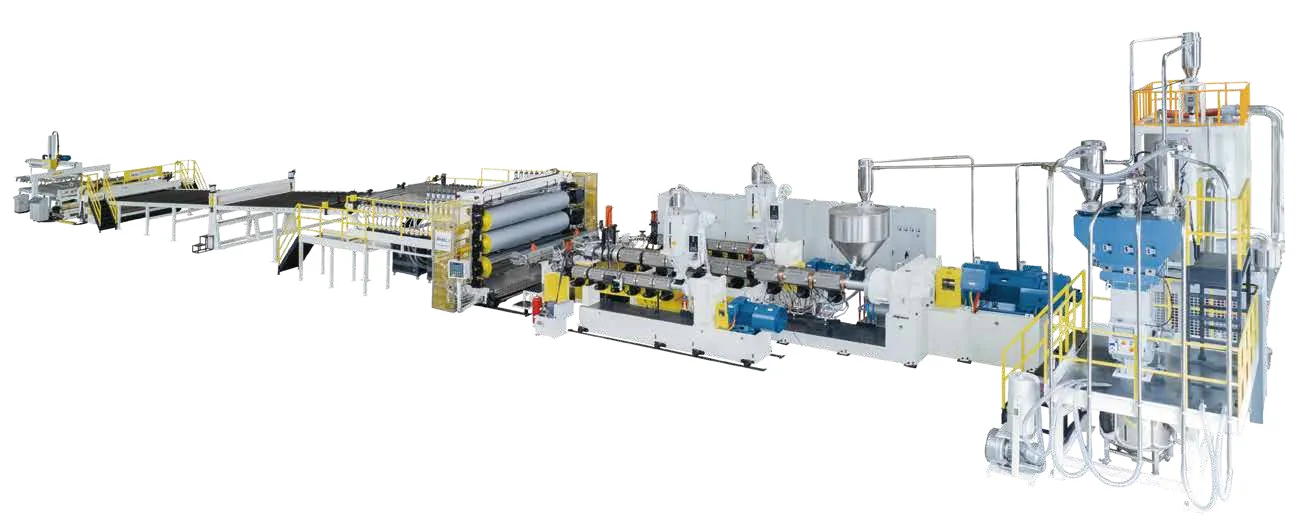
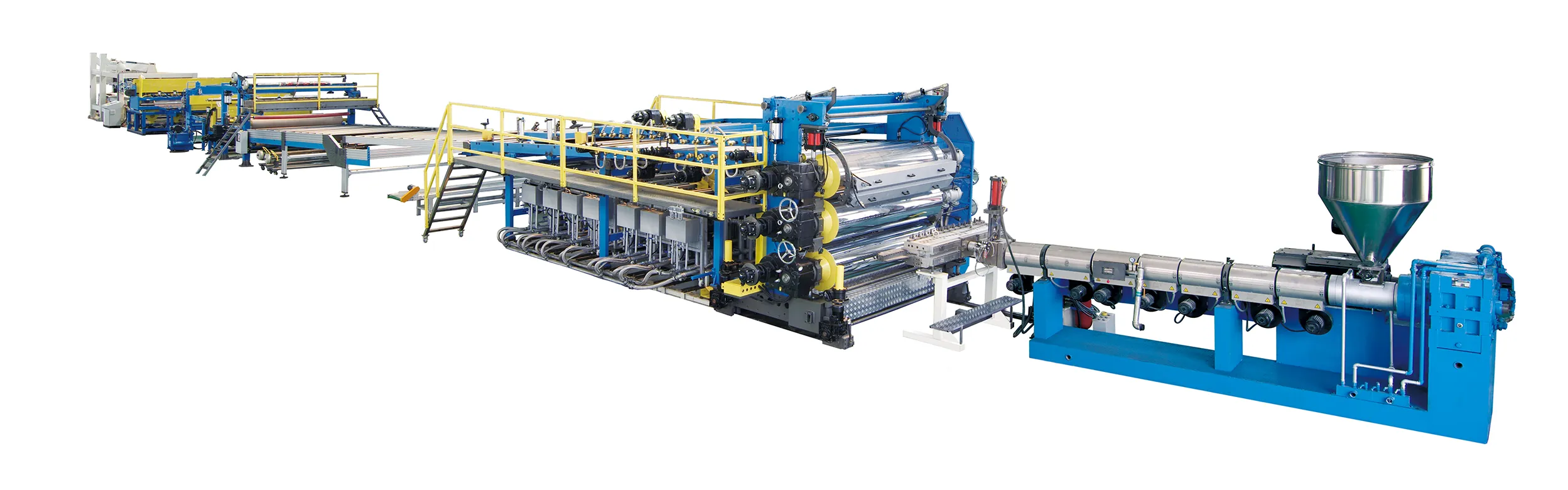
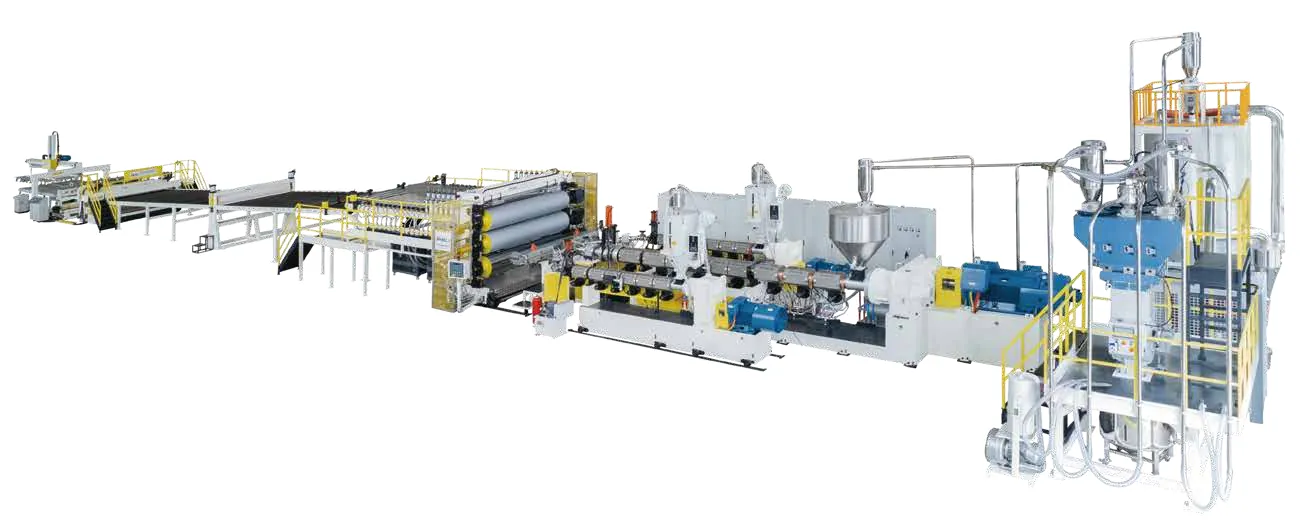
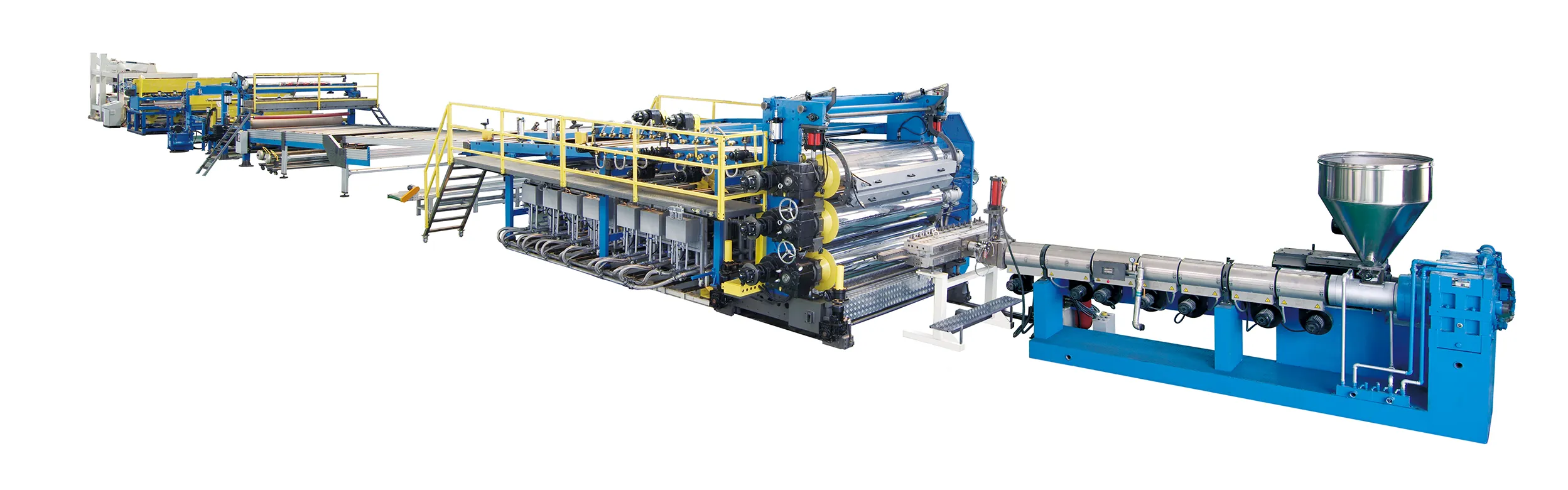
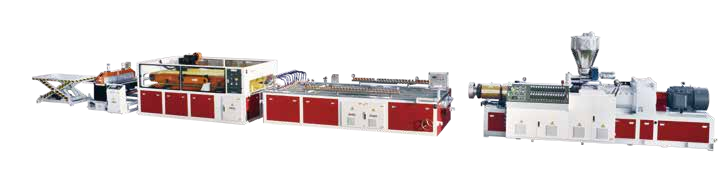
PP Thick Plate Extrusion Line

Single Screw 120/150/180 | Melt Pump | T-Die | 3-Roller | 500-800 kg/h | Film Lamination Option | CE/ISO 9001

| 1 | Three Model Options: 150/38/35 (500kg/h), 170/38/35 (700kg/h), 180/38/35 (800kg/h) | 规格配置 |

| 2 | 3-30 mm Thickness Range — the broadest heavy-gauge PP capability in its class | 产品性能 |

| 3 | Melt Pump Precision — gear pump eliminates output pulsation, ensures uniform thick section | 产线设计 |

PP Thick Plate Extrusion Line: Related JWELL Extrusion Lines

The PP Thick Plate Extrusion Line is part of JWELL’s complete extrusion portfolio. Customers evaluating this PP Thick Plate Extrusion Line also frequently request our PE Thick Plate Extrusion Line | Jwell Machinery and PP Honeycomb Board Line | Jwell Machinery, which share the same proven screw, die and control platforms. For layout drawings, pricing and lead times, contact JWELL Machinery directly.

# Item Key Point
1 🌀 Scalable Architecture Model 150/38/35 (500 kg/h), 170/38/35 (700 kg/h), 180/38/35 (800 kg/h) — 内容:
2 Jwell offers the PP thick plate extrusion line in three extruder configurations, each optimized for a spec
3 ⚡ Positive Displacement Gear Melt Pump Eliminating Output Pulsation for Consistent Thick Sections — 内容:
4 Heavy-gauge PP plate production at 500-800 kg/h presents a fundamental melt delivery challenge that single
5 🎯 3-Roller Vertical Calibration Individual Servo Drive, Precision Gap Control for 3-30mm — 内容:
6 The three-roller vertical calibration stack is the primary forming and surface-finishing station for PP th
7 🔄 Single Pass Production Extruder → Melt Pump → Screen Changer → T-Die → 3-Roller → Cooling → Haul-Off → Cross & Longitudinal Cutter → Stacker — 内容:
8 The Jwell PP thick plate extrusion line converts PP resin pellets into finished, dimensionally accurate pl

Scalable Architecture — Model 150/38/35 (500 kg/h), 170/38/35 (700 kg/h), 180/38/35 (800 kg/h)

内容:

Jwell offers the PP thick plate extrusion line in three extruder configurations, each optimized for a specific production capacity range, allowing manufacturers to select the model that matches their volume requirements without paying for excess capacity or outgrowing undersized equipment:

Model 150/38/35 (500 kg/h):

The entry-level configuration for manufacturers entering the heavy-gauge PP plate market. The 150 mm screw diameter with 38:1 L/D ratio provides the residence time needed for complete PP melt homogeneity at 500 kg/h throughput. This model is recommended for regional plate converters serving construction, chemical processing, and food industry customers within a 500 km distribution radius.

Model 170/38/35 (700 kg/h):

The mid-range configuration balancing throughput with operating cost efficiency. The 170 mm screw at 700 kg/h represents the sweet spot for manufacturers serving multiple market segments simultaneously — for example, producing chemical tank lining plate in one shift and food-grade cutting board stock in the next.

Model 180/38/35 (800 kg/h):

The high-output configuration for large-scale PP plate manufacturers supplying national or export markets. The 180 mm screw provides the melt pumping capacity required for continuous 800 kg/h operation, with downstream equipment sized proportionally to handle the material flow without bottlenecks.

All three models share the same line architecture — single screw → melt pump → screen changer → T-die → 3-roller → cooling → haul-off → cutter → stacker — enabling operators trained on one model to transition seamlessly between capacity levels.

Positive Displacement Gear Melt Pump — Eliminating Output Pulsation for Consistent Thick Sections

内容:

Heavy-gauge PP plate production at 500-800 kg/h presents a fundamental melt delivery challenge that single-screw extruders alone cannot solve: even minor output pulsation from screw rotation creates thickness variation that, at 10-30 mm sheet thickness, results in unacceptable gauge bands and internal density variation.

Jwell’s melt pump — a positive displacement gear pump positioned between the extruder discharge and the T-die — transforms the pulsating melt flow from the screw into a stable, volumetric flow with variation below ±0.5%. The pump’s precision-ground gears (hardened to 60 HRC minimum) are sized at 300-630 cc/rev to match each extruder model’s output range, with oversized bearings designed for the elevated discharge pressures of 20-35 MPa generated when pumping high-viscosity PP melt.

The melt pump delivers three critical benefits for thick plate quality:

1. Thickness Uniformity: Stable melt flow translates into sheet thickness control of ±1% of nominal for plates across the full 3-30 mm range, meeting the demanding flatness requirements of chemical tank butt-welding applications where thickness variation translates directly to welding joint quality.

2. Pressure Isolation: The pump decouples the extruder from the die hydraulically, meaning screw speed changes for throughput adjustment do not cause die pressure fluctuations that would produce transient thickness variation.

3. Energy Efficiency: By building die pressure through positive displacement rather than screw back-pressure, the melt pump reduces extruder motor load by 10-15% compared to direct screw-to-die configurations at equivalent throughput.

3-Roller Vertical Calibration — Individual Servo Drive, Precision Gap Control for 3-30mm

内容:

The three-roller vertical calibration stack is the primary forming and surface-finishing station for PP thick plate. After exiting the T-die, the molten PP sheet passes through the precisely gapped rollers where sheet thickness is established, surface finish is imparted, and initial cooling begins. For heavy-gauge PP plate (3-30 mm), the calibration stack must handle the thermal load and melt pressure of thick sections without roller deflection, surface marking, or gap variation.

Jwell’s calibration stack features:

– Individual Servo Drive per Roller: Each of the three rollers is driven by its own AC servo motor with closed-loop speed control synchronized to the haul-off system. This eliminates the inter-roller slippage that scratches the plate surface on chain-driven or single-motor calibration stacks.

– Roller Gap Positioning: Servo-driven wedge mechanisms set the roller gap with 0.01 mm positioning resolution. Gap settings are stored in the PLC recipe system, enabling rapid thickness changeover with one-touch recall of calibrated parameters.

– Heavy-Duty Roller Construction: Rollers are manufactured from forged alloy steel with chrome-plated surface finish (Ra ≤0.10 µm, hardness ≥64 HRC), sized at Φ400-500 mm diameter to provide the thermal mass required for consistent surface temperature during continuous heavy-gauge production.

– Individual Temperature Control: Each roller has its own closed-loop pressurized water circuit maintaining surface temperature within ±1°C across the full face width — critical for uniform sheet crystallinity and surface gloss.

Single Pass Production — Extruder → Melt Pump → Screen Changer → T-Die → 3-Roller → Cooling → Haul-Off → Cross & Longitudinal Cutter → Stacker

内容:

The Jwell PP thick plate extrusion line converts PP resin pellets into finished, dimensionally accurate plates in one continuous production pass. The process chain integrates every operation from raw material to palletized product:

1. Single Screw Extruder (120/150/180 mm): 33:1 L/D barrier screw generating homogeneous PP melt at 500-800 kg/h with melt temperature uniformity within ±2°C at the die entry

2. Melt Pump (300-630 cc/rev): Positive displacement gear pump stabilizing melt flow and building die pressure with <±0.5% flow variation

3. Hydraulic Continuous Screen Changer: Accepting contamination levels up to 0.5% in feedstock, enabling reclaimed PP material blending for non-food-contact applications

4. Flexible-Lip T-Die: Coat-hanger manifold die with chrome-plated flow surfaces, producing uniform melt web across the full plate width

5. 3-Roller Vertical Calibration Stack: Individually servo-driven rollers setting plate thickness, surface finish, and initiating controlled cooling

6. Multi-Roller Cooling Section: Graduated cooling conveyor reducing plate temperature at controlled rate to minimize internal stress and warpage

7. Haul-Off System: Precision speed-controlled pulling maintaining consistent line speed and sheet tension

8. Cross Cutter: Traveling saw cutting plates to programmed length with dimensional accuracy of ±1 mm

9. Longitudinal Slitter: Edge trimming and width slitting to finished panel dimensions

10. Automatic Stacker: Vacuum lift handling system stacking finished plates with interleaving sheet placement for surface protection

This full integration eliminates intermediate handling, storage, and secondary processing — delivering finished plates ready for fabrication, welding, or direct shipment from the end of the production line.

Technical Specifications

Model Comparison

Parameter Model 150/38/35 / Model 170/38/35 / Model 180/38/35
Production Capacity 500 kg/h / 700 kg/h / 800 kg/h
Screw Diameter Φ120 mm / Φ150 mm / Φ180 mm
L/D Ratio 38:1 / 38:1 / 38:1
Screw Design Barrier screw with mixing section / Barrier screw with mixing section / Barrier screw with mixing section
Main Motor Power 200 kW / 285 kW / 355 kW

Extruder & Melt Delivery

Parameter Specification
Extruder Type Single-screw, vented (optional)
Barrel Heating Zones Multi-zone, independent PID control
Heating Type Ceramic band heaters
Melt Pump Type Positive displacement gear pump
Melt Pump Capacity 300 – 630 cc/rev (model-dependent)
Melt Pump Discharge Pressure 20 – 35 MPa
Screen Changer Hydraulic, continuous operation
Screen Mesh 120 – 200 mesh

Sheet & Die Specifications

Parameter Specification
Applicable Material PP homopolymer, PP copolymer, PP + glass fiber (up to 30%), PP + mineral filler (up to 40%)
Sheet Width 1,220 mm, 1,500 mm, 2,000 mm (configurable)
Sheet Thickness 3 – 30 mm
Die Type Flexible-lip flat sheet die, coat-hanger manifold
Die Construction Chrome-plated, heavy-gauge body
Die Lip Deflection <0.05 mm at max operating pressure

Roll Stack & Cooling

Parameter Specification
Calibration Stack 3-roller vertical, individually servo-driven
Roller Diameter Φ400 mm / Φ500 mm
Roller Material Forged alloy steel, chrome-plated (Ra ≤0.10 µm, ≥64 HRC)
Roller Gap Resolution 0.01 mm (servo-controlled)
Roller Temperature Control Individual closed-loop water circuit, ±1°C
Cooling Conveyor Multi-stage, graduated temperature zones
Cooling Zone Control PLC-programmable temperature ramp profile

Lamination (Optional)

Parameter Specification
Lamination Position After cooling section, before cutter
Film Types PVC, PET, PMMA, printed decorative films
Application One or both surfaces
Nip Pressure Uniform full-width pneumatic/hydraulic
Lamination Bond Temperature 80-110°C (plate surface)

Cutting & Handling

Parameter Specification
Haul-Off Speed 0.2 – 5.0 m/min
Cross Cutter Traveling circular saw
Longitudinal Slitter Edge trim + width slitting
Cutting Accuracy ±1 mm (length)
Stacker Vacuum lift, configurable suction cup array
Max Plate Weight (Stacker) 120 kg

Control & Certifications

Parameter Specification
Control System Siemens S7-1500 PLC
HMI 15-inch touchscreen with recipe management
Data Logging 50+ parameters at 10-second intervals
Industry 4.0 PROFINET/Ethernet/IP, MES/ERP integration ready
Certifications CE, ISO 9001
Available as Complete line turnkey solution
After-Sales Global engineer certification system, 48-hour spare parts dispatch

Chemical Tank Lining & Corrosion-Resistant Industrial Equipment

描述:

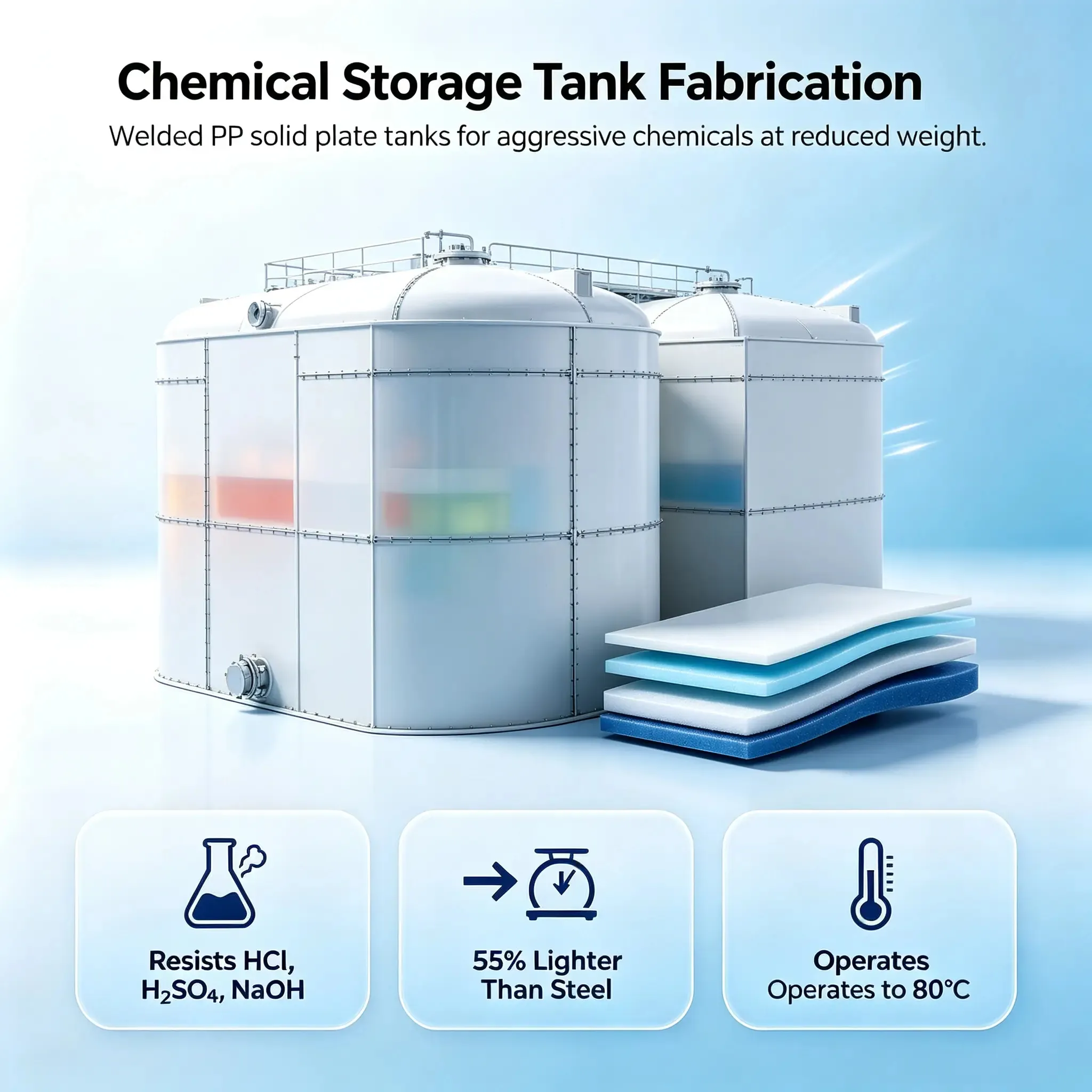
Chemical processing facilities use PP thick plates (8-20 mm) to fabricate storage tanks, reaction vessels, electroplating bath liners, and fume extraction ductwork for handling concentrated acids (HCl up to 36%, H₂SO₄ up to 96%), alkalis (NaOH up to 50%), and aggressive solvents at operating temperatures up to 100°C. PP’s density of 0.91 g/cm³ means fabricated tanks weigh approximately 55% of equivalent steel vessels — reducing installation costs and simplifying support structure requirements.

Custom chemical vessel fabricators use hot-gas or extrusion welding to join PP thick plates into tanks, with the plate’s uniform thickness (maintained by the melt pump + graduated cooling system) ensuring consistent welding joint quality and vessel integrity under hydrostatic pressure testing. PP’s 50+ year design life in properly specified chemical service, combined with its zero corrosion rate in acid and alkali environments, makes it the material of choice for chemical containment where stainless steel would suffer pitting, crevice corrosion, or stress corrosion cracking.

Marine Dock Fendering & Waterfront Infrastructure

描述:

Port authorities and marina operators specify PP thick plates (15-25 mm) for fender backing boards installed between steel fender panels and concrete dock walls. PP’s zero water absorption eliminates the swelling, cracking, and biological degradation that destroy timber backing boards in saltwater service within 3-5 years. UV-stabilized PP grades maintain mechanical properties through years of tropical sun exposure without embrittlement, and the material’s compressive strength of 25-35 MPa at 10% deformation provides reliable load distribution across the fender-to-dock interface.

Additional marine applications include: lock gate bearing surfaces where PP’s self-lubricating properties and resistance to submerged service eliminate the greased-bearing maintenance requirements of metal alternatives; cathodic protection insulation plates in impressed-current anti-corrosion systems where PP’s electrical insulation properties prevent stray current leakage; and seawall expansion joint filler boards where PP’s resistance to marine organisms (barnacles, teredo worms) ensures joint integrity over decades of immersion service.

Frequently Asked Questions

What is the thickness range and production capacity of Jwell's PP thick plate extrusion line? -

The Jwell PP thick plate extrusion line produces polypropylene plates from 3 to 30 mm thickness at output rates of 500-800 kg/h, depending on the extruder configuration. Three extruder models are available: model 150/38/35 delivers 500 kg/h, model 170/38/35 delivers 700 kg/h, and model 180/38/35 delivers 800 kg/h. The complete line integrates single screw extruder (120/150/180 mm diameter) → melt pump → screen changer → T-die → 3-roller calibration → cooling → haul-off → cross & longitudinal cutter → stacker, with optional inline film lamination capability.

What are the main applications for PP thick plates produced on this line? +

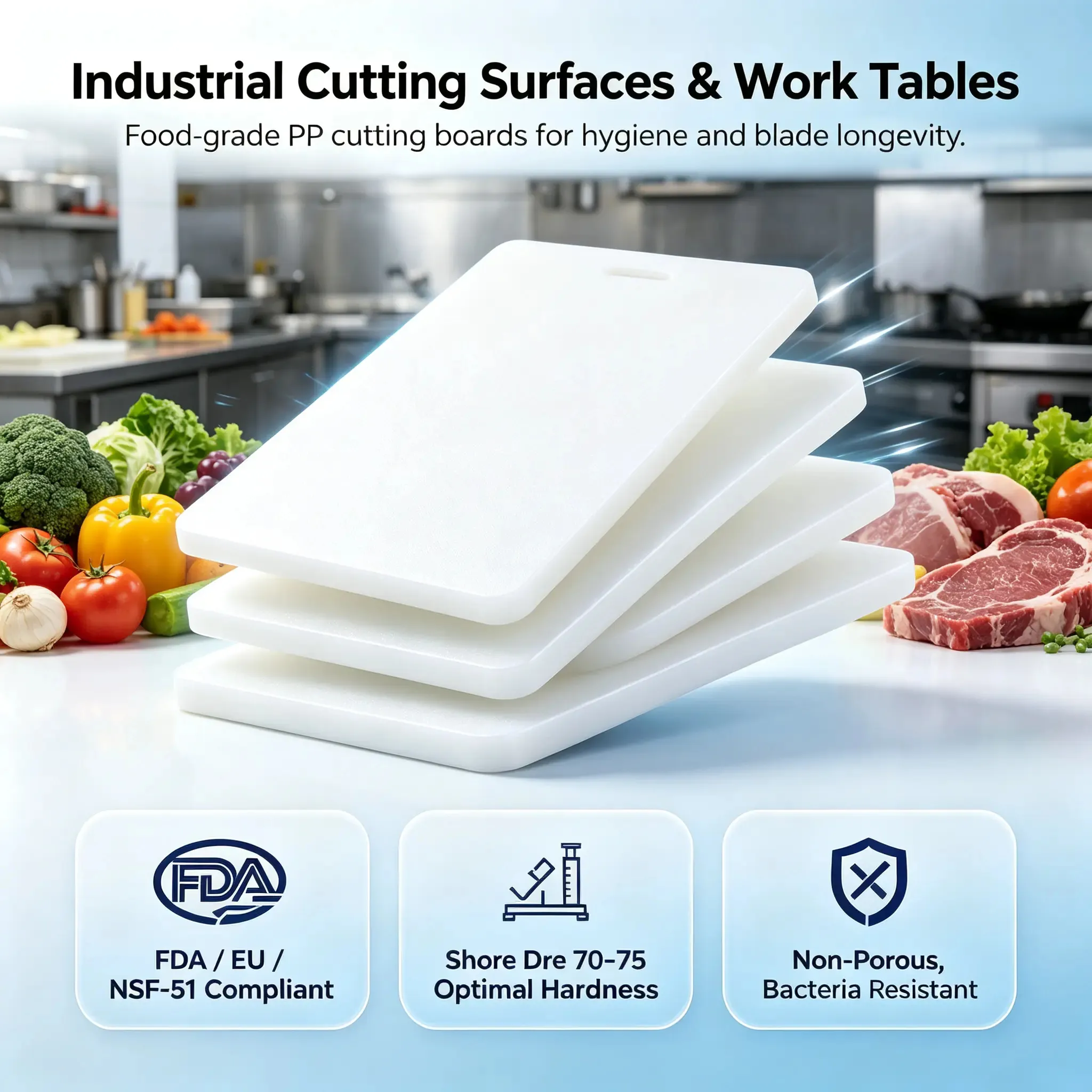
PP thick plates (3-30 mm) produced on the Jwell line serve four primary application categories: (1) Chemical tank lining and corrosion-resistant industrial equipment — PP’s resistance to concentrated acids, alkalis, and solvents at operating temperatures up to 100°C makes it the material of choice for chemical processing vessels; (2) Marine dock fendering and waterfront infrastructure — zero water absorption, marine organism resistance, and UV-stabilized grades ensure long service life in saltwater environments; (3) Food cutting boards and commercial kitchen work surfaces — FDA and EU 10/2011 compliant, non-porous surface prevents bacterial penetration; (4) Outdoor recreation equipment — playground components, park benches, and recreational facility structures requiring weather resistance and durability.

What are the key components of the Jwell PP thick plate extrusion line? +

The Jwell PP thick plate extrusion line integrates nine key processing stations in a complete continuous production system: (1) Single Screw Extruder — 120/150/180 mm diameter options with 33:1 L/D barrier screw for homogeneous PP melt at high throughput; (2) Melt Pump — positive displacement gear pump (300-630 cc/rev) eliminating output pulsation and stabilizing melt flow; (3) Hydraulic Screen Changer — continuous operation enabling mesh changes without production interruption; (4) T-Die — flexible-lip flat sheet die with coat-hanger manifold; (5) 3-Roller Vertical Calibration Stack — individually driven, chromed and polished rollers for sheet thickness and surface finish control; (6) Cooling Section — multi-roller conveyor with controlled temperature gradient; (7) Haul-Off — precision speed-controlled sheet pulling; (8) Cutting System — cross-cutter and longitudinal slitter for panel sizing; (9) Automatic Stacker — finished sheet handling and palletizing.

Does the PP thick plate line support inline film lamination? +

Yes. The Jwell PP thick plate extrusion line can be equipped with an inline film lamination station positioned after the calibration stack. This station applies decorative, protective, or functional films (PVC, PET, PMMA, or printed decorative films) to one or both surfaces of the PP plate while the plate retains residual extrusion heat, eliminating the need for a separate offline lamination process. Common applications include decorative film lamination for furniture and construction panels, UV-protective film for outdoor applications, and anti-static film for electronics manufacturing work surfaces. The lamination station is optional and can be specified at time of order or retrofitted to existing Jwell thick plate lines.

What is the difference between PP thick plate and PP solid plate extrusion lines? +

The primary difference is the thickness range and throughput capacity. PP thick plate lines (this line) handle 3-30 mm thickness at 500-800 kg/h, using larger extruders (120/150/180 mm) and including a melt pump and film lamination capability. PP solid plate lines typically handle 3-25 mm at 300-800 kg/h, focusing on general-purpose sheet production. The thick plate line’s integrated cutting system (cross + longitudinal cutter) and automatic stacker are optimized for producing finished panels ready for fabrication, whereas solid plate lines may produce rolls or sheets for diverse converting applications. The thick plate line is the recommended choice for manufacturers producing heavy-gauge PP plate for chemical tank fabrication, marine infrastructure, and industrial applications where high throughput of thick sections is the primary requirement.

Related Sheet Extrusion Lines

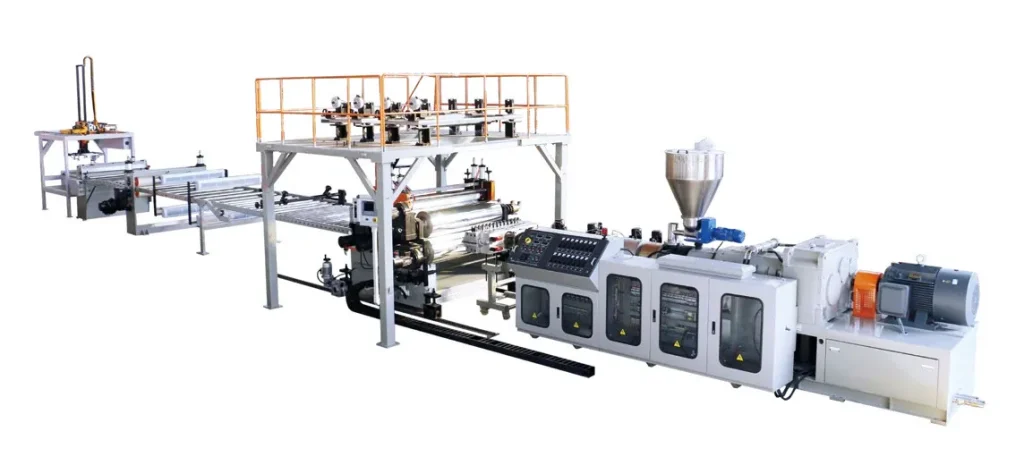
WPC Flooring Production Line

WPC Flooring Production Line

Extruder Type: Conical twin-screw, vented; Screw Material: 38CrMoAlA, nitrided, bimetallic optional; Screw Structure: Conical twin, designed for PVC + wood flour + CaCO₃ + foaming agent; L/D Ratio: Optimized for controlled foaming zone
Learn More ➔
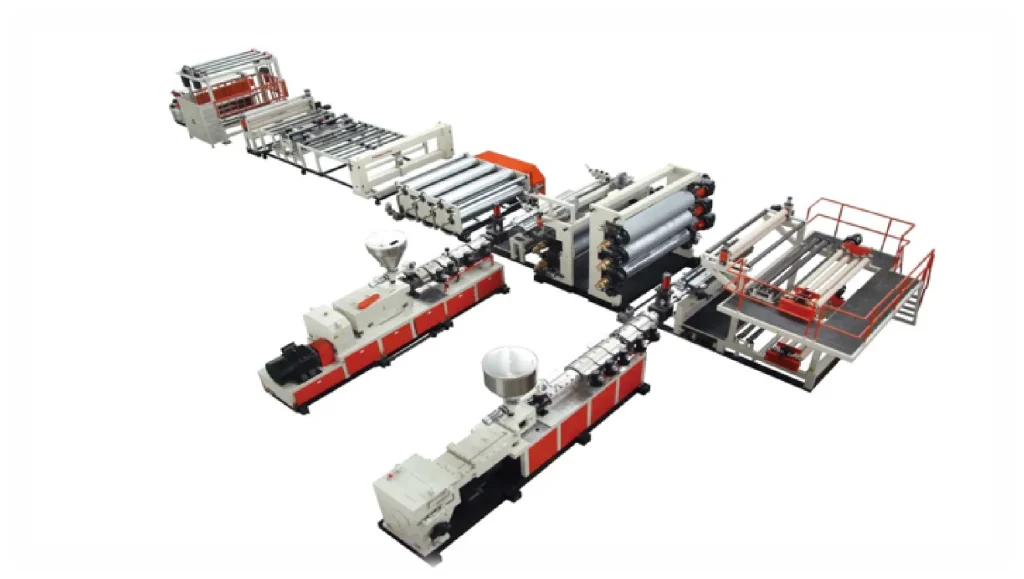
SPC Flooring Production Line

SPC Flooring Production Line

Screw Diameter: Φ 80 mm / Φ 92 mm / Φ 110 mm / Φ 180 mm; Output (24h, SPC): 6-8 T / 12-18 T / 25-32 T / 70-100 T; Line Speed at 4 mm: 0.4-0.6 m/min / 0.8-1.3 m/min / 1.8-2.4 m/min / 5-9 m/min; Screw Material: 38CrMoAlA, nitrided, bimetallic optional / ← Same / ← Same / ← Same

Learn More ➔

Why Choose Jwell for Your PET Sheet Line

🏭

Factory/Experience

Jwell has manufactured PET sheet extrusion equipment since 2005, accumulating field data from over 400 installed PET lines worldwide. Each new machine generation incorporates refinements validated across hundreds of real production environments — not just lab prototypes.

🔬

Test/Validate

Our Changzhou facility operates a full production-scale PET line for customer trials. Bring your raw materials and target specifications — we run your recipe before you commit. The line delivered to your factory is a proven configuration, eliminating startup risk.

🌍

Service/Support

Factory-trained Jwell engineers based in Brazil, Spain, Mexico, and Shanghai travel to customer sites for installation and operator training. Remote diagnostic support via WeChat/WhatsApp responds within 2 hours. Critical spares ship from Shanghai within 48 hours.

Request a Quote or Technical Consultation

Your information will never be shared with third parties.