
PVC Marble Sheet Extrusion Line

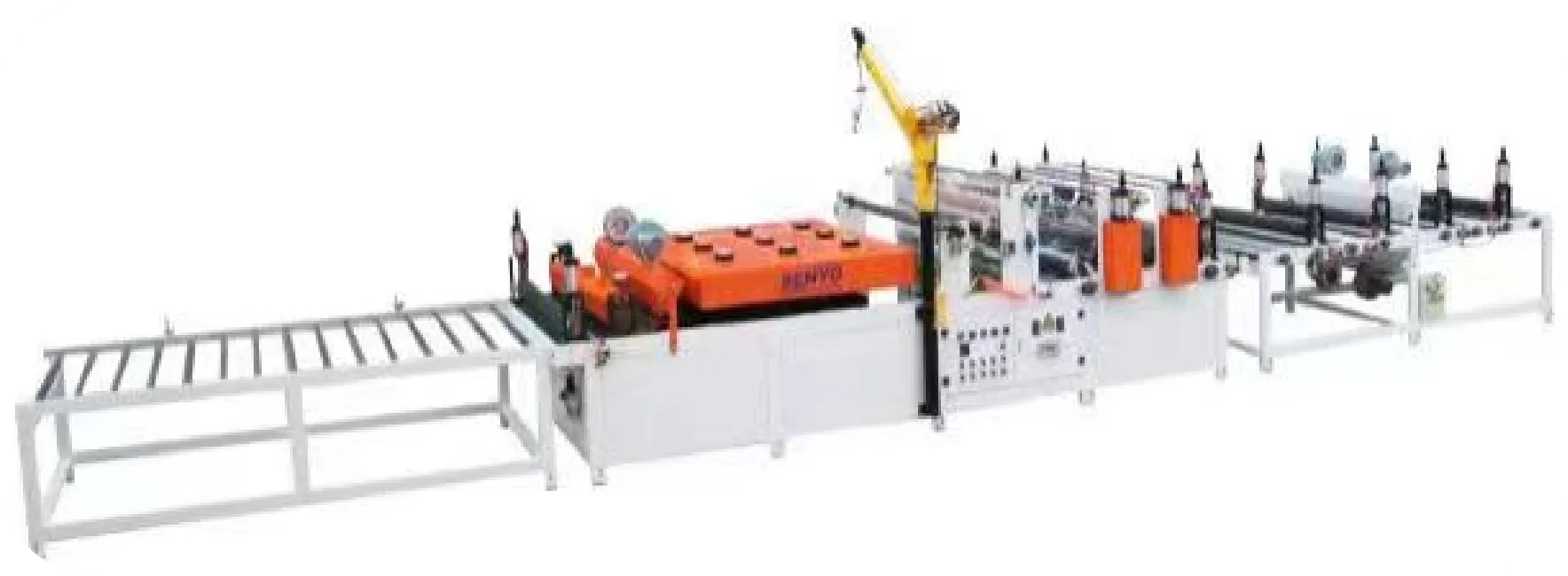
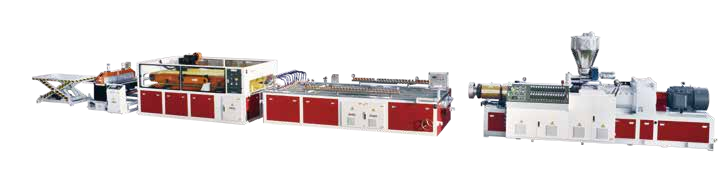
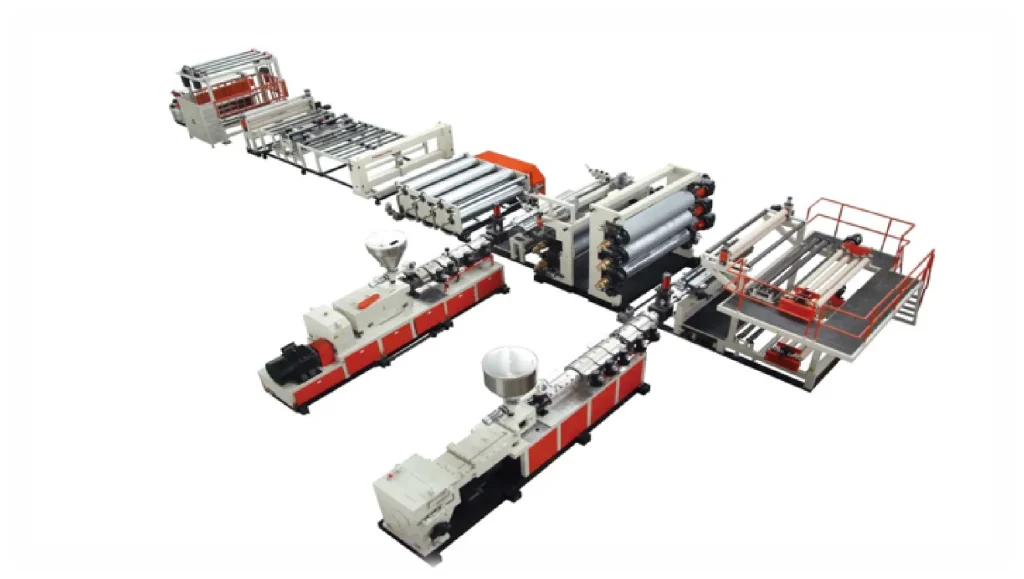
| pvc-lamination-panel-extrusion-line.webp | Jwell PVC marble sheet production line — complete production line with embossing roller system | 主图 |

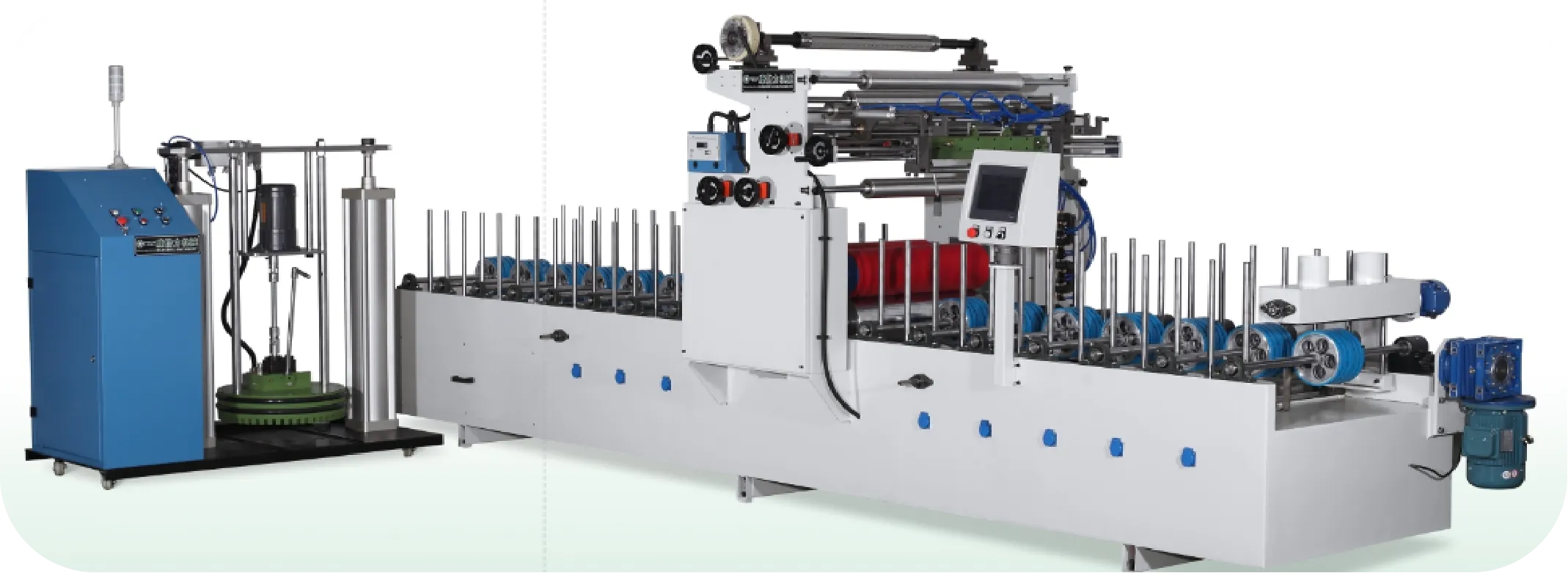
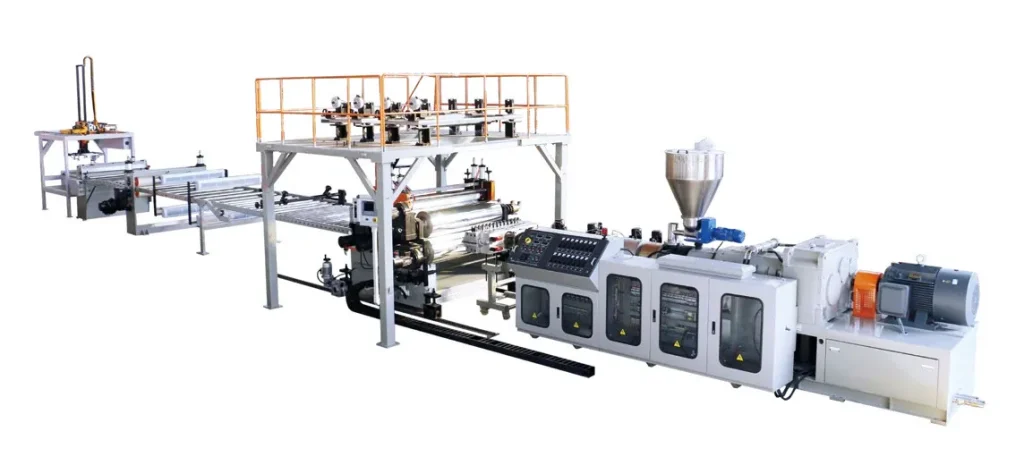
| pvc-lamination-panel-extrusion-line(1).webp | Jwell PVC marble sheet line — conical twin-screw extruder and embossing calendar detail | 整线安装 |

See the PVC Marble Sheet Production Line in Action

PVC Marble Sheet Extrusion Line: Related JWELL Extrusion Lines

The PVC Marble Sheet Extrusion Line is part of JWELL’s complete extrusion portfolio. Customers evaluating this PVC Marble Sheet Extrusion Line also frequently request our PVC Soft Rigid Sheet Extrusion Line | Jwell Machinery and SPC Flooring Production Line | Jwell Machinery, which share the same proven screw, die and control platforms. For layout drawings, pricing and lead times, contact JWELL Machinery directly.

# Item Key Point
1 🌀 Marble Texture via Embossing Roller precision-engraved stone pattern transferred directly to PVC sheet surface
2 ⚡ Conical Twin-Screw Extruder counter-rotating, optimized for PVC + CaCO3 filled compounds
3 🎯 200-500 kg/h Output scalable capacity for decorative panel production
4 🔄 Integrated Protective Film Lamination PE film applied inline to preserve marble texture
5 🔧 Complete Production Chain extruder -> T-die -> embossing roller -> cooling -> film lamination -> cutter
6 ✅ Interchangeable Pattern Sleeves Carrara, Calacatta, Nero Marquina, custom designs, 2-3 hour changeover
7 ♻️ Siemens PLC Control recipe management for pattern/compound changeover, 50+ parameter logging
8 🌍 CE Certified, ISO 9001 29 years, 8 bases, 3500 employees, 25000+ lines worldwide since 1997

Conical Twin-Screw Extruder — Optimized for PVC + CaCO3 Filled Compounds

The Jwell PVC marble sheet production line is built around a conical twin-screw extruder — the industry-standard extrusion technology for PVC processing. The counter-rotating screw geometry creates a positive displacement pumping action that provides controlled, low-shear melting of the highly filled PVC compound (typically 40-60% CaCO3 filler content by weight). Single-screw extruders cannot match this performance: they rely on friction-to-viscous drag transition for melting, which generates excessive shear heating in CaCO3-filled compounds and leads to thermal degradation hotspots.

The conical twin-screw geometry addresses these requirements through its counter-rotating, intermeshing screw design that functions as a positive displacement pump. Material moves forward in discrete, enclosed volumes between screw flights — minimizing shear heating, maximizing throughput stability, and ensuring thorough wetting of filler particles by the PVC melt.

The screws are manufactured from nitrided steel with surface hardness HV>=740 on the flight lands and HV>=940 on the barrel interior. The nitriding treatment creates a 0.5-0.7mm deep case that resists abrasive wear from CaCO3 filler while maintaining the substrate toughness required to survive accidental metal tramp. Screw and barrel lifetime in CaCO3-filled PVC service typically exceeds 5 years before reconditioning is needed.

A gravimetric dosing system feeds the PVC compound — typically a dry blend of PVC resin, CaCO3, stabilizer, lubricant, and marble-color masterbatch — with batch accuracy of +/-0.5%, ensuring consistent compound composition from the first kilogram of sheet to the last.

配图建议: 锥形双螺杆挤出机主机近景,标注螺杆型号和CaCO3喂料系统

Embossing Roller Technology — Marble Stone Texture Transfer

The embossing roller is the defining technology of the PVC marble sheet production line — it transforms a flat, uniform PVC sheet into a decorative product. Positioned immediately after the T-die and integrated into the 3-roller calendar stack, the embossing roller permanently imprints a stone pattern onto the still-warm PVC sheet surface (130-160°C at the embossing nip).

The embossing roller surface is engraved with a stone pattern derived from a high-resolution scan of natural marble — capturing the vein patterns, crystal structure details, and natural color variation boundaries that the human eye uses to identify “real marble.” The engraving process resolves features down to 0.1mm in size and pattern depths of 0.05-0.15mm, creating a surface texture with both visual fidelity and tactile authenticity.

The embossing roller is maintained at 40-70°C by an internal temperature control circuit. This temperature range is critical: too hot, and the PVC sheet surface becomes too fluid, filling the engraving valleys and losing texture definition; too cold, and the sheet surface does not flow into the engraving depth, producing shallow, washed-out texture. The +/-1°C temperature uniformity across the full roller face width ensures consistent texture quality edge-to-edge in sheet widths up to 1,560mm.

Jwell offers standard marble pattern sleeves (Carrara white, Calacatta gold, Emperador brown, Nero Marquina black, travertine beige) and custom-engineered sleeves from customer-provided marble samples. Sleeve changeover is completed in 2-3 hours including PLC recipe changeover for the new pattern’s optimized process parameters.

配图建议: 压花辊筒近景,展示大理石纹理雕刻表面

Protective Film Lamination Unit — Inline Surface Protection

The embossed marble texture on PVC decorative sheet is a premium surface feature that is extraordinarily vulnerable to scratching during cutting, stacking, transport, and on-site installation. A single scratch across the marble vein pattern renders the sheet unusable for premium wall panel or furniture applications.

Jwell integrates a protective film lamination unit directly into the production line, positioned after the cooling bracket and before the cutter. This strategic position applies the PE protective film while the sheet surface retains sufficient residual heat (40-50°C) to bond the film without adhesive — eliminating the risk of adhesive residue on the marble texture after film removal at the installation site.

The lamination unit accommodates film widths matching the sheet width (up to 1,560 mm) and applies film at line speed without creating tension disturbances. Automatic edge alignment ensures full coverage with zero exposed marble surface. Splice detection alerts operators before a film roll change is needed, preventing unprotected sheet from reaching the cutter.

For converters producing marble sheet for premium furniture and wall panel applications, the protective film is not an optional accessory but a production requirement. Jwell’s integrated lamination unit turns this requirement into a seamless, automated process step.

配图建议: 覆膜单元近景,展示保护膜贴合过程

Precision T-Die and Thickness Control — Uniform Sheet for Decorative Applications

The T-die is the component that distributes the PVC melt from the cylindrical extruder output into a flat, uniform sheet web across the full production width. For decorative PVC marble sheet, die performance directly determines the visual quality of the final product — thickness variations as small as +/-5% create visible marble pattern distortion.

Jwell uses a coat-hanger manifold T-die manufactured from high-quality mold steel with a chrome-plated flow channel. The coat-hanger manifold geometry is computationally optimized to deliver uniform melt distribution across the full die width with minimum residence time — important for heat-sensitive PVC where prolonged residence at 180°C can initiate thermal degradation.

For automated thickness control, the line can be equipped with an online thickness gauge (beta or laser) that continuously measures the sheet profile and sends feedback signals to an automatic T-die, where individual thermal bolts adjust the die lip opening in real time. Combined with the servo-driven roll gap adjustment (0.01mm precision), this system maintains thickness tolerance within +/-3% standard, or +/-1.5% with the automated option.

The die lip surface is polished to Ra 0.05micrometer to prevent die lines — longitudinal streaks in the sheet surface caused by roughness or buildup on the die lip edge. For marble-textured decorative sheet, die lines are particularly visible because the stone pattern makes any linear surface defect stand out against the organic, non-linear marble texture.

配图建议: T-die模头近景,展示衣架形流道和柔性模唇调节系统

Technical Specifications

Extruder

Parameter Specification
Extruder Type Conical twin-screw, counter-rotating, intermeshing
Model Options 80/156 (small-end 80mm / large-end 156mm) / 92/188
Screw Material Nitrided steel, HV >=740 (flight), HV >=940 (barrel)
Barrel Liner Bimetallic, Xaloy X-800 equivalent, 58-62 HRC
Screw Speed 5-35 rpm (PVC-optimized low-speed range)
Drive Motor AC, variable frequency, 55-90 kW (model dependent)
Heating Zones 8-12 zones, independent PID control
Cooling Type Forced air (standard) / water mist (optional)
Feeding System Gravimetric dosing for PVC dry blend / pellets

Die & Embossing Calendar

Parameter Specification
Die Type Coat-hanger manifold, flexible-lip
Die Material High-quality mold steel, chrome-plated flow channel
Die Lip Surface Roughness Ra 0.05 micrometers
Calendar Type 3-roller vertical or inclined
Roll Diameter 300-400 mm
Embossing Roller Chrome-plated, precision-engraved stone pattern
Pattern Depth 0.05 – 0.15 mm
Pattern Resolution Down to 0.1 mm feature size
Embossing Roller Temperature 40 – 70°C, +/-1°C across face width
Other Rollers Chrome-plated smooth, Ra <=0.02 micrometers
Roll Gap Adjustment Servo-driven, 0.01mm precision
Sleeve Changeover 2-3 hours including PLC recipe changeover

Production Parameters

Parameter Specification
Material PVC + CaCO3 filler (40-60%) + stabilizer + marble-color masterbatch
Output Capacity 200 – 500 kg/h (model & formulation dependent)
Sheet Thickness 0.5 – 3.0 mm
Sheet Width 900 – 1,560 mm
Thickness Tolerance +/-3% (with optional online thickness gauge)
Line Speed 2 – 12 m/min (thickness & formulation dependent)
Downstream Equipment Extruder -> T-die -> Embossing roller -> Cooling -> Protective film lamination -> Cutter -> Stacker
Protective Film PE film, heat-bonded, auto edge alignment, splice detection
Control System Siemens S7-1200 PLC + 10″ HMI
Total Installed Power 120 – 220 kW
Power Supply 380V/50Hz (440V/60Hz adaptable)
Certifications CE, ISO 9001

Available Marble Patterns

Pattern Name Description / Base Color
Carrara White Fine gray veining on white background / White
Calacatta Gold Bold gold and gray veining on white / White
Nero Marquina White veining on black background / Black/Gray
Emperador Brown Light veining on chocolate brown / Brown
Travertine Beige Linear texture on warm beige / Beige
Custom Customer-provided marble sample or digital file / Custom

Decorative Wall Panels

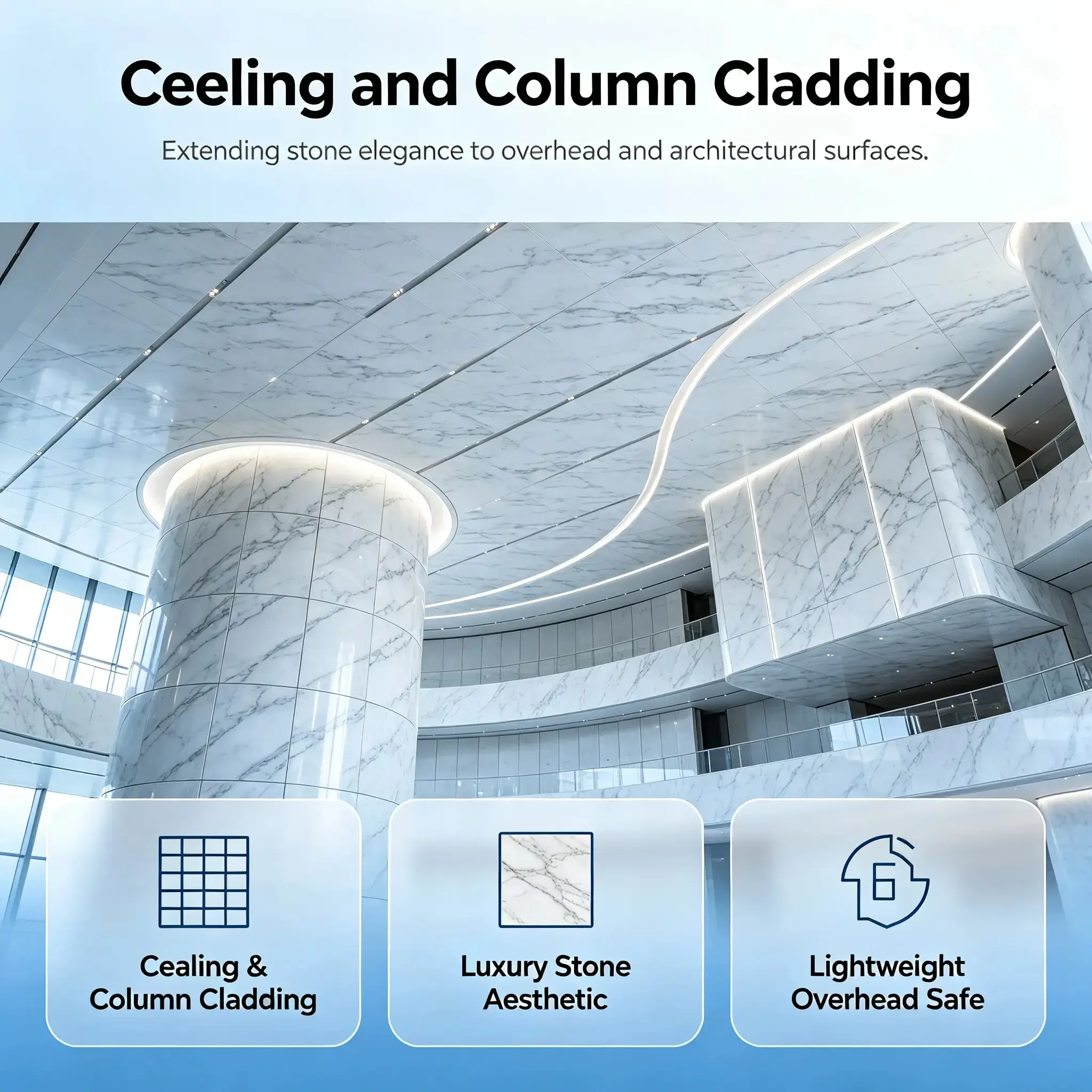
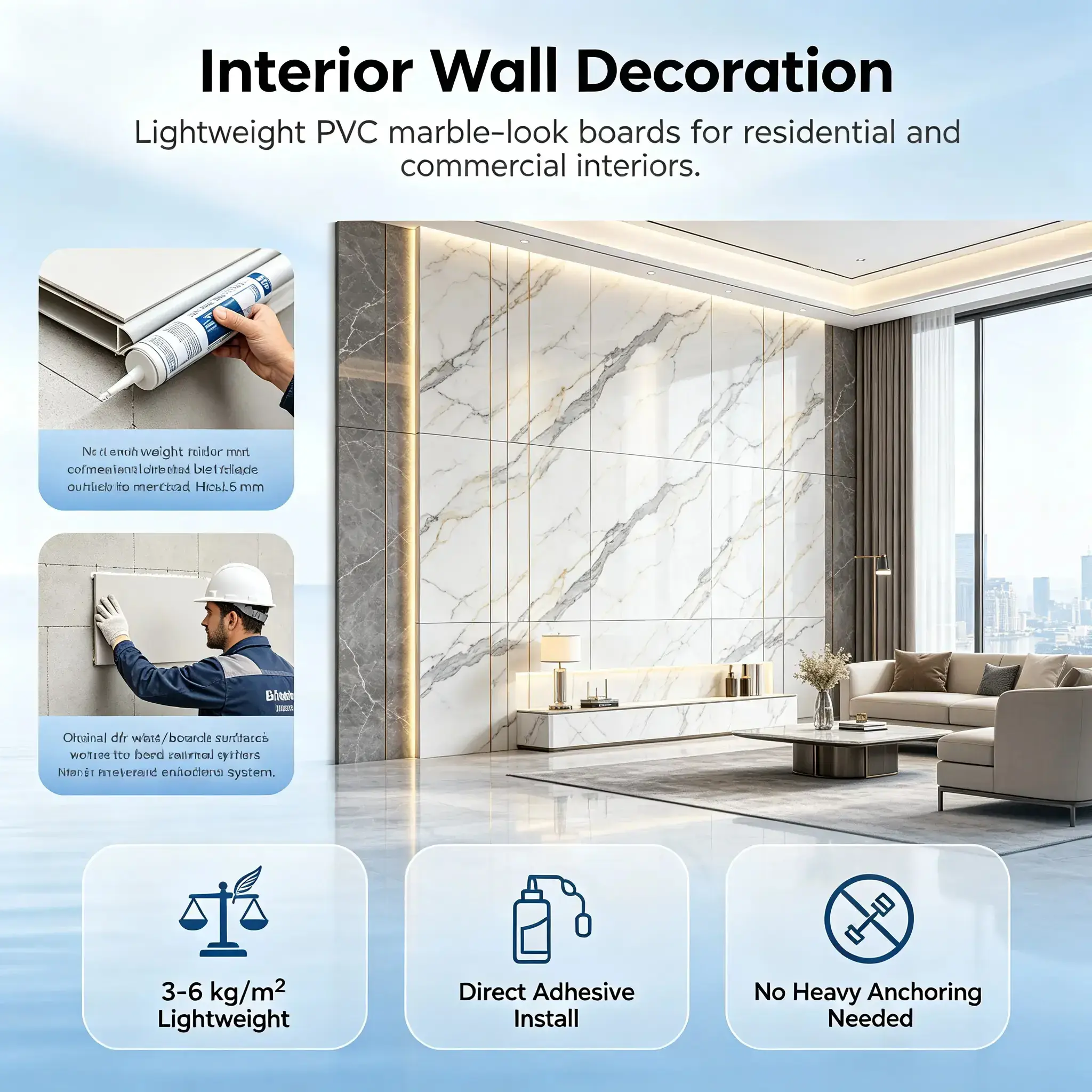
PVC marble sheet at 1.0-3.0 mm thickness is the leading material for decorative wall cladding in residential interiors, hotel lobbies, restaurant dining rooms, retail spaces, and corporate offices. It delivers the luxury stone aesthetic at a fraction of natural marble’s cost and installation complexity — mounted with adhesive or clip systems on standard drywall substrates without the structural reinforcement natural stone panels require.

The Jwell PVC marble sheet line produces wall-panel-grade sheet with the consistent embossing depth and thickness uniformity that large-format wall installations demand. In premium wall panel applications, panel-to-panel marble pattern continuity is the quality metric that separates professional-grade sheet from commodity material. The precision-engraved embossing roller and repeatable process conditions (temperature, pressure, line speed) maintained by the Siemens PLC ensure that every panel from the same production batch carries the identical marble pattern with zero batch-to-batch variation.

The integrated protective film lamination ensures that wall panels arrive at the installation site with pristine marble texture — critical for feature walls and high-visibility retail environments where surface quality sells the space.

PVC Marble Sheet Extrusion Line

Furniture Surface & Cabinet Doors

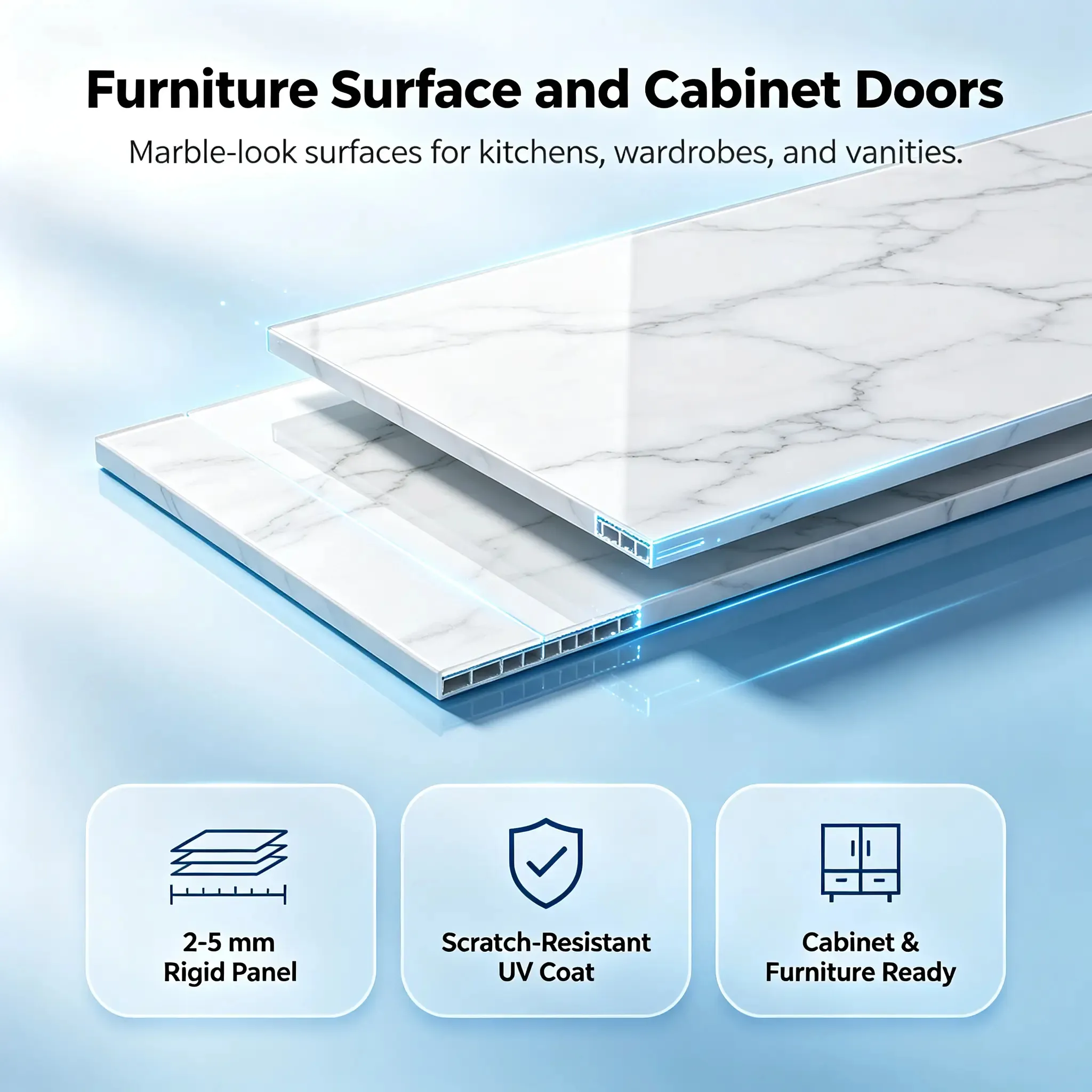
PVC marble sheet at 0.5-2.0 mm thickness is increasingly used as the surface material for kitchen cabinet doors, wardrobe fronts, bathroom vanity tops, and modular office furniture. The thin sheet is laminated to a substrate (MDF, particle board, or plywood) using PVA or PUR adhesive, creating a finished furniture component with marble appearance at less than one-tenth the weight and cost of natural stone.

For furniture applications, the marble texture quality is the primary differentiator between premium and budget products. The Jwell embossing roller’s 0.1mm feature resolution and 0.05-0.15mm pattern depth create texture detail that survives the lamination process and end-user handling — distinguishing Jwell-produced marble sheet from the shallow, easily-worn texture of low-cost calendar lines. In furniture showrooms, customers touch cabinet doors — the tactile quality of the marble texture is as important as the visual appearance.

The line’s consistent thickness control (+/-3% with optional gauge) is critical for furniture applications because the thin PVC sheet is laminated to substrate materials. Thickness variation causes uneven adhesive distribution and visible surface waves in the finished furniture panel.

Frequently Asked Questions

How does the Jwell PVC marble sheet production line create the stone texture? -

The marble texture is created by an embossing roller positioned immediately after the T-die in the 3-roller calendar stack. The embossing roller has a precision-engraved stone pattern surface (0.05-0.15mm depth, down to 0.1mm feature resolution) derived from high-resolution scans of natural marble. As the still-warm PVC sheet passes through the embossing nip, the surface is permanently imprinted with the stone pattern. The embossing roller is maintained at 40-70°C by an internal temperature control circuit to ensure consistent, defect-free texture transfer.

What is the thickness and width range of PVC marble sheet produced on this line? +

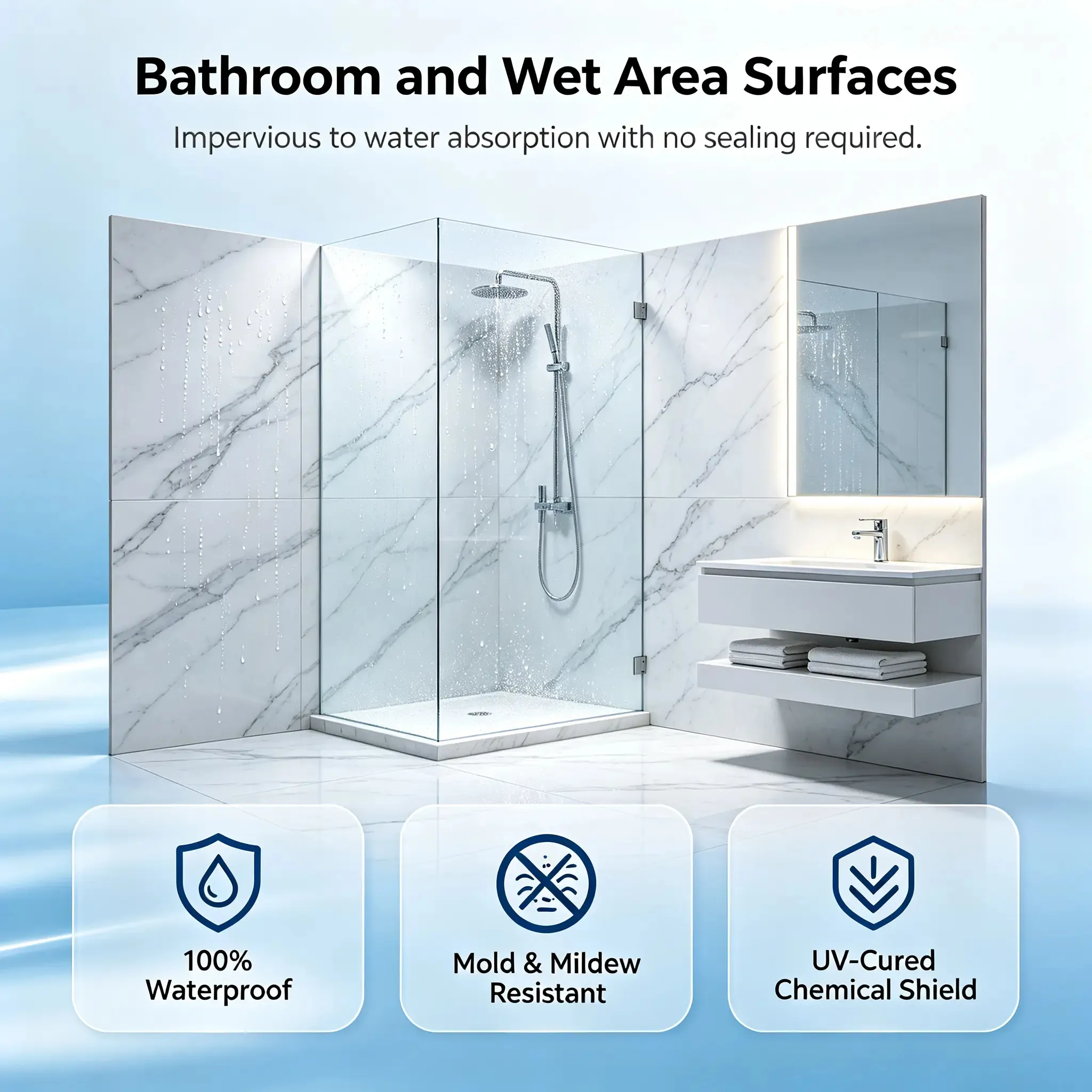
The line produces PVC marble sheet from 0.5 to 3.0 mm thickness with sheet width from 900 to 1,560 mm. This thickness range covers the primary decorative panel applications: wall panels at 1.0-3.0mm, furniture surfaces at 0.5-2.0mm, and bathroom/wet-area panels at 2.0-3.0mm. Thickness tolerance is ±3% standard, improving to ±1.5% with the optional online thickness gauge and closed-loop die lip control.

What is the production process flow of the PVC marble sheet line? +

The complete production process comprises six synchronized stages: (1) Conical twin-screw extruder melts and homogenizes PVC compound (resin + CaCO3 + stabilizer + marble-color masterbatch) at 160-190°C; (2) T-die distributes melt into a uniform flat sheet web; (3) 3-roller embossing calendar calibrates thickness and transfers marble texture via the precision-engraved embossing roller; (4) Cooling bracket brings sheet to ambient temperature under controlled conditions; (5) Protective film lamination unit applies PE film to the embossed surface; (6) Cross-cut saw produces flat panels at programmable lengths (±1mm accuracy). All stages are synchronized through the main PLC.

Can the embossing roller pattern be changed for different marble designs? +

Yes. The embossing roller accepts interchangeable surface sleeves with different stone patterns. Jwell offers standard marble pattern sleeves: Carrara White, Calacatta Gold, Nero Marquina, Emperador Brown, and Travertine Beige. Custom patterns can be engineered from a customer-provided marble sample or digital file. Sleeve changeover is completed in 2-3 hours including PLC recipe changeover for the new pattern’s optimized process parameters.

Is the protective film lamination included as standard equipment? +

Yes. The protective film lamination unit is integrated into the production line as standard equipment, positioned after the cooling bracket and before the cutter. PE protective film is applied to the embossed marble surface, bonded by residual sheet heat without adhesive. The unit accommodates film widths matching sheet width (up to 1,560mm), applies film at line speed without tension disturbances, and includes automatic edge alignment and splice detection to alert operators before a film roll change is needed.

Related Sheet Extrusion Lines

WPC Flooring Production Line

WPC Flooring Production Line

Extruder Type: Conical twin-screw, vented; Screw Material: 38CrMoAlA, nitrided, bimetallic optional; Screw Structure: Conical twin, designed for PVC + wood flour + CaCO₃ + foaming agent; L/D Ratio: Optimized for controlled foaming zone
Learn More ➔
SPC Flooring Production Line

SPC Flooring Production Line

Screw Diameter: Φ 80 mm / Φ 92 mm / Φ 110 mm / Φ 180 mm; Output (24h, SPC): 6-8 T / 12-18 T / 25-32 T / 70-100 T; Line Speed at 4 mm: 0.4-0.6 m/min / 0.8-1.3 m/min / 1.8-2.4 m/min / 5-9 m/min; Screw Material: 38CrMoAlA, nitrided, bimetallic optional / ← Same / ← Same / ← Same

Learn More ➔

Why Choose Jwell for Your PET Sheet Line

🏭

Factory/Experience

Jwell has manufactured PET sheet extrusion equipment since 2005, accumulating field data from over 400 installed PET lines worldwide. Each new machine generation incorporates refinements validated across hundreds of real production environments — not just lab prototypes.

🔬

Test/Validate

Our Changzhou facility operates a full production-scale PET line for customer trials. Bring your raw materials and target specifications — we run your recipe before you commit. The line delivered to your factory is a proven configuration, eliminating startup risk.

🌍

Service/Support

Factory-trained Jwell engineers based in Brazil, Spain, Mexico, and Shanghai travel to customer sites for installation and operator training. Remote diagnostic support via WeChat/WhatsApp responds within 2 hours. Critical spares ship from Shanghai within 48 hours.

Request a Quote or Technical Consultation

Your information will never be shared with third parties.