
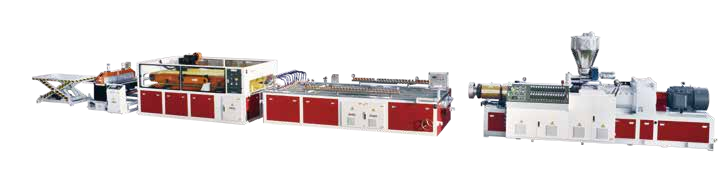
TPU Film Extrusion Line

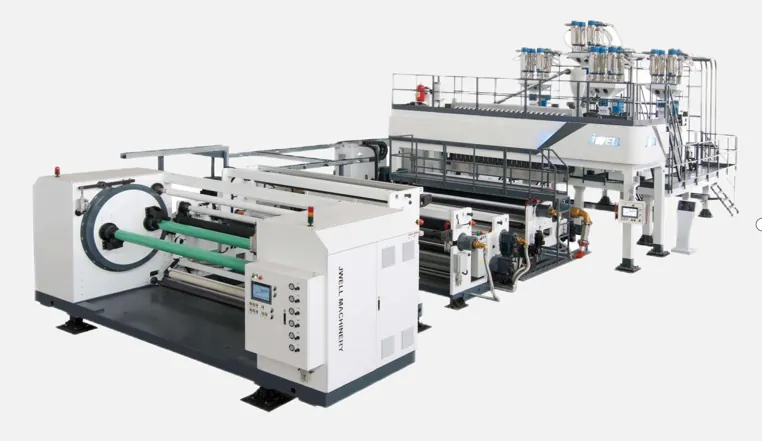
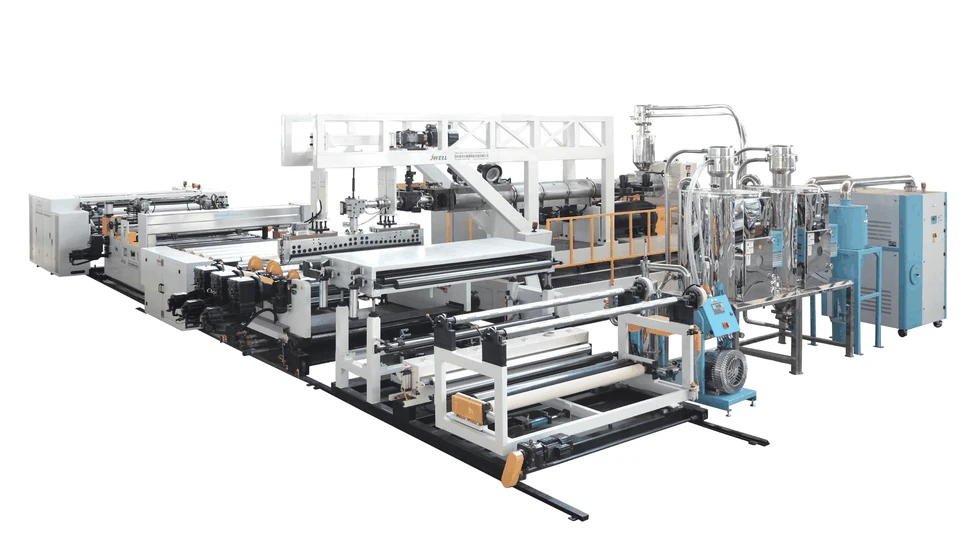
The Jwell TPU extrusion lamination machine is a complete multi-layer composite film production system designed for in-line extrusion coating and lamination of thermoplastic polyurethane (TPU) film with diverse substrates. With product widths from 1000 to 3000mm, finished film thickness from 0.02 to 2.0mm, and extrusion capacity from 250 to 600 kg/h, the line integrates multiple extruders and unwinding units in a step-by-step extrusion, one-step in-line lamination configuration that enables 3-5 layer composite structures in a single pass. The system supports flexible layer combinations, allowing one line to produce multiple product types for different downstream applications.

TPU composite film produced on the line combines the elasticity, abrasion resistance, and environmental friendliness of thermoplastic polyurethane with the mechanical strength, barrier properties, or aesthetic surface characteristics of substrates such as fabric, non-woven, paper, and metal foil. Compared with adhesive-bonded laminates, extrusion-laminated TPU composites offer superior bond strength (peel strength typically above 40 N/15mm for fabric substrates), zero solvent or adhesive residue, lower converting cost, and uniform coating weight across the full web width. These characteristics make extrusion-laminated TPU composites the preferred construction for safety-critical and high-durability applications including inflatable life rafts, life jackets, military self-inflating mattresses, and medical protective barriers.

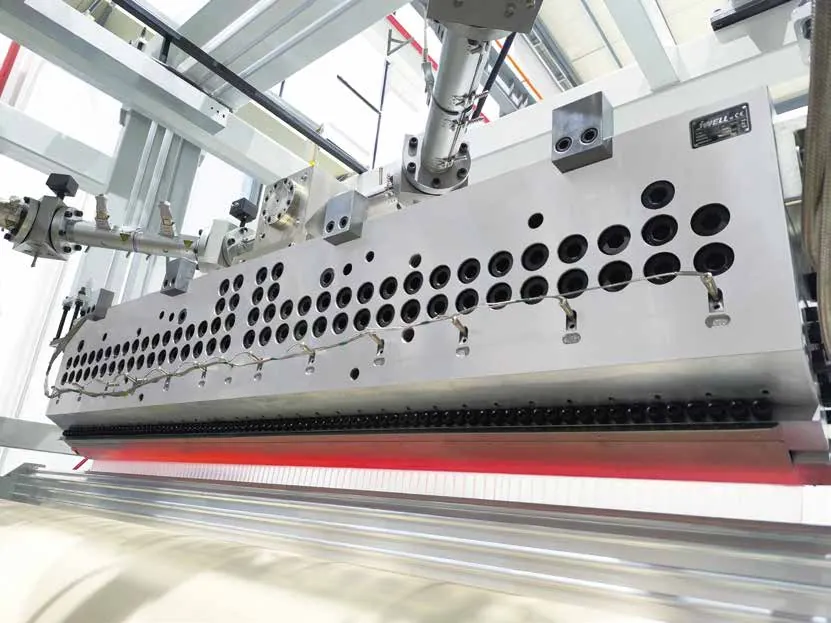
Changzhou Jwell Plate & Sheet Equipment Technology Co., Ltd. has engineered the TPU extrusion lamination machine specifically for the material’s demanding processing characteristics — its narrow melt processing window (typically 180-220°C), sensitivity to moisture, aggressive adhesion to metal surfaces, and tendency to produce gauge variation when shear or temperature is poorly controlled. The line features a low-compression screw design that minimizes shear heating, a chrome-plated chill roll with release coating for clean film stripping, a closed-loop online thickness gauge maintaining ±0.005mm accuracy, and servo-driven tension control for stable winding of soft and tacky TPU laminates.

TPU Film Extrusion Line: Related JWELL Extrusion Lines

The TPU Film Extrusion Line is part of JWELL’s complete extrusion portfolio. Customers evaluating this TPU Film Extrusion Line also frequently request our TPU Film Extrusion Line | Thermoplastic Polyurethane Film | Jwell and TPU lamination composite film sheet extrusion line, which share the same proven screw, die and control platforms. For layout drawings, pricing and lead times, contact JWELL Machinery directly.

# Item Key Point
1 🌀 Multi-Extruder Architecture for 3-5 Layer Composite Production The Jwell TPU extrusion lamination machine uses a parallel multi-extruder arrangement — typically two or three
2 ⚡ Closed-Loop Online Thickness Control with ±0.005mm Accuracy Lamination thickness uniformity is the critical quality parameter for downstream converting — gauge variation
3 🎯 Servo Energy-Saving Drive with 15-20% Energy Reduction The TPU extrusion lamination machine replaces conventional AC motors with servo-driven motors on the extruder,
4 🔄 Chrome-Plated Chill Roll with Proprietary Release Coating for Clean Film Release TPU’s aggressive adhesion to hot metal — useful in lamination bonding but a processing liability in film casti

Multi-Extruder Architecture for 3-5 Layer Composite Production

The Jwell TPU extrusion lamination machine uses a parallel multi-extruder arrangement — typically two or three extruders of different sizes (JWS90, JWS120) — to enable step-by-step extrusion of different polymer grades, colors, or functional layers, followed by one-step in-line lamination with the substrate. The multi-extruder architecture allows the line to produce composites such as TPU / fabric / TPU (sandwich construction for inflatable products), TPU / non-woven / TPU (for medical protective barriers), or TPU / metal foil / TPU (for thermal-reflective safety gear) without offline rewind or adhesive coating. The JWS90/JWS120/JWS90 configuration, for example, is the standard build for 3-layer TPU-fabric-TPU composite used in life rafts and military self-inflating mattresses where both surfaces require TPU sealing and the fabric core provides mechanical strength.

Closed-Loop Online Thickness Control with ±0.005mm Accuracy

Lamination thickness uniformity is the critical quality parameter for downstream converting — gauge variation above 2-3% causes weld-seam weakness in inflatable products, visible thickness bands in decorative laminates, and inconsistent barrier performance in protective applications. The Jwell line integrates a radioactive or X-ray based online thickness gauge that scans the full web width, with real-time feedback to the extruder screw speed and die lip adjustment. Closed-loop control maintains lamination thickness accuracy within ±0.005mm across the full web and full production run, ensuring that every meter of finished laminate meets the customer’s thickness specification and that downstream RF or heat welding processes produce consistent seam strength. The thickness data is logged for each production batch, providing full traceability for automotive, medical, and military customers who require documented process capability.

Servo Energy-Saving Drive with 15-20% Energy Reduction

The TPU extrusion lamination machine replaces conventional AC motors with servo-driven motors on the extruder, calendar, and winding sections, paired with an intelligent temperature control system that adjusts barrel and die heating zone by zone based on throughput demand. Compared with constant-speed hydraulic or AC systems, the servo architecture reduces overall energy consumption by 15-20% — a meaningful operating cost saving for continuous production lines running 24/7 at extrusion capacity above 400 kg/h. Energy consumption is also reduced by the line’s low-compression screw design, which achieves melt homogeneity through barrel heating rather than viscous dissipation, requiring less motor torque to achieve target throughput. The result is a TPU lamination line with substantially lower cost-per-kilogram of finished product than conventional designs.

Chrome-Plated Chill Roll with Proprietary Release Coating for Clean Film Release

TPU’s aggressive adhesion to hot metal — useful in lamination bonding but a processing liability in film casting — requires a casting surface engineered specifically for clean film release. The Jwell chill roll uses a hardened chrome plating polished to Ra ≤0.05 μm, combined with an internal water circulation design providing roll surface temperature uniformity within ±1°C across the full roll face. The roll surface is treated with a proprietary release coating that prevents TPU adhesion at the stripping point, eliminating the picking, sticking, and surface micro-defects that reduce optical clarity in transparent TPU film and that produce surface contamination in laminates bound for medical or food-contact use. Stripping point is controlled by roll temperature adjustment — typically 25-50°C for 85-95A TPU grades used in most lamination applications.

Technical Specifications

Parameter JWS120/JWS120 / JWS90/JWS90/JWS90 / JWS90/JWS120/JWS90
Product Width 1000-3000 mm / 1000-3000 mm / 1000-3000 mm
Product Thickness 0.02-2.0 mm / 0.02-2.0 mm / 0.02-2.0 mm
Extrusion Capacity 400-600 kg/h / 250-350 kg/h / 350-450 kg/h
Layer Configuration 3-5 layers / 3-5 layers / 3-5 layers
Lamination Thickness Accuracy ±0.005 mm / ±0.005 mm / ±0.005 mm
Substrate Compatibility Fabric, non-woven, paper, foil, film / Fabric, non-woven, paper, foil, film / Fabric, non-woven, paper, foil, film
Energy Saving 15-20% (servo motor) / 15-20% (servo motor) / 15-20% (servo motor)
Certifications CE, ISO 9001, TUV, UL / CE, ISO 9001, TUV, UL / CE, ISO 9001, TUV, UL
Warranty 1 year / 1 year / 1 year
Delivery Time 90 days / 90 days / 90 days
MOQ ≥1 set / ≥1 set / ≥1 set

Inflatable Life Jackets, Life Rafts, and Marine Safety Equipment

Marine safety equipment — life jackets (PFDs), life rafts, escape slides, immersion suits, and emergency position-indicating radio beacon (EPIRB) housings — requires a laminate construction that is airtight, hydrolysis-resistant, and durable under repeated flexing, UV exposure, and saltwater immersion. The Jwell TPU extrusion lamination machine produces the standard 3-layer TPU-fabric-TPU composite used in these applications, with TPU film at 100-200 μm on each surface and a woven or knitted fabric (typically nylon or polyester at 70-150 g/m²) as the core. The composite meets ISO 12402 (life jackets) and SOLAS (life rafts) performance requirements for hydrostatic resistance, peel strength, and accelerated aging, and is in production at more than 20 customer sites worldwide.

Military Self-Inflating Mattresses and Tactical Equipment

Military self-inflating mattresses, sleeping pads, and tactical load-bearing equipment use TPU-fabric composites that must withstand rough handling, temperature extremes from -40°C to +60°C, and repeated inflation-deflation cycles without delamination. The Jwell line produces the high-density TPU laminate used in these applications, with TPU film at 150-250 μm, fabric weight at 100-200 g/m², and lamination peel strength above 50 N/15mm verified by production testing. Military customers typically require full traceability, lot-level quality documentation, and process capability data — all provided by Jwell’s online thickness logging and batch-level process data capture.

Frequently Asked Questions

What is a TPU extrusion lamination machine and how does it differ from a TPU film extrusion line? -

A TPU extrusion lamination machine is a production system specifically designed to extrude TPU film and bond it in-line to one or more substrates — fabric, non-woven, paper, or metal foil — in a single continuous process. The key difference from a TPU film extrusion line (which produces only the TPU film as a standalone product) is the in-line lamination section: a TPU extrusion lamination machine integrates unwinding stations for the substrate(s), a TPU extruder with a flat die, a laminating nip where the molten TPU film is pressed against the substrate(s), a chill roll for cooling, and a winder for the finished laminate. This integrated configuration produces composite material in one pass, eliminating the offline adhesive coating, drying, and re-lamination steps required when TPU film is produced separately and then bonded to substrates in a secondary process.

How many layers can the Jwell TPU extrusion lamination machine produce in a single pass? +

The standard Jwell line is configured for 3-5 layer composite production, with the most common configurations being 3-layer (TPU / substrate / TPU for inflatable and safety products) and 5-layer (TPU / adhesive / substrate / adhesive / TPU for high-strength technical laminates). The number of layers is determined by the number of extruders (each extruder contributes one TPU layer) and the number of substrate unwinds. A 2-extruder configuration produces 3-layer composites; a 3-extruder configuration produces 5-layer composites with two substrate layers. For specialized applications requiring more layers, Jwell can engineer custom configurations with additional extruders and unwinds.

What substrates can be laminated with TPU on the Jwell line? +

The Jwell TPU extrusion lamination machine accepts a wide range of substrates including woven fabrics (nylon, polyester, polypropylene, aramid, cotton), knitted fabrics, nonwovens (spunbond, meltblown, needle-punched), paper and paperboard, metal foils (aluminum, copper), plastic films (PET, PE, PP, PA), and composite scrims. The substrate weight range is typically 20-600 g/m², with web widths from 1000 to 3000 mm. Substrates that resist direct TPU bonding due to low surface energy (e.g., silicone-coated fabrics, certain fluoropolymers) can be processed with the optional in-line corona or plasma pretreatment station, which raises surface energy to a level that allows TPU wet-out and bond formation.

What TPU grades can be processed on the Jwell TPU extrusion lamination machine? +

The Jwell line processes both polyester-based and polyether-based TPU in the hardness range 70 Shore A to 70 Shore D, covering the full spectrum of TPU grades used in lamination applications. Polyester-TPU (e.g., BASF Elastollan, Lubrizol Estane, Covestro Desmopan, Wanhua WHT) is the standard choice for applications requiring high tensile strength, abrasion resistance, and oil/fuel resistance — including automotive, industrial, and inflatable product applications. Polyether-TPU is preferred for medical, food-contact, and outdoor applications requiring hydrolysis resistance, low-temperature flexibility, and microbial resistance. The line’s desiccant drying system, low-compression screw, and temperature control system are all adjustable to process both TPU families without hardware changeover.

What is the typical production capacity and energy consumption of the TPU extrusion lamination machine? +

Production capacity depends on the chosen configuration: the JWS120/JWS120 line produces 400-600 kg/h, the JWS90/JWS90/JWS90 line produces 250-350 kg/h, and the JWS90/JWS120/JWS90 line produces 350-450 kg/h. Energy consumption is reduced by 15-20% compared with conventional AC-driven lines, through the use of servo energy-saving motors and an intelligent temperature control system that adjusts heating zone power based on throughput demand. For a typical JWS120/JWS120 line producing 500 kg/h of 3-layer TPU-fabric-TPU composite, total connected power is approximately 380-450 kW, with operating energy consumption of 280-340 kW under steady-state conditions.

Related Sheet Extrusion Lines

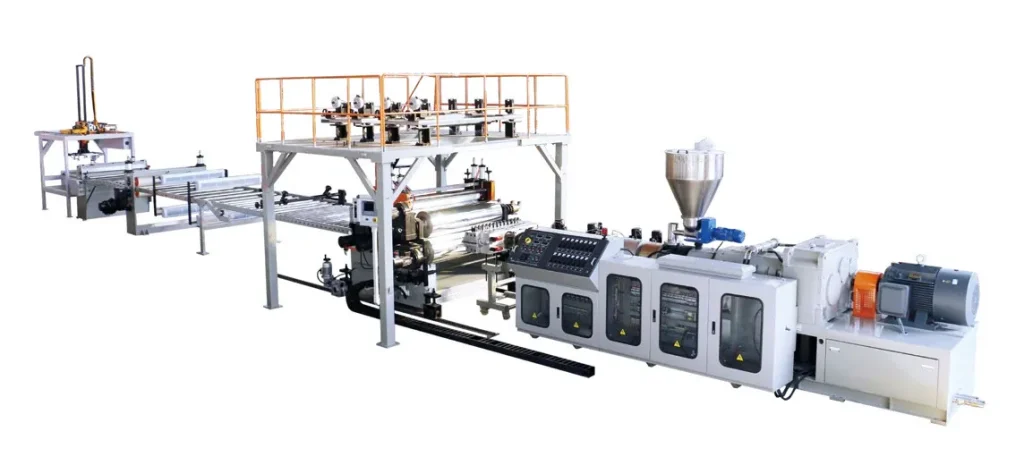
WPC Flooring Production Line

WPC Flooring Production Line

Extruder Type: Conical twin-screw, vented; Screw Material: 38CrMoAlA, nitrided, bimetallic optional; Screw Structure: Conical twin, designed for PVC + wood flour + CaCO₃ + foaming agent; L/D Ratio: Optimized for controlled foaming zone
Learn More ➔
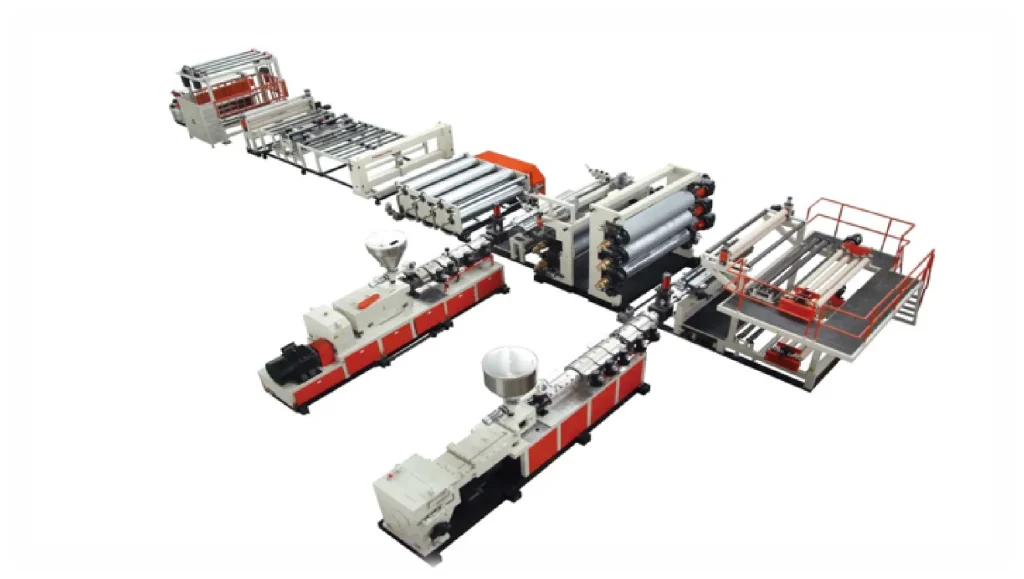
SPC Flooring Production Line

SPC Flooring Production Line

Screw Diameter: Φ 80 mm / Φ 92 mm / Φ 110 mm / Φ 180 mm; Output (24h, SPC): 6-8 T / 12-18 T / 25-32 T / 70-100 T; Line Speed at 4 mm: 0.4-0.6 m/min / 0.8-1.3 m/min / 1.8-2.4 m/min / 5-9 m/min; Screw Material: 38CrMoAlA, nitrided, bimetallic optional / ← Same / ← Same / ← Same

Learn More ➔

Why Choose Jwell for Your PET Sheet Line

🏭

Factory/Experience

Jwell has manufactured PET sheet extrusion equipment since 2005, accumulating field data from over 400 installed PET lines worldwide. Each new machine generation incorporates refinements validated across hundreds of real production environments — not just lab prototypes.

🔬

Test/Validate

Our Changzhou facility operates a full production-scale PET line for customer trials. Bring your raw materials and target specifications — we run your recipe before you commit. The line delivered to your factory is a proven configuration, eliminating startup risk.

🌍

Service/Support

Factory-trained Jwell engineers based in Brazil, Spain, Mexico, and Shanghai travel to customer sites for installation and operator training. Remote diagnostic support via WeChat/WhatsApp responds within 2 hours. Critical spares ship from Shanghai within 48 hours.

Request a Quote or Technical Consultation

Your information will never be shared with third parties.