
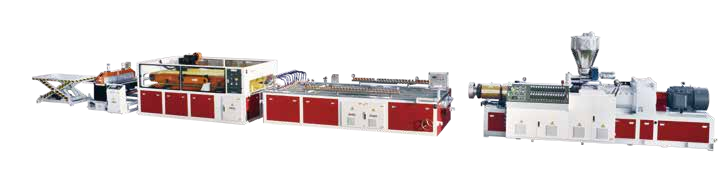
TPU Leather Line

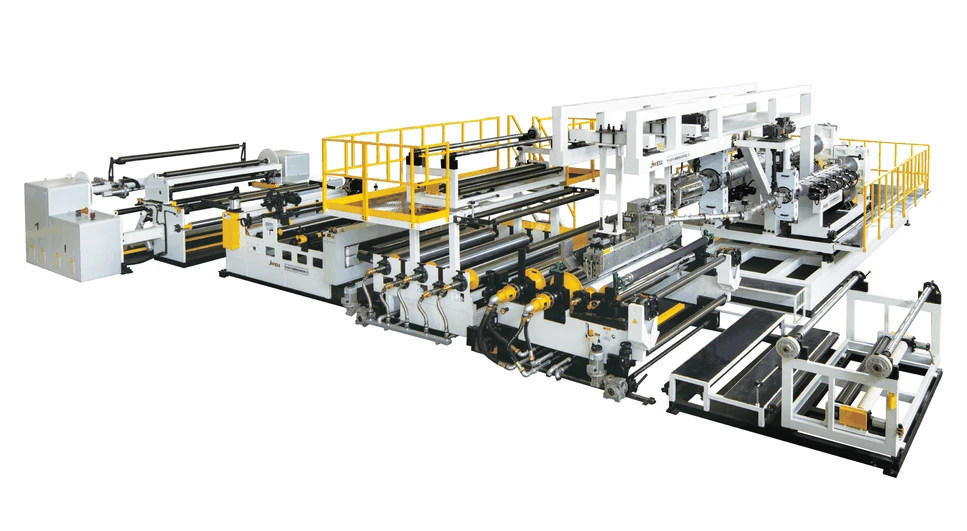
The Jwell TPUTPE leather extrusion composite production line is a multi-layer sheet and film extrusion system engineered to manufacture TPU (thermoplastic polyurethane) and TPETPR (thermoplastic elastomer based on polyester elastomer) leather-composite materials in a continuous process. Operating at outputs of 100 to 300 kg/h, the line produces leather-simulation composites with a TPU or TPETPR surface layer (providing the leather-like tactile feel, abrasion resistance, and chemical resistance) laminated to a fabric or foam backing (providing dimensional stability, tear strength, and substrate compatibility) in a single pass.

“TPUTPE leather” refers to a family of leather-alternative materials where a TPU or TPETPR elastomer layer (0.3-1.5 mm thickness) is extrusion-coated or coextruded onto a textile substrate (woven, nonwoven, or knit) with or without an intermediate foam layer (PVC or PU foam, 0.5-3.0 mm thickness). The resulting composite mimics the appearance, hand-feel, and mechanical properties of genuine leather at 20-40% of the material cost, with the additional advantages of consistent quality (no hide-to-hide variation as with genuine leather), weldability (TPU and TPETPR can be heat-sealed), and design flexibility (color, texture, and surface finish are fully controllable in the extrusion process).

Changzhou Jwell Plate & Sheet Equipment Technology Co., Ltd. brings its expertise in TPU processing and multi-layer coextrusion to the leather-composite market, engineering a line that handles the distinctive challenges of TPUTPE leather production: precise temperature control for TPU/TPETPR melt (narrow processing window), controlled adhesion between the elastomer layer and the substrate (neither too weak nor too strong — the composite must bend and flex without delamination), and surface-texture replication (the TPUTPE layer must replicate the embossed texture of a release paper or engraved roll to achieve the leather-like appearance).

TPU/TPE Leather Extrusion Composite Production Line: Related JWELL Extrusion Lines

The TPU/TPE Leather Extrusion Composite Production Line is part of JWELL’s complete extrusion portfolio. Customers evaluating this TPU/TPE Leather Extrusion Composite Production Line also frequently request our TPU lamination composite film sheet extrusion line and TPU/ABS Composite Plate Extrusion Line | 200-600kg/h | Jwell, which share the same proven screw, die and control platforms. For layout drawings, pricing and lead times, contact JWELL Machinery directly.

# Item Key Point
1 🌀 Multi-Layer Coextrusion with Feedblock or Multi-Manifold Die TPUTPE leather composites are frequently produced as a 3-layer structure: a TPU/TPETPR wear layer, a tie layer
2 ⚡ Release-Paper or Engraved-Roll Embossing for Leather-Like Texture The leather-like appearance of TPUTPE leather is created by embossing the TPU/TPETPR surface layer with a leat
3 🎯 Controlled Adhesion with Tie-Layer Coextrusion or Primer Coating The TPU/TPETPR layer must adhere to the substrate (fabric or foam) with sufficient strength to survive flexing
4 🔄 Integrated UV-Curing Station for Surface Finish Protection TPUTPE leather for automotive and marine applications requires a surface finish that resists staining (from de

Multi-Layer Coextrusion with Feedblock or Multi-Manifold Die

TPUTPE leather composites are frequently produced as a 3-layer structure: a TPU/TPETPR wear layer, a tie layer (for adhesion to difficult substrates), and a foam or substrate-compatible layer — all coextruded in a single die. Jwell’s line offers both feedblock coextrusion (multiple melt streams combined in a pre-die manifold, then cast through a single die — lower cost, suitable for compatible materials with distinct but not critically distinct layers) and multi-manifold coextrusion (each layer has its own die manifold, layers combine immediately before die exit — sharper layer interfaces, suitable for dissimilar polymers). For TPU/TPETPR leather on PVC foam substrate, the feedblock approach is typical; for TPU on polyolefin foam (where adhesion without a tie layer is poor), the multi-manifold approach with a dedicated tie-layer extruder is specified.

Release-Paper or Engraved-Roll Embossing for Leather-Like Texture

The leather-like appearance of TPUTPE leather is created by embossing the TPU/TPETPR surface layer with a leather-grain texture immediately after extrusion, while the material is still above its softening temperature. Jwell’s line offers two embossing methods: (1) Release-paper embossing — a silicone-treated release paper with leather-grain texture is pressed against the extruded TPU/TPETPR layer by a rubber-covered pressure roll; the paper is subsequently peeled off, leaving the texture in the TPU/TPETPR surface. This method provides the highest-fidelity texture replication and is used for premium automotive and furniture leather. (2) Engraved-roll embossing — an engraved steel roll (leather-grain pattern) contacts the TPU/TPETPR surface; the roll is heated (60-90°C) to prevent the TPU from sticking. This method is lower cost and used for furniture and marine leather where texture fidelity requirements are less demanding than automotive.

Controlled Adhesion with Tie-Layer Coextrusion or Primer Coating

The TPU/TPETPR layer must adhere to the substrate (fabric or foam) with sufficient strength to survive flexing, stretching, and environmental exposure — but not so strongly that the composite cracks at the interface when folded over a sharp radius. Jwell’s line achieves this “goldilocks” adhesion through tie-layer coextrusion (a thin 0.02-0.05 mm tie layer of a compatible polymer, coextruded between the TPU/TPETPR and the substrate) or, for substrates where coextrusion tie layers are impractical, a primer-coating station before the lamination nip (applying a solvent-based or water-based primer to the substrate surface, then drying it before lamination). Peel strength is controllable in the range of 8-25 N/25mm depending on the substrate and application, and Jwell’s application team provides tie-layer and primer recommendations for common substrate materials.

Integrated UV-Curing Station for Surface Finish Protection

TPUTPE leather for automotive and marine applications requires a surface finish that resists staining (from denim dye transfer, food and beverage spills), abrasion (from repeated contact), and UV degradation (from sunlight exposure through windshield or marine-environment UV). Jwell’s line can be configured with an integrated UV-curing station immediately after embossing: a thin (5-15 μm) UV-curable topcoat is applied by gravure roll or slot-die coater, then cured by a 120-240 W/cm UV lamp array. The UV-cured topcoat provides stain resistance (denim dye transfer <Grade 4 per AATCC 16-2004), abrasion resistance (Taber abrasion <10 mg loss/1,000 cycles), and UV resistance (color change ΔE <3.0 after 500 hours Xeon arc exposure) — performance levels that meet automotive OEM specifications (GM, Ford, VW, Toyota, Honda interior trim standards).

Technical Specifications

Parameter Specification
Extruder Configuration 1-3 extruders (TPU/TPETPR layer + optional foam + optional tie layer)
Screw Diameter (TPU) 65 mm, 75 mm, 90 mm
Output Capacity 100 – 300 kg/h (TPU/TPETPR layer)
Composite Width 1,200 – 2,000 mm
TPU/TPETPR Layer Thickness 0.3 – 1.5 mm
Substrate Types Woven fabric, nonwoven, knit, foam-backed
Substrate Width 1,200 – 2,000 mm
Lamination Type Hot-melt (fresh-extruded TPU/TPETPR)
Surface Finish Embossed (via release paper or engraved roll)
Die Type Flexible-lip coat-hanger, chrome-plated
Calibration 3-roll vertical stack or steel-belt casting
Line Speed 3 – 25 m/min
Control System Siemens S7-1500 PLC + 15″ HMI

Automotive Interior Upholstery and Trim

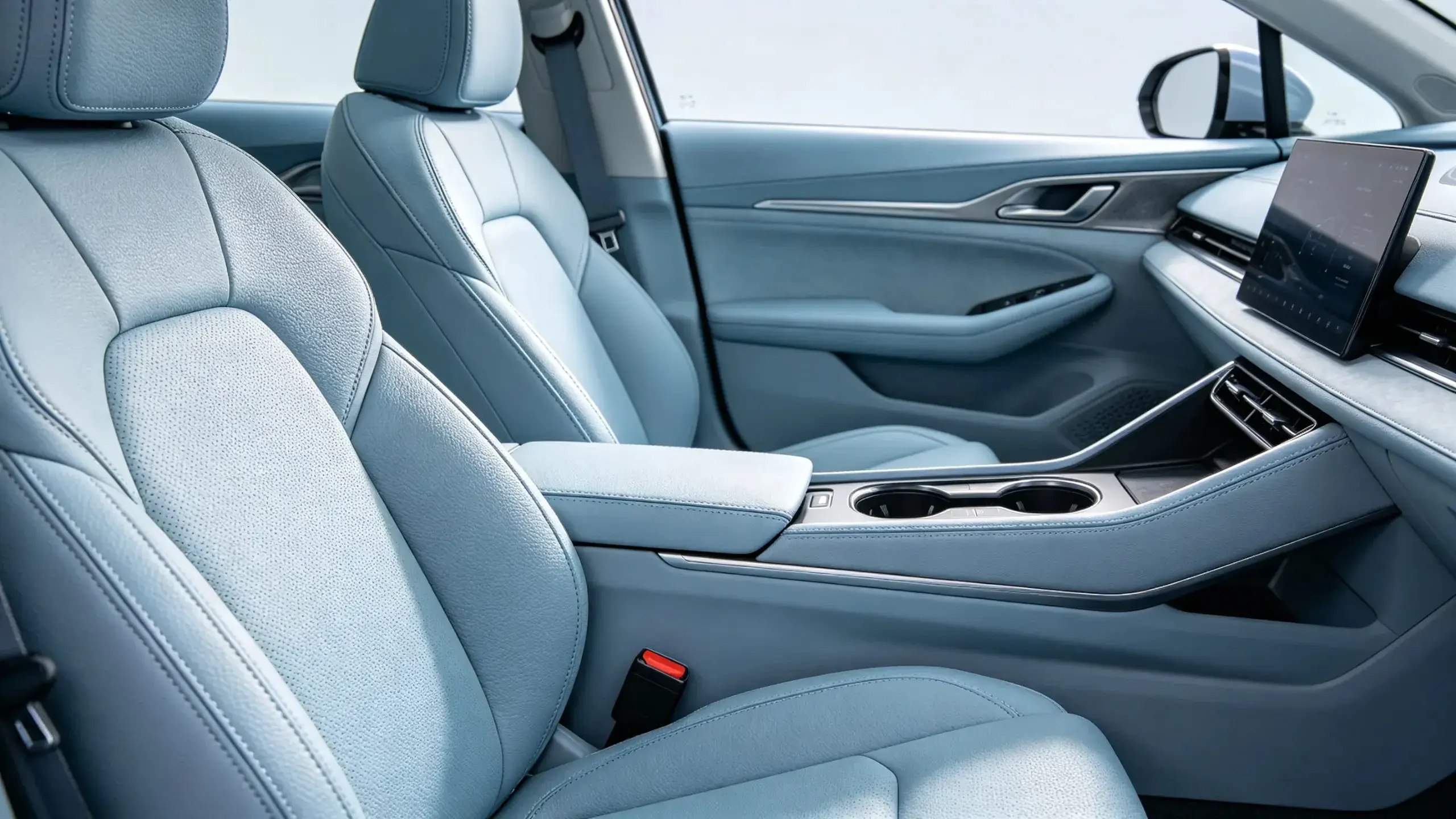
Automotive tier suppliers use TPUTPE leather composite (1.0-1.5 mm TPU layer on 0.5-1.0 mm PU foam + polyester knit backing) for seat upholstery, door panel inserts, instrument panel covers, and headliner inserts. The material provides the leather-like appearance and tactile feel that consumers associate with premium interiors, at 25-40% of genuine leather cost. TPU’s UV resistance (aliphatic TPU, stabilized) and stain resistance (with UV-cured topcoat) meet automotive OEM specifications (GMW14872 for stain resistance, GMW14162 for UV resistance). The composite is thermoformable (for 3D-shaped door panels and instrument panel skins) and laser-cuttable (for airbag-door perforations and decorative patterns) — process capabilities that genuine leather cannot match for consistency.

Furniture and Contract Upholstery

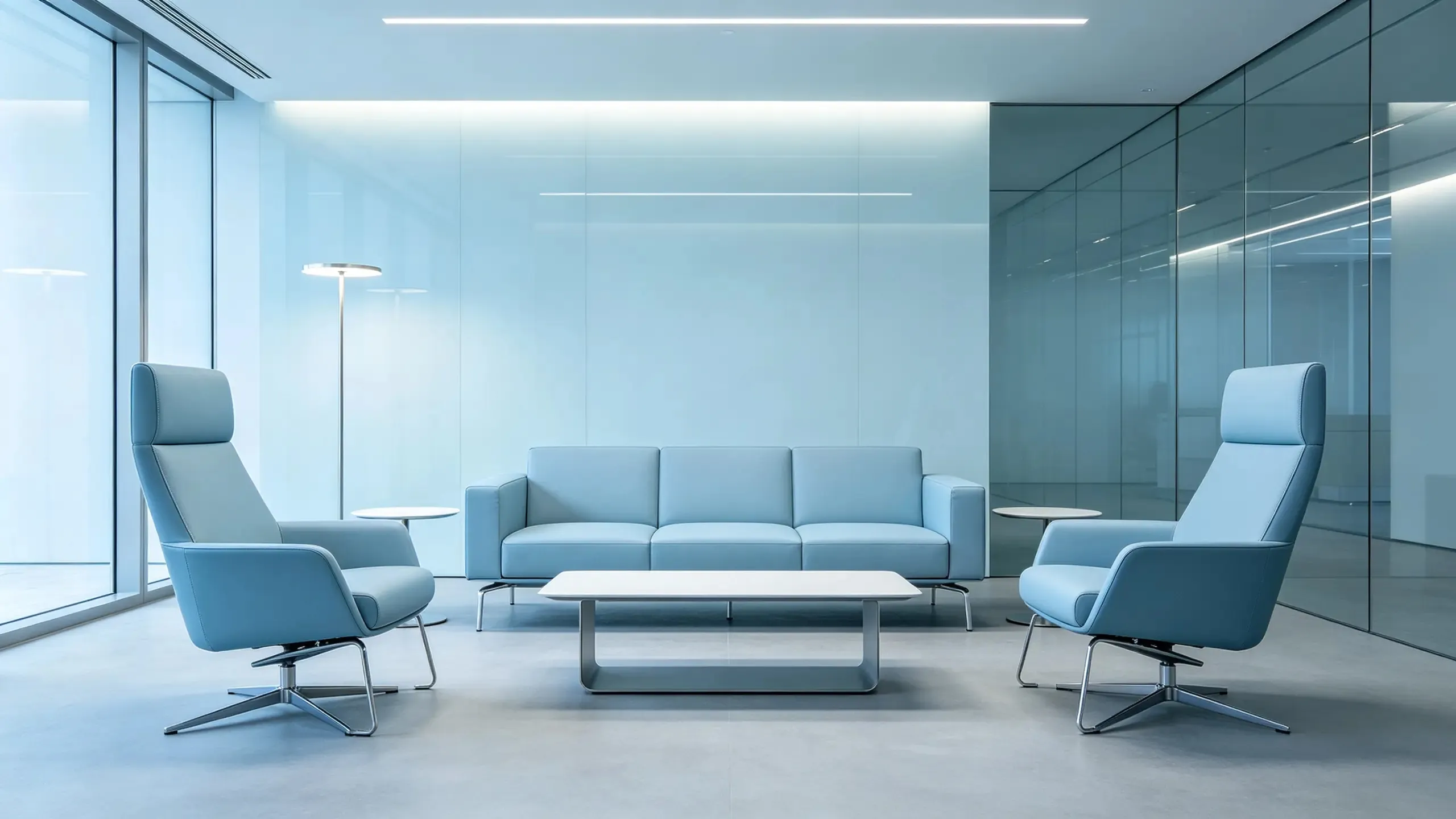
Office furniture, hospitality seating, and residential furniture use TPUTPE leather composite (0.8-1.2 mm TPU layer on 0.3-0.8 mm PVC or PU foam + nonwoven or knit backing) for seat and back upholstery. The material’s advantages over genuine leather include: consistent color and texture (no hide variation), cleanability (stain-resistant topcoat, cleanable with mild detergent), and cost (20-30% of genuine leather). For contract furniture (office, hospitality) where CA TB117 fire resistance and BIFMA durability standards apply, TPUTPE leather composites are formulated with flame-retardant additives (phosphorus-based, halogen-free) and achieve 100,000+ double-rubs Wyzenbeek abrasion resistance (vs. 50,000+ for genuine leather).

Frequently Asked Questions

What is the difference between TPUTPE leather composite and PVC leather (vinyl) for upholstery applications? -

TPUTPE leather and PVC leather (vinyl) are both leather-alternative materials, but with fundamentally different property profiles. TPUTPE leather offers: (1) superior low-temperature flexibility (brittle point below -40°C for polyether-TPU vs. -10 to -20°C for plasticized PVC — important for automotive and marine applications where interiors experience sub-zero temperatures); (2) better long-term flexibility retention (TPU does not require plasticizer, which migrates out of PVC over 3-8 years, causing embrittlement; TPUTPE leather retains flexibility for 10-15+ years); (3) higher abrasion resistance (Taber abrasion <10 mg/1,000 cycles vs. 20-40 mg/1,000 cycles for PVC leather); (4) better environmental profile (TPU is recyclable, PVC contains chlorine and requires phthalate plasticizers with endocrine-disrupting potential). PVC leather offers: (1) lower material cost ($8-15/m² vs. $20-40/m² for TPUTPE leather); (2) established supply chain and processing infrastructure; (3) wider range of available textures and surface effects (PVC's lower melt viscosity enables finer embossing detail). Jwell's position is that TPUTPE leather targets the premium segment (automotive, premium furniture, marine) where durability and long-term flexibility justify the cost premium, while PVC leather remains the cost-performance choice for price-sensitive markets.

Can Jwell's TPUTPE leather line produce composites on recycled or bio-based TPU formulations? +

Yes, the line can process TPU formulations based on bio-based polyols (from castor oil, at 20-60% bio-based content) or recycled TPU (from post-industrial or post-consumer TPU scrap, at up to 30-50% recycled content) without hardware modification. Bio-based TPU has slightly different processing characteristics (bio-based polyols have different hydroxyl numbers and reactivity compared to petrochemical polyols, affecting melt viscosity and processing temperature) — Jwell’s application team provides adjusted temperature profiles and screw-speed recommendations for bio-based TPU grades from major suppliers (Lubrizol, Huntsman, Wanhua, Huafeng). Recycled TPU may have broader molecular-weight distribution than virgin TPU, which can affect melt-processability (higher shear sensitivity) and foamability (if the leather composite includes a foamed TPU layer) — Jwell’s screw design (with intensive mixing section and controlled shear) accommodates this, but for premium automotive applications where appearance specifications are stringent, the recycled-content TPU may be limited to non-appearance layers (substrate-adjacent) or back-side layers where minor surface imperfections are acceptable.

Related Sheet Extrusion Lines

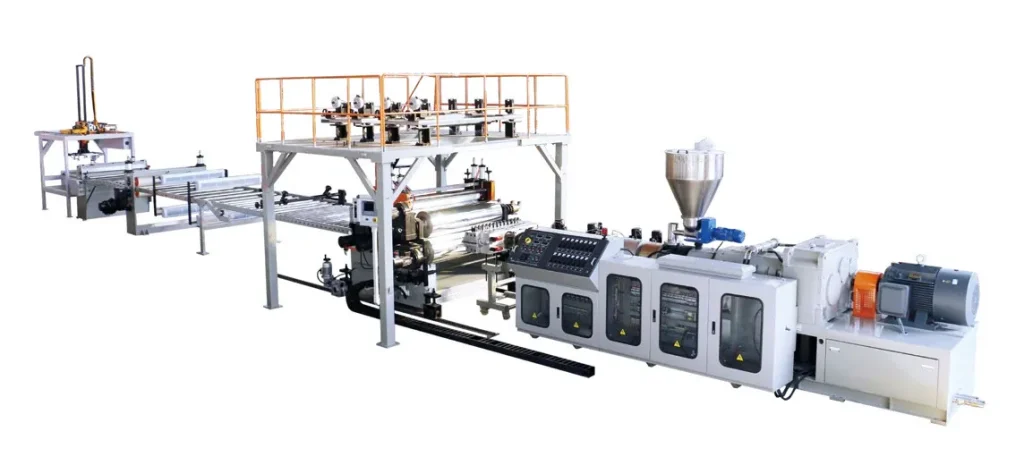
WPC Flooring Production Line

WPC Flooring Production Line

Extruder Type: Conical twin-screw, vented; Screw Material: 38CrMoAlA, nitrided, bimetallic optional; Screw Structure: Conical twin, designed for PVC + wood flour + CaCO₃ + foaming agent; L/D Ratio: Optimized for controlled foaming zone
Learn More ➔
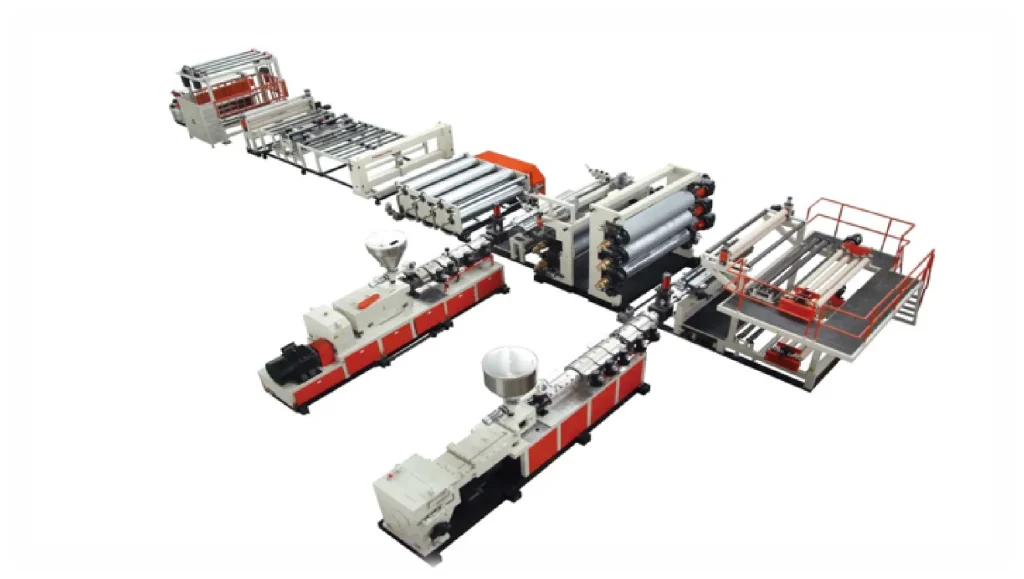
SPC Flooring Production Line

SPC Flooring Production Line

Screw Diameter: Φ 80 mm / Φ 92 mm / Φ 110 mm / Φ 180 mm; Output (24h, SPC): 6-8 T / 12-18 T / 25-32 T / 70-100 T; Line Speed at 4 mm: 0.4-0.6 m/min / 0.8-1.3 m/min / 1.8-2.4 m/min / 5-9 m/min; Screw Material: 38CrMoAlA, nitrided, bimetallic optional / ← Same / ← Same / ← Same

Learn More ➔

Why Choose Jwell for Your PET Sheet Line

🏭

Factory/Experience

Jwell has manufactured PET sheet extrusion equipment since 2005, accumulating field data from over 400 installed PET lines worldwide. Each new machine generation incorporates refinements validated across hundreds of real production environments — not just lab prototypes.

🔬

Test/Validate

Our Changzhou facility operates a full production-scale PET line for customer trials. Bring your raw materials and target specifications — we run your recipe before you commit. The line delivered to your factory is a proven configuration, eliminating startup risk.

🌍

Service/Support

Factory-trained Jwell engineers based in Brazil, Spain, Mexico, and Shanghai travel to customer sites for installation and operator training. Remote diagnostic support via WeChat/WhatsApp responds within 2 hours. Critical spares ship from Shanghai within 48 hours.

Request a Quote or Technical Consultation

Your information will never be shared with third parties.