PVC Edge Banding Extrusion Line

Single-screw compact extruder | 30-150 kg/h | 0.4-3.0 mm | Wood Grain · Solid Color · Metallic Finish

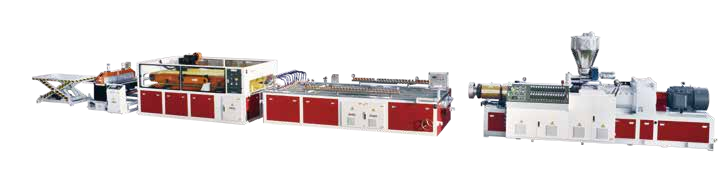
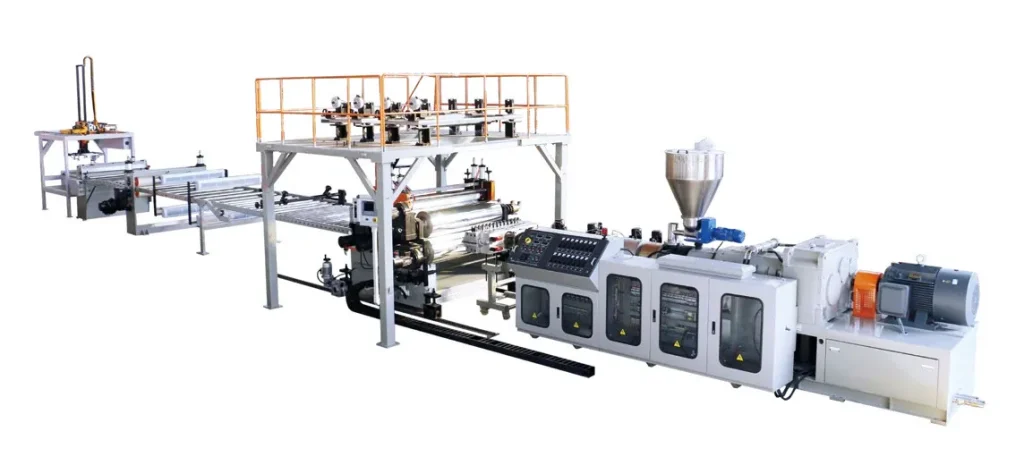
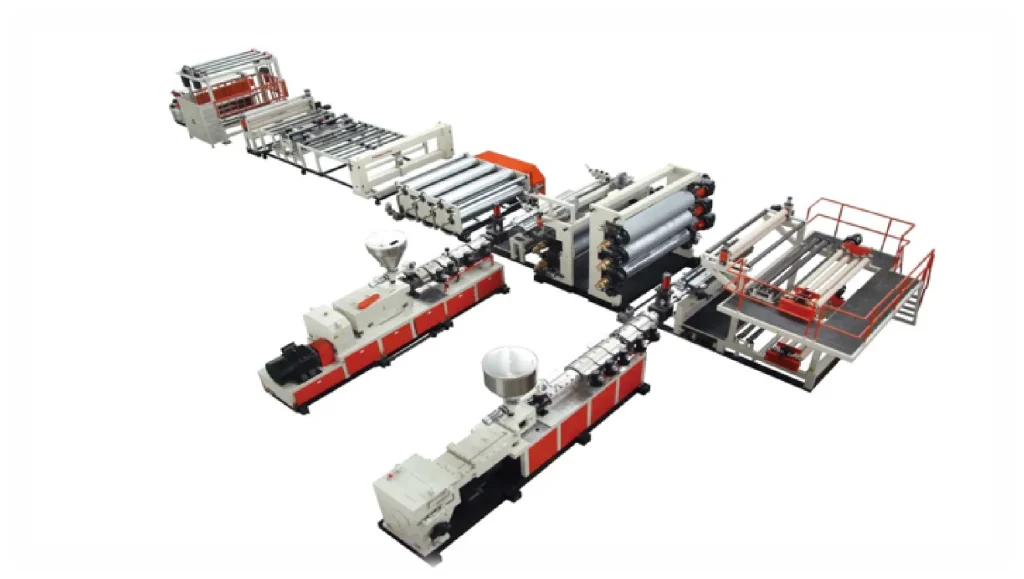
| pvc-edge-banding-hero.webp | Jwell PVC edge banding extrusion line — complete system from extruder to winder | Hero 主图 |

| pvc-edge-banding-die-detail.webp | Precision flat die with adjustable lip for PVC edge banding extrusion | 模具特写 |

| pvc-edge-banding-embossing.webp | Quick-change embossing roller with wood grain sleeve — PVC edge banding surface texture | 压花辊 |

PVC Edge Banding Extrusion Line: Related JWELL Extrusion Lines

The PVC Edge Banding Extrusion Line is part of JWELL’s complete extrusion portfolio. Customers evaluating this PVC Edge Banding Extrusion Line also frequently request our PVC Marble Sheet Production Line | Stone-Texture Decorative Panels | Jwell and PVC Soft Rigid Sheet Extrusion Line | Jwell Machinery, which share the same proven screw, die and control platforms. For layout drawings, pricing and lead times, contact JWELL Machinery directly.

# Item Key Point
1 🌀 Compact Footprint: Small-scale dedicated line optimized for edge banding production economics where high throughput is not the objective but color consistency and grain authenticity are
2 ⚡ Precision Flat Die Adjustable-lip T-die with chrome-plated flow surfaces, ±0.02 mm thickness tolerance across full strip width
3 🎯 Quick-Change Embossing Roller: Interchangeable sleeve system wood grain, matte, gloss, leather texture, stone — 20-30 minute sleeve changeover
4 🔄 Gravimetric Dosing System: ±0.5% batch accuracy for PVC dry blend, plasticizer, stabilizer, and pigment batch-to-batch color consistency
5 🔧 Automatic Traverse Winder Programmable winding patterns, tension control ±2%, automatic spool change for continuous production
6 ✅ Inline Hot-Stamp Foil Option: Metallic finish application immediately after embossing gold, silver, chrome, brushed metal effects
7 ♻️ Siemens PLC with Recipe Storage: One-touch recall of calibrated parameters for each color/grain/width combination minimize changeover scrap
8 🌍 29 Years of Manufacturing 8 production bases, 3500+ employees, 25000+ machines, ISO 9001 & CE certified

Compact Single-Screw Extruder — 45/55/65mm, PVC-Optimized for Edge Banding Production

PVC edge banding production operates on fundamentally different economics from commodity sheet extrusion. Where a refrigerator sheet line might output 1,000-3,000 kg/h, an edge banding line typically produces 30-150 kg/h — and this is by design, not by limitation. Edge banding is a color-and-grain business where a single line dedicated to a production campaign of one color/grain combination produces enough strip to supply a furniture factory for weeks. Sizing the extruder larger would create inventory management problems without production benefit.

Jwell’s edge banding extruders use 45 mm, 55 mm, or 65 mm diameter single screws with 28:1 L/D ratio — optimized for PVC dry blend processing. The 38CrMoAlA nitrided screw (HV≥740 surface hardness, 0.5-0.7 mm nitrided layer) features a compression ratio of 2.8:1 designed specifically for rigid and semi-rigid PVC formulations. PVC’s thermal sensitivity — degradation begins at 180°C with HCl evolution that autocatalyzes further degradation — demands precise temperature control, and Jwell’s barrel heating/cooling zones maintain ±1°C uniformity using ceramic band heaters with forced-air cooling.

The vented barrel design (atmospheric vent in the decompression zone) removes residual moisture from the PVC dry blend and volatiles from the plasticizer, preventing surface defects (splay, bubbles, silver streaks) on the finished edge banding. The screw’s chrome-plated surface in the metering zone further reduces PVC adhesion and degradation risk during extended production campaigns.

Precision Flat Die — Adjustable Lip, Chrome-Plated, ±0.02mm Tolerance for Edge Banding

For edge banding, thickness consistency is the defining quality parameter. An edge banding strip applied to a furniture panel must sit flush — any thickness variation greater than ±0.03 mm creates a visible and tactile ridge at the joint between the banding and the panel surface. This is the primary quality complaint in edge banding, and it originates at the die.

Jwell’s precision flat die for PVC edge banding is a coat-hanger manifold design with an adjustable flexible lip, chrome-plated flow surfaces polished to Ra 0.05 μm. The adjustable lip uses differential adjustment bolts spaced at 20 mm intervals across the die width, enabling localized thickness correction based on measurement feedback. The chrome plating provides a non-stick surface that prevents PVC degradation buildup at the die lip — the primary source of die lines (parallel streaks) on edge banding surfaces.

The die is heated by multi-zone cartridge heaters with independent PID control, maintaining melt temperature uniformity within ±1°C across the full die width. For edge banding widths of 12-60 mm, the die’s internal flow channel geometry is calculated to deliver uniform melt distribution at the low flow rates characteristic of edge banding production — a design challenge that distinguishes edge banding dies from commodity sheet dies where high flow rates naturally promote flow channel self-balancing.

Quick-Change Embossing Roller — Wood Grain, Matte, Gloss, Leather, Stone — 30-Minute Sleeve Change

The embossing roller is where edge banding acquires its market identity. Furniture manufacturers specify edge banding by grain pattern name — “German Oak,” “Italian Walnut,” “Alpine White Matte” — because the surface must match or complement the decorative laminate, melamine, or veneer surface of the panel it edges. Jwell’s embossing system is designed around a chrome-plated base roller that accepts quick-change outer sleeves, each engraved with a specific grain, texture, or gloss pattern.

The sleeve change process takes 20-30 minutes: the pneumatic roll-nip opens, the sleeve retaining ring is released, the previous sleeve slides off the roller end, the new sleeve slides on, retaining ring secured, and the roll-nip closes to calibrated gap. The gap calibration and roll temperature profile for each sleeve are stored in the Siemens PLC recipe system, recalled with one touch.

Available embossing patterns include:

– Wood Grains: Oak, walnut, cherry, ash, beech, maple, teak, mahogany, wenge — deep-grain (0.08-0.15 mm depth) for realistic wood feel

– Solid Finishes: Super-matte (Ra 2-3 μm), matte (Ra 1-2 μm), satin (Ra 0.5-1 μm), high-gloss mirror (Ra 0.02-0.05 μm)

– Textures: Leather grain, stone/cement, linen fabric, brushed metal linear grain

– Custom: Customer-supplied master patterns can be reverse-engineered into sleeve tooling

The roller is heated by a pressurized oil circuit maintaining ±1°C temperature uniformity — critical because PVC’s surface gloss is extremely sensitive to roller temperature: a 3°C variation can shift a satin finish to matte, causing visible gloss bands across the strip width.

Gravimetric Dosing System — ±0.5% Batch Accuracy for Perfect Color Match

Color match failure is the most costly quality defect in edge banding — a batch of “Alpine White” that measures L 94.5 instead of the customer’s specification of L 95.0 ± 0.3 will be rejected in its entirety. The root cause is almost always dosing variation: a pigment masterbatch feeder drifting by 0.3 percentage points shifts the final color outside the tolerance window.

Jwell’s gravimetric dosing system for the edge banding line meters up to five components by weight: PVC resin (suspension grade, K-value 57-60), plasticizer (DOP/DINP at 5-15 phr for semi-rigid grades), Ca/Zn stabilizer (2-4 phr), pigment masterbatch (2-5%), and process aid/impact modifier. Each component has a dedicated weigh hopper with load cell feedback (±0.5% batch accuracy) and loss-in-weight monitoring. The blender’s PLC logs every batch weight, creating a traceable quality record that furniture OEM quality audits require.

For wood-grain edge banding, the color base (e.g., medium brown for walnut) is dosed into the formulation, while the grain pattern is created mechanically by the embossing roller — the combination of base color and mechanical grain creates the visual depth that distinguishes premium edge banding from printed-film alternatives. For solid-color edge banding, the pigment loading and the roller surface finish together determine the final appearance.

Technical Specifications

Parameter JW-EB45 / JW-EB55 / JW-EB65
Extruder / /
Screw Diameter 45 mm / 55 mm / 65 mm
L/D Ratio 28:1 / 28:1 / 28:1
Screw Material 38CrMoAlA, nitrided HV≥740 / 38CrMoAlA, nitrided HV≥740 / 38CrMoAlA, nitrided HV≥740
Compression Ratio 2.8:1 / 2.8:1 / 2.8:1
Barrel Heating Zones 4 / 5 / 5
Barrel Cooling Forced air / Forced air / Forced air
Main Motor Power 15 kW / 22 kW / 37 kW
Output Capacity (PVC rigid) 30-50 kg/h / 50-100 kg/h / 80-150 kg/h
Die / /
Die Type Coat-hanger, adjustable lip / Coat-hanger, adjustable lip / Coat-hanger, adjustable lip
Die Width 150 mm / 200 mm / 250 mm
Die Lip Adjustment Range 0.3-4.0 mm / 0.3-4.0 mm / 0.3-4.0 mm
Surface Finish Chrome-plated, Ra 0.05 μm / Chrome-plated, Ra 0.05 μm / Chrome-plated, Ra 0.05 μm
Heating Zones 3 / 4 / 4
Embossing Roller / /
Roll Diameter 200 mm / 250 mm / 300 mm
Roll Width 200 mm / 250 mm / 300 mm
Heating Medium Pressurized oil / Pressurized oil / Pressurized oil
Temperature Range 40-120°C / 40-120°C / 40-120°C
Temperature Uniformity ±1°C / ±1°C / ±1°C
Sleeve Change Time 20-30 min / 20-30 min / 20-30 min
Product Range / /
Strip Thickness 0.4-2.0 mm / 0.4-3.0 mm / 0.4-3.0 mm
Strip Width 12-40 mm / 15-50 mm / 19-60 mm
Thickness Tolerance ±0.02 mm / ±0.02 mm / ±0.02 mm
Winder / /
Winder Type Automatic traverse, servo-driven / Automatic traverse, servo-driven / Automatic traverse, servo-driven
Max Winding Speed 50 m/min / 80 m/min / 100 m/min
Spool Core Diameter 75-150 mm / 75-200 mm / 75-300 mm
Max Spool OD 400 mm / 500 mm / 600 mm
Tension Control ±2% / ±2% / ±2%
Auto-Spool Change Optional / Standard / Standard
Hot-Stamp Foil (Optional) / /
Foil Width 12-40 mm / 15-50 mm / 19-60 mm
Foil Temperature 120-180°C / 120-180°C / 120-180°C
Foil Utilization 70-85% / 70-85% / 70-85%
Control & Utilities / /
PLC Siemens S7-1200 / Siemens S7-1200 / Siemens S7-1200
HMI 12″ touchscreen / 12″ touchscreen / 12″ touchscreen
Main Motor Brand WEG / WEG / WEG
Inverter ABB ACS380 / ABB ACS380 / ABB ACS380
Total Installed Power ~35 kW / ~55 kW / ~80 kW
Line Dimensions (L×W×H) 8×2×2.5 m / 10×2.5×2.5 m / 12×3×2.5 m
Certifications CE, ISO 9001 / CE, ISO 9001 / CE, ISO 9001

Kitchen Cabinetry — PVC Edge Banding for Modern Kitchen Manufacturing

Kitchen cabinetry is the dominant market for PVC edge banding, consuming an estimated 60-70% of global edge banding production. Every kitchen cabinet door, drawer front, and exposed panel edge in modern flat-pack and custom kitchen manufacturing receives edge banding to seal the substrate (MDF, particleboard, or plywood) against moisture ingress and to provide a finished aesthetic matching the panel surface.

PVC edge banding dominates this application over ABS and PP alternatives due to its lower raw material cost (PVC suspension resin at $800-1,200/ton vs ABS at $1,800-2,200/ton), established processing infrastructure (every edge banding machine worldwide is calibrated for PVC’s thermal activation temperature of 190-210°C for pre-applied hot-melt adhesive), and the vast color/grain library developed over decades of kitchen industry specification. Jwell’s edge banding lines serving the kitchen market typically run long production campaigns of popular colors — Alpine White, Cashmere, Anthracite Grey, Oak, and Walnut — with weekly or bi-weekly changeovers to replenish inventory.

The line’s ±0.02 mm thickness tolerance is particularly valued by kitchen manufacturers using laser edge banding technology, where the zero-joint visible seam demands thickness precision that commodity edge banding cannot deliver.

Office Furniture — PVC Edge Banding for Desks, Workstations & Commercial Interiors

Office and commercial furniture — desks, workstations, conference tables, storage units, reception counters — represents the second-largest edge banding market. This segment demands edge banding in corporate color schemes (charcoal, slate grey, espresso brown), high-traffic durability (impact resistance, scratch resistance, UV stability for near-window placement), and fire-rated specifications (BS 476 Part 7 Class 1 or EN 13501-1 B-s1,d0 for commercial building code compliance).

PVC edge banding for office furniture is typically in the 1.0-2.0 mm thickness range — thicker than kitchen edge banding (0.4-1.0 mm) to provide sufficient material for radius-edge profiling (R2-R3 rounding of the panel edge, a standard office furniture design detail). The Jwell line’s embossing roller produces the matte and super-matte finishes that dominate contemporary office furniture design — gloss levels of 5-15 GU at 60° measurement angle, achieved through precision roller surface finish and calibrated roll temperature.

Frequently Asked Questions

What thickness range can the Jwell PVC edge banding line produce? -

The Jwell PVC edge banding extrusion line produces strip from 0.4 mm to 3.0 mm thickness with width from 12 mm to 60 mm. The precision flat die with adjustable lip and calibrated embossing section maintain thickness tolerance within ±0.02 mm — critical for edge banding where thickness variation causes visible gaps in furniture panel application.

Can the line produce wood-grain, solid-color, and metallic edge banding on the same machine? +

Yes. The line’s embossing roller uses quick-change sleeves with custom-tooled grain patterns — wood grain (oak, walnut, cherry, ash), matte solid, high-gloss mirror, leather texture, and stone patterns. Color changeover is accomplished through the gravimetric dosing system that meters pigment masterbatch at 2-5% into the PVC dry blend. Recipe storage in the Siemens PLC recalls calibrated parameters for each color/grain combination. A full color/grain changeover typically takes 30-45 minutes including purging.

What is the typical output capacity of a PVC edge banding extrusion line? +

Jwell’s PVC edge banding lines deliver 30-150 kg/h output depending on extruder size (45 mm, 55 mm, or 65 mm screw diameter) and product thickness. A 55 mm extruder producing 1.0 mm × 22 mm edge banding at 30 m/min line speed yields approximately 80 kg/h. The small extruder size reflects the low throughput nature of edge banding — consistent with the market where a single line serves as a dedicated production unit for a color/grain portfolio rather than a high-volume commodity sheet operation.

How is color consistency maintained across production batches? +

Color consistency is maintained through a gravimetric dosing system that meters PVC dry blend, plasticizer, stabilizer, and pigment masterbatch with ±0.5% batch accuracy. The extruder’s 28:1 L/D single-screw design provides sufficient residence time for complete pigment dispersion. For premium metallic edge banding, the two-roll embossing station applies a metallic hot-stamp foil inline after the embossing roller. Color is verified against a master standard using a spectrophotometer at QC sampling intervals.

Does Jwell provide global after-sales service for edge banding extrusion lines? +

Yes. Jwell has established overseas offices and a global engineer certification system. Certified engineers authorized by Jwell can install, commission, and service Jwell extrusion equipment worldwide with full warranty coverage. Critical spare parts — embossing roller sleeves, die lip heaters, winder tension controllers — are stocked in Jwell’s Shanghai bonded warehouse for 48-hour international dispatch.

Related Sheet Extrusion Lines

WPC Flooring Production Line

WPC Flooring Production Line

Extruder Type: Conical twin-screw, vented; Screw Material: 38CrMoAlA, nitrided, bimetallic optional; Screw Structure: Conical twin, designed for PVC + wood flour + CaCO₃ + foaming agent; L/D Ratio: Optimized for controlled foaming zone

Learn More ➔
SPC Flooring Production Line

SPC Flooring Production Line

Screw Diameter: Φ 80 mm / Φ 92 mm / Φ 110 mm / Φ 180 mm; Output (24h, SPC): 6-8 T / 12-18 T / 25-32 T / 70-100 T; Line Speed at 4 mm: 0.4-0.6 m/min / 0.8-1.3 m/min / 1.8-2.4 m/min / 5-9 m/min; Screw Material: 38CrMoAlA, nitrided, bimetallic optional / ← Same / ← Same / ← Same

Learn More ➔

Why Choose Jwell for Your PET Sheet Line

🏭

Factory/Experience

Jwell has manufactured PET sheet extrusion equipment since 2005, accumulating field data from over 400 installed PET lines worldwide. Each new machine generation incorporates refinements validated across hundreds of real production environments — not just lab prototypes.

🔬

Test/Validate

Our Changzhou facility operates a full production-scale PET line for customer trials. Bring your raw materials and target specifications — we run your recipe before you commit. The line delivered to your factory is a proven configuration, eliminating startup risk.

🌍

Service/Support

Factory-trained Jwell engineers based in Brazil, Spain, Mexico, and Shanghai travel to customer sites for installation and operator training. Remote diagnostic support via WeChat/WhatsApp responds within 2 hours. Critical spares ship from Shanghai within 48 hours.

Request a Quote or Technical Consultation

Your information will never be shared with third parties.